
Made under the influence of ghosts. Enjoy. Tracklist coming soon … maybe.

Made under the influence of ghosts. Enjoy. Tracklist coming soon … maybe.
Approaching the release of the new Dahga Bloom album – “No Curtains,” upcoming on Captcha Records – we give you “ZUU ZUU”!
We’re incredibly pleased to be premiering more new Dahga Bloom videos every Thursday morning for the next few weeks.
Below: “No Curtains” LP cover illustration – by Italian street artist Awer.

Approaching the release of the new Dahga Bloom album – “No Curtains,” upcoming on Captcha Records – we give you “I DON’T KNOW”!
We’re incredibly pleased to be premiering more new Dahga Bloom videos every Thursday morning for the next few weeks.
Below: “No Curtains” LP cover illustration – by Italian street artist Awer.
If there’s anything disappointing about “Like Elephants 1” – the new album from Sweden’s The Movements – it’s not to be found within the magnificent whole of the album itself, but rather within the reflection of our own impatience. As indicated by the numeral “1” in the album’s title, this release is the first of a two-part set – and the idea that we can’t hear the subsequent sounds immediately is difficult for our patience to understand, so utterly under the spell of “Like Elephants” do we find ourselves after the first half of the story.

Describing the sound of “Like Elephants 1” is not a job we have the resources to accomplish, seeing as the album lives up to the band’s moniker, moving toward alternate aural reference points from moment to moment, then as quickly away again, until we ultimately must concede that The Movements sound most like The Movements. Not that we had the right to expect anything else; until the recent release of “Like Elephants 1,” the work of The Movements had eluded the grasp of our ears. Given the strength of this album – and the level of our continued impatience in hearing its counterpart (scheduled for a release early in 2014), we won’t be missing their sounds again.
If forced, we could comfortably place The Movements’ sound somewhere within the continuum of song-craft displayed by their countrymen, perhaps nicely seated between The Soundtrack of Our Lives and contemporaries (and label-mates) such as Dean Allen Foyd. More accurately – and more impressively – the album “Like Elephants 1” brings to mind most directly is “Forever Changes.” No one will mistake one for the other, but the reach and ambition of Love’s melodic masterpiece is somewhat echoed in spirit, if not always in sound, by The Movements on “Like Elephants 1.”
This comparison, in large part, is owed to The Movements’ brilliant album opener, “The Death of John Hall D.Y.,” a spiritual relative of “Alone Again Or.” Truth be told, the two songs have almost nothing in common, apart from both being uncommonly, eternally, autumnally catchy – especially the repeated guitar riff. But both songs – yes – set the scene for the remainder of their respective albums, fulfilling on the promise and delivery of glorious garage-rock orchestrations, fine-tuned toward impressive, impassioned odes to yearning and regret, to the unending change of seasons.
We could point to each song on the album and paint comparative pictures – that “Boogin’” sounds a little like “Born on the Bayou,” if it had been born in Gothenburg, Sweden, with a grip of mushrooms in its mouth; that “Two Tongues” sounds a little like the best song from “Who’s Next” that was accidentally left off of the album; that the memorable refrain of the album closing “It Takes A Spark” – “The first thing that you said to me / Was the last thing on my mind” – should sue The Byrds for their failure to write it first.
But this does little to express the true spirit of “Like Elephants 1,” and the illuminating sound of the songs within. Instead, such comparative shorthand makes us feel like the proverbial blind man with the elephant, with the realization that “what we observe is not nature in itself, but nature exposed to our method of questioning.” And without question, “Like Elephants 1” is an album – and The Movements are a band – that we’ll be seeking to observe for many, many moons to come.
“Like Elephants 1” is available from Crusher Records.
“The problem, as usual, is not with the content but with the process. So the solution is to be found not in what we believe, but in how we hold those beliefs. The solution to differing views is not some objective standard by means of which those with wrong views can simply learn what is true and change to right views. Such a reference point does not in fact exist in our postmodern world of diversity and the local construction of meaning. Rather, the key to harmony is learning to differ in opinions without engaging the fatal move of saying, ‘Only this is true; everything else is wrong.’” – Andrew Olendzki
Approaching the release of the new Dahga Bloom album – “No Curtains,” upcoming on Captcha Records – we give you “BORN TO BE BROWN”!
We’re incredibly pleased to be premiering more new Dahga Bloom videos every Thursday morning for the next few weeks.
Below: “No Curtains” LP cover illustration – by Italian street artist Awer.
As surely as the earth and sea are one, the distance between Earthless and Teeth of the Sea, seemingly untraversable, is closer than it looks – perhaps defined by the indefinable, although the destination is never in question.

Earthless is, of course, the most appropriate of names, given that the trio seems unwilling or unable to remain within the ordinary orbit of our fine planet for more than a moment at a time. And yet, despite this weightlessness, despite the interstellar yearning that runs through “From the Ages” as naturally as blood through the veins, there’s something endearingly down to earth about Earthless.
Think of it – the band uses a spectacularly simple set-up to deliver the listener to the third ring of Saturn. It’s nothing more than a well-fueled power-trio core that lights the Earthless ignition switch – “Vincebus Eruptum” taken to its expansive, evolutionary extreme, without a vocal mic, and loaded with enough clean-burning rocket fuel to have us searching the album’s liner notes furiously, dead-set on confirming our suspicions that the whole thing was recorded at the Jet Propulsion Laboratories.
Let us be clear: if you don’t enjoy hearing someone play a guitar – someone play a guitar magnificently, unhurriedly and yet aggressively – then “From the Ages” is not the album for you. However, if you do enjoy hearing someone play a guitar – someone play a guitar phenomenally, quintessentially stoned but beautiful – then “From the Ages” is the album for you.
And once you’ve secured the pressurized Earthless flight helmet on your head, there is no escape; the flight path has been set. Just before the nine-minute mark of “Uluru Rock,” guitarist Isaiah Mitchell switches to a gear that’s not yet been defined – simultaneously noisy and narcotic, a comforting scream of amplified bliss. It’s the macrocosmic, expansive Earthless universe momentarily minimized into one microcosmic, twenty-second time capsule. It took awhile, Jim – but Earthless have saved time in a bottle.
Meanwhile, in another sector of the multiverse, Teeth of the Sea seem to take every cosmically created music element jettisoned before the latest Earthless journey and twist those sounds into submission, subdued by this “Master.”
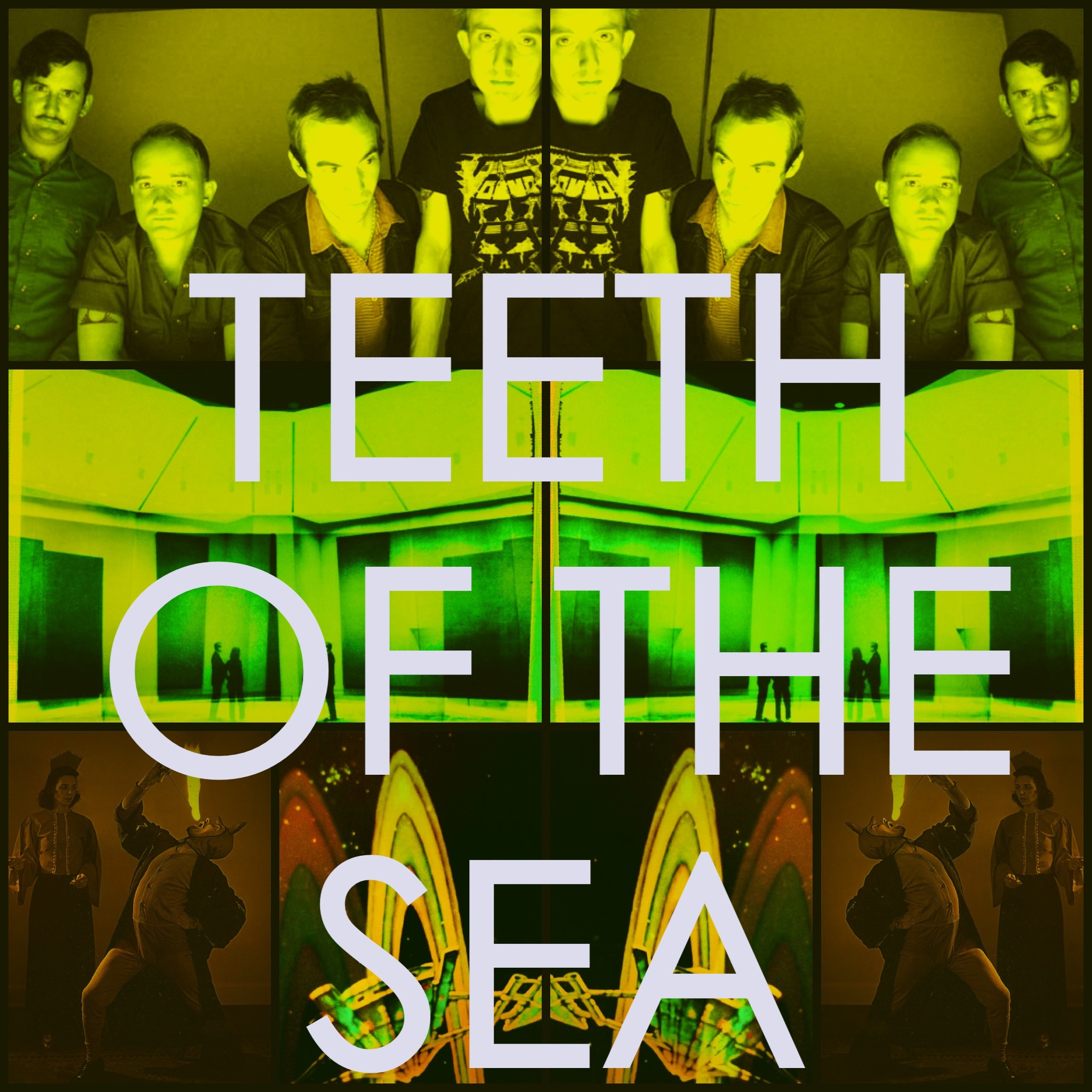
How even to begin to describe Teeth of the Sea? How even to begin describing, “Master”? If the Earthless launch skyward is achieved with only the essential equipment – guitar, bass, drums and a metric ton of creativity – than Teeth of the Sea achieve similar orbits through the employ of aerodynamics and precision equipment, not to mention that same metric ton of creativity. Teeth of the Sea is like a prototype, the experimental spacecraft equivalent of what a band could be like in the future, representing the outer limits of sundry sonic sciences working together (while still being able to enjoy the odd Slayer riff now and again) . It’s remarkable – more so because Teeth of the Sea ensure that the future is happening right here, right now. The future is now and it’s your master.
Roaring guitars have their place on “Master” as well, but that roar just as often finds itself interlocked with snaking synths and robotic rhythms, in sync with horns and backup singers and probably an amplified jet engine or two as well. Gauges are checked and angles are calculated through the entire flight of “Master,” with not a single sound falling out of place, out of time.
Through it all, “Master” is never anything short of being anthemic, from “Reaper” to “Responder,” even if the anthem transmitted is, “All Human Are Error.” But make no mistake – “Master” is an absolutely remarkable achievement, an eternally satisfying electric exegesis of a future sound that never was, is now and still may be.
“From the Ages” is now available from TeePee Records.
“Master” is now available from Rocket Recordings.
“When we see human life only from that narrow view of time, we are blind to the total picture of time. This is a big problem. It is like always climbing a mountain and never seeing the mountain from a distance. Sometimes, to understand the life of the mountain, you have to see the beauty of the mountain as a whole, connected with the clouds and the sky. We cannot ignore or escape from the stream of time. We must be there. But we cannot be blind.” – Dainin Katagiri, “Each Moment Is the Universe“
Approaching the release of the new Dahga Bloom album – “No Curtains,” upcoming on Captcha Records – we give you “WAMPUM”!
We’re incredibly pleased to be premiering more new Dahga Bloom videos every Thursday morning for the next few weeks.
Below: “No Curtains” LP cover illustration – by Italian street artist Awer.
It again seems appropriate that the title above declares this “’The Current’ Interview” with Midday Veil, given that “The Current” is the name of the band’s recently released, singularly spectacular new album. But it’s also our “current” interview, given that nearly three years have passed since the band answered our ridiculous questions for the first time.
At the time, we found ourselves floating somewhere between being impressed and obsessed with the band’s debut album, “Eyes All Around.” And as if to prove that plus ça change, plus c’est la même chose, today we find ourselves welcoming that very familiar feeling when listening to “The Current.”
If anything, the intervening years have seen only a growth in the obsession side of the equation, growth most directly fueled by the majesty of “The Current.” As albums go, there are almost certainly none in our recent memory that surpass the sturdy sonic-symmetry delivered here by Midday Veil. Like its full-length predecessor, “The Current” is an album that shows the band displaying a transcendent, nearly outlandish level of confidence in their songs. By confidence, we mean that we hear the sound of a band that is fully and completely tuned-in to their strengths, to their individual and collective power. And by extension, we hear a band that sounds completely themselves, completely comfortable in their own skin as they travel the spaceways, the spaceways, from planet to planet.
Let us be clear: “The Current” is an album that is intensely personal and somewhat enigmatic; simply put, we’re never in danger of mistaking Midday Veil’s sound for that of another band. Yet it’s also an album that is immediately palatable and undeniably enjoyable; it’s perhaps the only album you’ll hear this year (or this lifetime) that’s filled with synth-heavy, crushingly cosmic, Gnostic invocations of the great beyond – while also awakening within you the great, irresistible urge to dance and sing-along. It’s a hypnotic and compelling combination, from a hypnotic and compelling band.
We could not recommend any album any more highly than we recommend “The Current,” and we could not be more thrilled to have Midday Veil’s Timm Mason, David Golightly and Emily Pothast once again answer our ridiculous questions below. Enjoy.
What are the most significant ways in which you see an evolution in Midday Veil, from the time you released “Eyes All Around” until now? Which of those evolutions were you consciously trying to accomplish and which – for lack of a better term – just snuck up on you?
Timm Mason: The obvious difference is the addition of Jayson Kochan on bass. He’s got rock-solid rhythm, and it freed David and I up from having to hold down bass-lines on the synth or bari guitar. He’s also a strong multi-instrumentalist, like everyone in the band.
David Golightly: Adding Jayson really firmed up the grooves and also let us venture into a more adventurous place sonically with the synths and guitars, so the new album has a lot more intense atmospheric parts and a darker overall vibe.
Emily Pothast: There have been a few lineup changes, all of which have come with a certain evolutionary shift. David, Timm and I have all been playing together as Midday Veil since January of 2009. For a while, MV was a 4-piece with our original drummer Chris Pollina, who played on both “Eyes All Around” and “The Current.” We added Jayson on bass in 2011, and we also added Sam Yoder as an auxilliary percussionist. Last summer, Chris left (on friendly terms), and we’ve been playing with Garrett Moore on drums ever since.
Lineup changes are a big deal for us, because so many of our song ideas are dependent on the group dynamic. Lately, we’ve been playing songs that feature more minimal drums, with Garrett on 12-string guitar. New people tend to take things in new directions.

Speaking strictly musically, was there a single (or perhaps multiple) notable source of inspiration that came into your life over the past couple of years in such a way that you can identify the impact it’s made on the music you make with Midday Veil? How did this inspiration enter your life? How does this inspiration manifest itself in the music of Midday Veil?
DG: Working with producer Randall Dunn was very influential for us. He really pushed us to test our boundaries and explore beyond our comfort zone.
TM: He opened up a broader sound palette in the studio. We’d wanted to work with him for some time, and I think he came in with a different perspective of what Midday Veil was – it was helpful in finding some new territories to stake out, and thinking about how the pieces might fit together.
EP: Randall has been a big influence for sure. More recently, we’ve been doing some recording with Tim Green at Louder, which is a beautiful studio in the woods near Grass Valley, California. Both Randall and Tim are insanely talented and knowledgeable recording engineers, but their styles and approaches to our sound couldn’t be more different. I like the balance of getting multiple points of view and exploring our dynamic by recording in different contexts with different people.
Speaking of realms outside of music specifically, was there a single (or perhaps multiple) notable source of inspiration that came into your life over the past couple of years in such a way that you can identify the impact it’s made on the music you make with Midday Veil? How did this inspiration enter your life? How does this inspiration manifest itself in your daily life? In the music of Midday Veil?
EP: Hm. David, Timm and I have all spent time working with video art in some capacity, and I think the aesthetics of video feedback have had a big influence on our music and everything else we do. I started out as a visual artist, and I still have a tendency to think of writing songs or melodies as “drawing” or collaging in sound and time.
Your new album, “The Current,” is utterly outstanding and while in many ways very different than “Eyes All Around,” one thing both albums share (to these ears) is a stunning collection of very memorable, very catchy (again, for lack of a better term) melodies and hooks that span outwards from what is (again, to these ears) a very deep, strange and cosmic core. Considering the other releases that Midday Veil has produced outside of your two albums proper, and considering your other artistic outlets, do you have the goal of making the albums more refined, more sculpted toward a larger purpose?
TM: I’d say the ‘proper’ albums are more intentional constructions, whereas the others are more about group interaction in the moment and channeling. They’re both sculpted towards a larger purpose, but the process is very different. With “The Current” and “Eyes All Around,” there’s an idea that we’re crafting songs and using them to build an experience. An album like “Integratron” is a meta-sonic experience unfolding in real time. We’re as surprised by where it leads as any listener is.
EP: In some ways, my favorite albums are the improvised ones. They are more like documents of Happenings than intentional objects. I like Timm’s description of “Integratron” as a meta-sonic experience. It’s a record of the band in a specific architectural-temporal situation having an investigatory sonic experience. But there are limitations to improvisation, too, so we’re always interested in bringing the lessons of that experience into the context of composition with more intentionality.
I’m personally excited by the version of “Choreia” on the new album. The basic idea for “Choreia” was born a long time ago during a Subterranean Ritual. It’s essentially a rhythmic idea that developed into a framework for live improvisation, which over time developed into a highly stylized piece that totally sounds like free improv, with all these unexpected bursts of noise, but is in fact tightly composed. The studio version is crafted out of improvised overdubs that were sculpted and edited as we went along. “Like growing crystals,” as Randall described it.
What does the title “The Current” represent to you? How is that concept represented in the cover art for the album? How is that concept represented in the song “The Current”? Are we hearing the lyrics correctly when the song begins, “A halo of light reflects along the perimeter, round and around, shot through a broken prism on the water, cut off from the Sun”? Is “The Current” later likened to a serpent, or are we mishearing things? Can you tell us a little more about these lyrics? Is there a catchier bass line on all of the earth than the one that anchors the song, “The Current”?
EP: Haha – the bass line is indeed catchy, and you’re hearing the words correctly. The song “The Current” was built in the studio on a jam originally laid down by Jayson on bass and Chris on drums. I had the task of taking it home and writing a vocal part to go with the basic tracks after they were recorded. Meanwhile, a curator friend commissioned an essay from me for an art exhibition, and my essay ended up serving, in part, as inspiration for the lyrics to “The Current,” which to me are about perception, feedback loops, and how the iterations of transformative snapshots of the same object (or person) through time give rise to narrative patterns of meaning, almost like magic:
a speck of dust
on the mirror’s surface
casts a shadow
that grows with every glance
like a wordless whisper
in a hall of glass
potentiality
reflecting all that you see
as you move through the dream
We were excited to see the inclusion of the song “Remember Child” on “The Current” – a song that we were originally introduced to on your “End of Time” EP. How has the song changed – either musically or metaphysically, or ideally, both – in the intervening years? Why did it make sense to you to include it on “The Current”?
TM: When we recorded “Remember Child” for “The Current,” I don’t think we’d played it live in some time. Maybe that allowed us to have a fresh perspective and approach it more as a sonic entity and less as a thing that needed to be performed – eluding some of the limitations of a live performance, but hopefully retaining the ceremonial or processional character.
EP: It’s funny – that old version of “Remember Child” was the very first song we ever recorded as Midday Veil. There was a time when it was the only track on our MySpace page!
A few years ago I was on a plane bound for Texas, to attend the trial of the drunk driver who killed my parents. I was reading a book about sacred geometry and Gnosticism, and came across a quote from Origen:
“Understand that you are a second little world, and that the sun and the moon are within you, and also the stars.”
I found it comforting in that moment of what felt like impossible, endless loss to think of myself as a little universe nested inside the big universe, so I made those words into a mantra that might be intoned to me by the Cosmic Mother, or in my case, my mother, whose voice I happen to share.
David and I just made a video for “Remember Child” that features all this footage of celestial bodies colliding into each other. Each collision represents the destruction of a world, but it’s also how new planets and moons get created. As above, so below …
As far as including “Remember Child” on “The Current,” it’s just one of those songs that we’ve always thought was worthy of a rich, fleshed out studio production. It made sense to bring it into the studio because it seemed right up Randall’s alley.
Would you care to comment on the rumor – the rumor that were are attempting to start right now – that you are in the middle of recording an album-length re-imagining of the mythology of “Gilligan’s Island,” under the working title, “Midday Sail”?
EP: I don’t know anything about that. But have you heard our unreleased concept album about leafy greens, “Midday Kale”?
What music have you been listening to lately? If push comes to shove, what’s your favorite song by The Master Musicians of Bukkake and why? Please show your work.
TM: I’ve been listening to Ghédalia Tazartès quite a bit. I’m also listening to a lot of synthesized sound by the likes of Roland Kayn, Conrad Schnitzler, and Asmus Tietchens. Regarding MMOB – right now, I like “The Cave of Light” from the new album “Far West.” It’s a song that formed in the studio and really took on a life of its own on the recent European tour. B.R.A.D. killed it on the lyrics, and I love that guitar melody. I enjoy watching audience reactions when the 7 vs. 4 chorus hits – thought it’s rare that anyone can see anyone in that fog.
EP: I feel blessed to live in the Northwest right now, with so many friends making such wonderful music. Panabrite, A Story of Rats, Swahili, Brain Fruit, Golden Retriever/Matt Carlson, Lumerians, M. Geddes Gengras, Sun Araw, White Manna … if I didn’t live on the West Coast, I’d want to move here.
William James writes the following in his book, “The Varieties of Religious Experience”:
“Knowledge about life is one thing; effective occupation of a place in life, with its dynamic currents passing through your being, is another.”
Your thoughts?
EP: Theory versus praxis. It’s one thing to behold something mentally, or abstractly, and quite another to be it. Playing music, especially with other people, is one surefire way to pull yourself out of the world of abstraction and into the realm of being. Words and ideas are useful for some things, but music slips into places where words can’t fit.
What’s next for Midday Veil?
EP: We’re doing a little bit of touring this fall, but mostly laying low to record and work on new ideas.
DG: We’ve got a ton of new material in the can already. We’ve been recording tracks with Tim Green, and also some new tracks with Randall. We’ve also got a much better home recording situation than we ever had, so expect a lot more material. We also have a ton of video ideas kicking around, so we’ll be doing more of those as well.
“The Current“ is available now.
With a fair degree of accuracy, we can pinpoint the exact moment the Windhand ‘s “Soma” dug its considerable claws into our corroded consciousness, thereby revealing itself less as a traditional album and more as untraditional alchemy.

And it didn’t take long. On opening track “Orchard,” the initial sound is that of whoever previously held the title for “World Heavyweight Championship of Downtuned Destruction” being defeated in just seconds, courtesy of a patient, piledriving riff. The drums and bass join in about thirty seconds later, thundering and threatening enough for the listener to consider plans for the afterlife, immediately followed by the vocals – deep in the mix, pulled perhaps from deep within a troubled soul, coursing through Windhand’s mesmerizing mountain of sound with the force of a river, a river possessed with the subtle strength to eventually erode a mountain, unhurried, un-humbled in the shadow of the mountain’s height.
“I’m having trouble with the downside,” is what we hear those vocals say about one minute and forty-five seconds in the unfolding of “Orchard,” and it’s at that very point that the alchemical power of “Soma” revealed itself to us. It doesn’t even matter if those are the words being sung – that’s certainly the sentiment that’s being sung. And “Soma” is the absolutely perfect sonic scenario served for the expression of having trouble with the downside.
One-minute and forty-five seconds is not a long time. It’s not enough time to realize that “Soma” carries the additional weight of trance-inducing songs – as in catchy, memorable, hooks with choruses you can embarrassingly attempt to sing along with as you drive at night toward an early autumn moon (maybe that’s just us). It’s not enough time to realize the album also positively pulses with – no two-ways about it – shit-hot guitar playing, lead runs with sinister sustain, vibrant and incendiary enough to make a statue bend its back in air-guitar aspiration.
In Windhand-land, one-minute and forty-five seconds is nothing more than the blink of an eye – “Soma” itself closes with the thirty-and-one-half minutes of “Boleskin,” an accomplishment that defies our powers of explanation. In fact, in WIndhand-land, time may be a dead concept entirely … and if it’s not, the band seems intent on slowly snuffing out its flame.
For “Soma” is that rare, truly timeless album – an album that comes alive in each moment, the independent attributes of the guitars, the bass, the drums and the vocals all being simultaneously dependent on the existence of the other; mountain and river become one.
Windhand‘s album “Soma” is available from Relapse Records or their own Bandcamp page.
“You should know that even though all things are liberated and not tied to anything, they abide in their own phenomenal expression. However, when most human beings see water they only see that it flows unceasingly. This is a limited human view; there are actually many kinds of flowing. Water flows on the earth, in the sky, upward, and downward. It can flow around a single curve or into bottomless abysses. When it rises it becomes clouds. When it descends it forms abysses.” – Dōgen Zenji
Approaching the release of the new Dahga Bloom album – “No Curtains,” upcoming on Captcha Records – we give you “SUPA”!
We’re incredibly pleased to be premiering more new Dahga Bloom videos every Thursday morning for the next few weeks.
Below: “No Curtains” LP cover illustration – by Italian street artist Awer
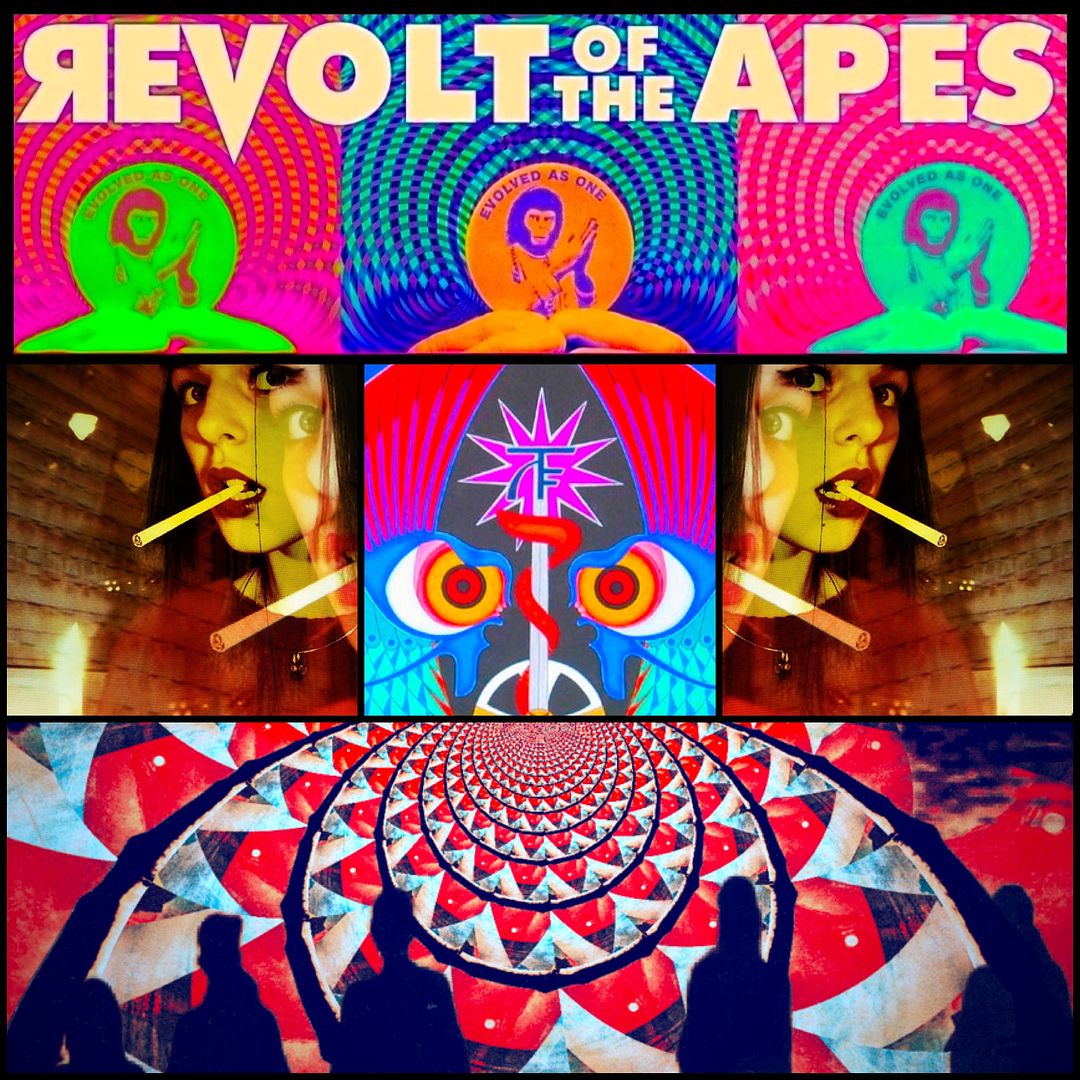
 Revolt of the Apes