There’s a temptation to declare that “Astral Body Electric” – the inconceivably flawless new album from Herbcraft – simply came into existence fully formed, with no predecessor, weighed down not in the slightest by the baggage of the past.
Logically, we know this isn’t the case, not least because we’re on record as having been stunned by the previous Herbcraft full-length, “Ashram to the Stars,” nearly two years before our first listen to “Astral Body Electric.” Still, we can’t help but indulge in the fantasy of “Astral Body Electric” having somehow appeared out of thin air. Because, in a certain manner, it did. And its great charm continues to take its place in that same thin air, its vast atmosphere always inviting and present.
Halfway through the opening invocation, “Mother’s Gate (Shambhala),” the peace of the piece gives way to a yawning, colossal yawp of wah-wah wisdom cast into the void, one hypnotic guitar line chasing another, in a graceful ouroboric charm. That same back-and-forth extends throughout the entire album, in such a way that its six songs and forty-two minutes truly does feel like just one complete experience – perhaps arriving in our ears out of thin air.
It’s perhaps worth noting that “Astral Body Electric” is chronologically the third full-length album from Herbcraft, though it seems to stand apart even from its highly enjoyable predecessors. And it’s probably worth paraphrasing something we said about those predecessors – the band is called Herbcraft, and the album is called “Astral Body Electric.” You’re likely either in or out based on those two factors alone.
We are, if there was any doubt, all the way in. “Astral Body Electric” is an album of remarkable beauty, defined both by a boundless spirit of exploration and a sense of utter control. It is, to these ears, perfect, or at least the nearest to which we can possibly imagine.
“Consider, for example, what takes places when one is listening to music. At a given moment a certain note is being played but a number of the previous notes are still ‘reverberating’ in consciousness. Close attention will show it is the simultaneous presence and activity of all these reverberations that is responsible for the direct and immediately felt sense of the whole, unbroken, living movement that gives meaning and force to what is heard.”
– David Bohm, “A New Theory on the Relationship of Mind and Matter”
Fasten your Van Allen belt. On their second LP, “Frozen Altars,” Moonrises effortlessly imagines a unique flightpath for their gravity-defying, spellbinding space-rock. It’s a sonic jet-propulsion-laboratory, with no shortage of mind-reeling, pin-wheeling prayers, frozen or otherwise, offered up to the altar of explosive amplification. That alone would be enough to earn our salute, but Moonrises manage to capture our imagination as well as our attention, taking us even further toward the unmapped and unknown.
Why? Forgive us, but there’s something defiantly down-to-earth about this journey to the stars.
Maybe “down-to-earth” doesn’t quite capture the sentiment. But we find the quirk, strangeness and charm of “Frozen Altars” to be centered around the band’s ability to offer a trip to a truly alternate dimension – one where outer-space exploration goes hand-in-hand with the kind of earth-born, inner-space exploration we associate with, perhaps an Incredible String Band or a Fairport Convention. With Moonrises in position behind the cockpit, things get Fairport Unconventional.
Walk awhile, if you will, in “The Ivy Maze” constructed by Moonrises:
Maybe it’s the centered, stoic organ that makes Moonrises interstellar imagination so organic. Maybe it’s the superb, evocative vocals, or the band’s overall commitment to creating a soundscape that’s both comfortable and compelling, whether hurtling past the most distant star or sitting motionless, reflecting on the stillness. Whatever the case, we highly recommend you spend some time before these “Frozen Altars.”
“Space, like time, engenders forgetfulness; but it does so by setting us bodily free from our surroundings and giving us back our primitive, unattached state.”
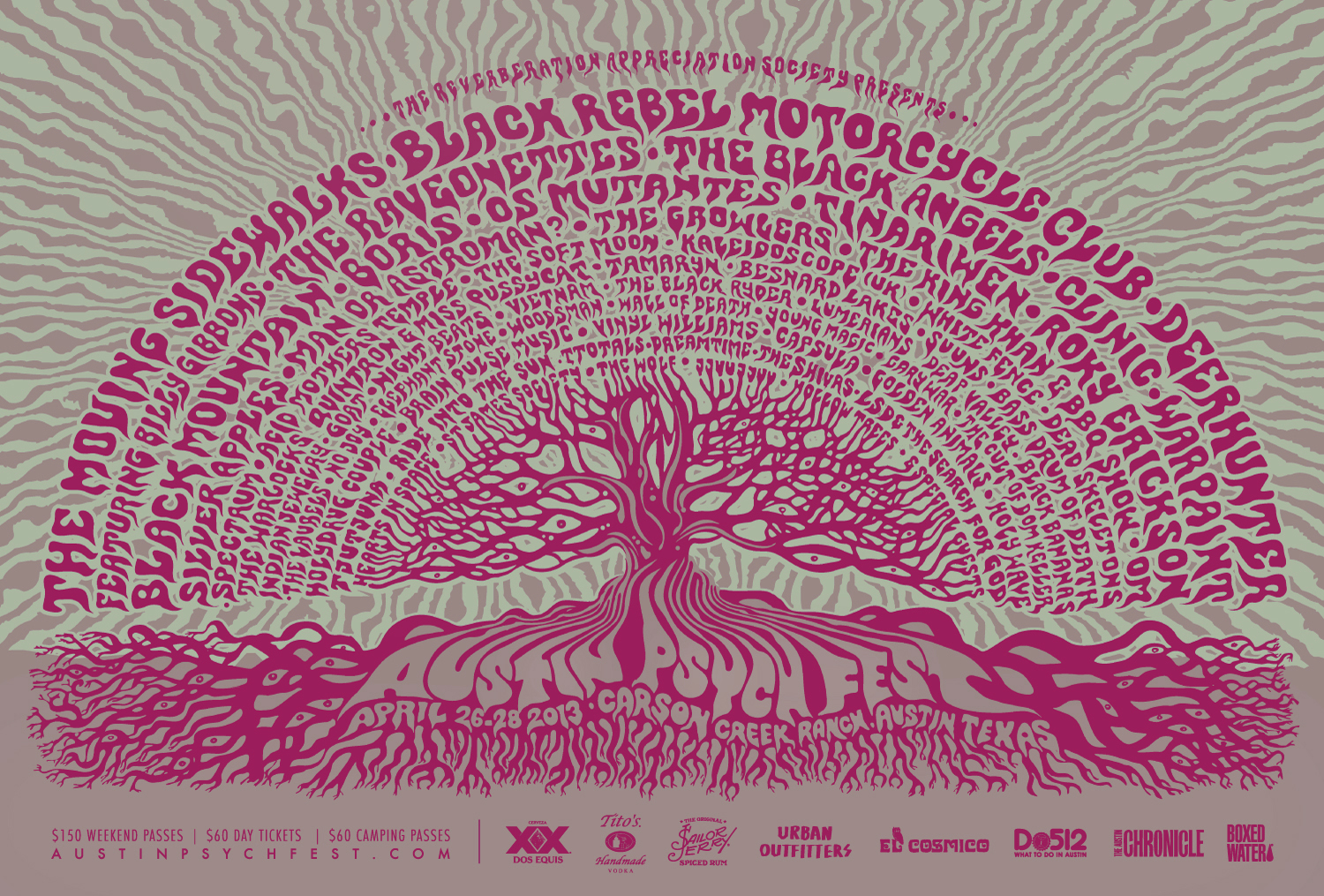
This week brings us the sixth edition of the Austin Psych Fest and for the first time since 2009, we’re sad to say, this ape will not be in attendance. Real life has inconveniently intervened, as it often does.
Which is not to say that the Austin Psych Fest is not real life – it is. It’s so real that it changes every year – just like life. And just like life, it sometimes doesn’t change. And that mix of consistency and transformation is a big part of what makes Austin Psych Fest so great.
Of course, there’s also the massive amount of planning, pursuing, paying, calling, emailing, texting, spread-sheeting, confirming, configuring and loo-renting that goes in to assuring that those lucky enough to attend Austin Psych Fest have the time of their life. And for that, the mysterious organization known as The Reverberation Appreciation Society deserves a round of applause. Still can’t figure out why they pick some band called The Black Angels to play every year, though.
The sting of knowing that missing Austin Psych Fest also means missing good times with great people, sonic communion with friends old and new, is matched only by the sting of missing such an extraordinary line-up. The Moving Sidewalks? Ouch. Om? Ugh. Dead Skeletons? I can’t take it.
That inconveniently intervening party known as “real life” has also put a dent into the time we’ve devoted to asking ridiculous interview questions to the bands taking the stage at Austin Psych Fest this year, a situation we hope to rectify over the next several kalpas. After interviewing something like 37 bands in the lead-up to Austin Psych Fest this past year (not that we’re counting), this year we’re clocking in with a grand total of … one.
And we heard that one is the loneliest number.
But we don’t feel so lonely knowing that bands that have previously, graciously agreed to answer our ridiculous questions – bands like Ttotals, bands like The Saint James Society – will have a place on the Austin Psych Fest stage this year. And we don’t feel so lonely knowing that other bands to which we’ve previously applied the “Band of the Week” label – bands like The Holydrug Couple, bands like Chatham Rise, and bands like, yes, Goat – will have their place as well.
We feel less than lonely. We feel good. We feel like a part of … something.
We feel like we’re all one, dude.
Although, of course, missing the second State-side appearance of The Cult of Dom Keller has us kicking, screaming and crying. Do not attempt to console the apes.
Consolation over these past many rough months has, as usual, been given by music, and perhaps no album has recently given us such an oddly uplifting sense of consolation as the album called “SUN,” delivered by the Australian band known as Dreamtime. “SUN” is such a magnificent, deep, dark and downright Dionysian-doom trip that we’re at a loss to explain why it makes us so … happy. Maybe Dionysus himself can explain:
“For as our sun, not by choosing or taking thought but by merely being, enlightens all things, so the Good by its mere existence sends forth upon all things the beams of its Goodness.”
So we can say little more than “SUN” is a really, really, really good album, and Dreamtime’s guitarist Zac Anderson was good enough to answer our ridiculous questions below. And all of those attending Austin Psych Fest this year should have a really, really, really good time. I’ll be there in spirit. Enjoy.
Does there exist in your mind a singular experience that, for you, most shed light on the connection between dreams and music? If so, what was it about that experience that made such a distinct impression on you? Do you find imagery from your dreams tend to stay buried in your mind – or are they nearly always at the forefront of your thoughts?
No, I don’t think I’ve ever actually heard music in my dreams before – haha! I feel like I’m weird for not having heard music in my dreams. Have you? I used to put Air or Portishead on my headphones and go to sleep to it. And these days I usually hear songs as I go to sleep that I guess my unconscious mind is writing for my conscious mind to listen to while I drift off. Dreams can be very powerful though – I’ve had countless dreams where I fall in love with a girl and then feel sad the whole of the next day because I’ll never see that girl again. But I enjoy the mysticism of dreaming, and, yes, often times the imagery is absolutely epic and insane. I still have a vivid image of this witch with blue eyes that tried to suck my soul out of my mouth once in a dream and that was years ago. I do also astral travel sometimes, and recommend it to anyone – waking up inside your dream and experiencing the landscape of your mind is amazing and really quite elating.
How would you describe your general introduction to making music in your youth? Was it something that was encouraged within your family or peer group, or did you find it to be more of a solitary pursuit? What were the albums or artists that convinced you that making music is something that you can do and do well?
I was a massive Michael Jackson fan when everyone was a Nirvana fan. I was only nine when Kurt Cobain died and couldn’t figure out why my older brother kept playing this shitty, mopey song about rape and telling me how good it was. It had nothing on The Moonwalker, I thought. I also dabbled in listening to three-chord pop punk bands like Frenzal Rhomb (Australian). My parents gave me heaps of stuff to try out. They bought me a trumpet which I played for years until I did a solo trumpet piece in front of my whole grade in year eight and everyone laughed at me. That was the end of the trumpet and the end of music for me until I finished school and got into Led Zeppelin … massively. I bought a guitar and tried to learn “Stairway to Heaven” (idiot) for about a week and a half until I had some of it down, roughly. Then I got into 60’s garage psych and down the rabbit-hole through psych obscurities from there. By the way, I’m pretty sure Cat played in a three-piece in primary school called “Burnt Toast” – haha! Kid punk music.
What is the immediate appeal of creating music for you? What is something that you now find to be a key aspect to making music that you perhaps did not account for at your beginning stages? Can you think of an artist or albums that you initially did not connect with, but now consider to be a major influence or inspiration?
Initially, it’s the telling of a story that I love, often wordless or lyrically obscure stories, unconventional stories, stories trying to explain the unexplainable. After years of playing I’ve realized the more you control a song the more rebellious it becomes, so you have to go with the flow when you write and when you jam. I’ve also realized it’s a good thing to appropriate your favourite riffs from your favourite artists and slow it down or put a surf drum beat behind it and recreate the riff into something new while also subtly paying homage to your influences. In regard to your last question … yes, Kyuss. I hated Kyuss at first because of those gnarly vocals. But then a year later I got into their stoner doom grooves and so did Cat and Tara. We actually did a cover of “Molten Universe” for a while. “Molten Universe” is one of the best songs ever written. I bow down to it. Kyuss definitely had their own style, and Dreamtime wanted to get heavier after hearing them.
One of the things that we find incredibly appealing about the music of Dreamtime is your ability to merge a tremendously wide range of sounds and styles into a cohesive and compelling whole. How do you think the mentality and experiences of the members of Dreamtime combine to produce this effect? Can you point to any specific examples of the members introducing each other to sounds that you otherwise might not have incorporated? Or do you feel that you have largely been on the same page, sonically, since the very beginning – or perhaps even before you met?
We listen to everything, not just psych music. But psych is just the best platform to explore because it’s diverse in nature. I think some of the biggest influences we have shown each other would be (in chronological order of us listening to them) Velvet Underground, Led Zeppelin, Sonic Youth, Link Wray, Kyuss, Bardo Pond, Warpaint, Ash Ra Tempel … a few years ago I got this record called “Distortions” by Blue Phantom, made by a bunch of Italian session musicians in 1971. I got this record at the start of our first shroom season ever and it seemed like the record was on repeat for the whole summer, so the album is eternally associated with the beautiful and gnarly experiences we had over that time. We ended up doing a cover of one of the songs off the album called “Equivalence,” which we have put on our new album, “Sun.” Tripped a lot of balls to that song, so want to pay homage to it. Our cover is a bit different, though.
The second song on your album “SUN” – “Baphomet” – is an intense collection of sounds, even among an album filled with a superb level of intensity. What can you tell us about the creation of this song? What does the image of the Baphomet – a symbol more often attached to death and black metal bands – represent to you? Was there a particular emotion or a summation of the album that you were looking to capture on “SUN“?
Well, that song’s meaning isn’t set in stone. It’s an exploration of a combination of mythologies. The song’s basically about the summoning of a demon or powerful spirit in the forest. The sounds of the forest and the chanting refer to nature and paganistic worship of the elements and overlaps into witchcraft – basically beliefs or practises that were deemed as satanic/anti-Christian by the Christian church. I believe the man who drew the image of Baphomet was influenced by historical documents regarding the church’s libelous slander of certain parties as satanic and worshipping the heads of beasts resembling that of a goat. The concept of the worship of a goat-headed beast fascinates me – it’s very powerful imagery, but a lot of information around satanists/pagans/the Baphomet image is very confusing. People believe what they want to believe – I’m merely interested in mythology. This song is a myth, as is the album!!!!
Would you care to comment on the rumor (the rumor that we are attempting to start right now) that your next album will be a collection of covers by The Electric Prunes, entitled, “(I Had Too Much to) Dreamtime Last Night”?
No that’s not true, but we will be releasing a cover of “Dreamtime Weaver” by Gary Wright soon.
What music have you been listening to lately? If push comes to shove, what is your favorite Radio Birdman song of all time and why? Please show your work.
The Cosmic Dead – they’re really amazing, some of the deepest, darkest, most beautiful jam-holes I’ve ever heard … Radio Birdman are cool but I’m probably more of a 13th Floor Elevators fan though. Their cover of “Gloria” makes me wanna smoke a pack of Horizon Red 50’s and drink tequila shots and pull cones all night!!! I know they’re a psych band, but their cover of that song has balls and is such a fast version, especially back in those days – it’s way more fast-rock/jet-rock or whatever you call it than it is psych.
How did you first become aware of Austin Psych Fest? Are there any other bands on the line-up that you are particular excited to see for the first time? Is it far to assume this will be Dreamtime’s first visit to the States as a band? Is there anything in particular you are looking to explore or experience about this strange land during your time here?
I can’t even remember how we heard about Austin Psych Fest – they’ve been going for years now. I think it was through my interest in Roky Erickson, and Austin being the birth place of psych rock that caught my interest. But now to be playing at it will be amazing. So pumped to play alongside all those bands, it’s crazy. BRMC is massive in Australia. But Warpaint is a favourite of ours, too, and we just can’t believe we’re playing a bloody gig with Warpaint and Acid Mothers Temple and … the whole line up is amazing. Black Angels are rad. I know they started the whole Austin Psych Fest thing, and what a gift to the world it really is – praise ’em. Yeah, it’s the first time for us in the States and we’re going to make a little tour of it from the West Coast to Austin, Texas, then up East Coast to NY and play about 10 shows along the way. We have no record label or manager or anything – DIY, baby – but we’re making friends over there and we’ll hopefully fit in some chill time there and meet people, have a few beers and a bit of a chin-wag.
Carl Jung – a man who had a bit to say about dreams, and no doubt a Radio Birdman fan himself – says the following in “The Psychology of Individuation”:
“The dynamic principle of fantasy is play, a characteristic also of the child, and as such it appears inconsistent with the principle of serious work. But without this playing with fantasy, no creative work has ever yet come to birth. The debt we owe to the play of imagination is incalculable. It is therefore short-sighted to treat fantasy, on account of its risky or unacceptable nature, as a thing of little worth.”
Your thoughts?
Well done Ryan, that’s a really good, and really appropriate question for the kind of music we play, as Dreamtime totally deals in fantasy and imagination. My dad used to always say that I was “off with the fairies” and my mum always said that I “come from a bloodline of the Faerie folk and I am part Faerie.” So I knew I had a very active imagination and I also felt like I was part of an actual mythology. Imagination is necessary for us to create, but I don’t know why we need to create. I suspect it’s some kind of cellular programming, like an animal instinct. It’s no coincidence that children have very active imaginations because their mental dictionaries aren’t full of words yet, they don’t think they know everything like adults who end up being able to receive only limited amounts of information as they become so narrow-minded. Take music, or fantasy novels or visualization meditations – so many people get so much out of all of these things. Why would someone sit and listen to Bach’s Toccata and Fugue in D Minor??? There’s not even any lyrics to sing along to. It’s because it activates their imagination. There must be something important in there that people need. And Carl Jung says so, and he pretty much figured out how to predict the future, so can’t really argue with him can we?
What’s next for Dreamtime?
Taking it easy once we get the vinyl for the “Sun” and the US tour. We need a manager – we’re all run off our feet. But if something’s difficult to do, it’s usually because it’s worth doing. Except for killing yourself – haha! I don’t think it applies to that situation. Thanks Ryan – that’s a really thoughtful interview.
Prone as these apes are to wasting time, we found near the end of the recently concluded year the great pleasures that exist in re-examining a crucial piece of literature known as “The Acid Archives.”
At nearly almost kinda sorta approximately close to precisely the same, we found ourselves in the possession of – and inordinately possessed by – an album that seems to exist outside the confines of time, seems to be exist within its own time, in the form of an extraordinary piece of crackling kosmiche entitle “EXU,” delivered by the Chicago group known as Verma.
This was not our first time in the company of either of these two things. The extraordinary treasure that is “The Acid Archives” is a permanent resident of our alien bookshelves, while we bestowed the highly questionable honor of “Band of the Week” on Verma a moon duo ago.
These two things, naturally, have everything and nothing in common.
The pleasure of revisiting “The Acid Archives” is for us defined by the pleasure of discovery, of the always present thought that spins like the , “Oh, wow, look at this world of the past we’ve created where there is so much weird, heavy, awesome, strange and beautiful music to hear. Oh, baby, baby, it’s a wild world.”
The pleasure of Verma’s “EXU” is the pleasure of realizing that world is going on right now.
Welcome to the New Wave of American Space Rock. Or not. Doesn’t matter. We’re thrilled to have the members of Verma respond to our ridiculous questions below. Enjoy.
What is the earliest recollection that you have of an album making an impact on you due to its combination of sound and aesthetics or visual presentation? What was it about that sound that made it so compelling to you? What was it about the visuals that band or artist presented that made have so much impact on you? Have your impressions about that album evolved over the years? In what way?
Whitney: I sat next to this guy in high school biology class who would always draw the four members’ symbols from Led Zeppelin. He was obsessed with Druids, and I think I probably had a thing for him and his pagan ways. He turned me on to Led Zeppelin number four. I think the hermit with the lantern on the record sleeve was what did it for me, that he came from a tarot deck. He has this melancholy look on his face that I thought must come with wisdom, and you can hear that on the record.
Johnny: I’ve always wanted to name my children I, II, III, and Zoso.
TJ: I spent my teen years solely listening to punk, hardcore and metal. But prior to that I was a pretty big Nine Inch Nails fan. Their sound has always shaped what I listen to and what I write … still to this day. There was that doomy, morose, apocalyptic vibe that came through … always staying in the minor keys … not quite goth but close. Even when I was real into punk and metal, I had tendency to listen bands that had that same gloomy vibe. And going back and listening to albums like “Downward Spiral” or “Broken” … it blows me away how great the synth work and sequencing is. At the time I had no clue what I was listening to … or even the process that went into make those records. Now that I really dig in I appreciate on a whole new level. And I don’t even need to mention the art and videos NIN put out. The “Broken” and “Downward Spiral” packaging layouts are still amazing.
Zach: As embarrassing as it may be, the album “For The Punx” by the Casualties. The ridiculous get up paired with the abrasive broken english made me want to freak out. I just thought it was so bad ass at the time. I remember crouching behind my friends house in the burbs smoking weed out of a pop can and saying with all seriousness, “I just can’t picture a time in my life when I won’t listen to the Casualties every day.” I graduated to grimier and less fashionable music shortly after but I can’t say that I don’t miss that feeling.
Johnny: Musically, TJ and I have been into the same scenes. That being said, I think Ministry’s “Mind is a Terrible Thing to Taste” was the album that set me into the stratosphere musically. It was the first record i wanted to listen to alone in the dark and it definitely scared me. The cover, an X-Ray of a skull with some kind of metal straps connected to it balanced by the script font, it was just the raddest thing i’d ever seen, like an invitation to hell. i think it also helped that we didn’t have the internet like we do now, so the cover was all you got to see. i had no clue what the band looked like, i just imagined electro-robots in leather jackets smashing through car factories on fire. i’ve heard people theorize about how musicians go back and try to embrace their roots, like whatever they listened to when they were in their early teens. i’m definitely a victim of that, or i guess a proponent of the theory depending on how you look at it.
Can you recall a time when music began to take on a larger significance in your life? Perhaps it came “out of nowhere” or perhaps it was a long, slow-burn toward obsession, but what were the things that began to take on greater significance for you in terms of the co-mingling of music and your own life?
Zach: I can’t remember a time that I didn’t want to be a drummer, but it seems like the passion for music didn’t come until later. I lived in a little neighborhood in Pittsburgh growing up and everyone I knew rode BMX bikes. On the street, in the woods – we always were on bikes. One day I strapped a walkman with a Doors cassette tape to the handlebars and rode around. I think it was the first time I could use the word “cruising” to describe what I was doing. I had already been in the school band at that point, but it was probably the turning point where I knew I wanted to be in a real band. I quickly became a burn-out. The only reason I didn’t totally fall off the face of the earth was because I was obsessed with playing shows and zoning out while listening to mix tapes. Format is the only thing that has changed.
Rob: For me music has always been a pretty significant part of my life. I can’t think of a time where music wasn’t a presence. A lot of my oldest memories are just of being in a car with some member of my family and hearing this or that song on the radio. Looking back, those moments are pretty mundane, but for some reason they stick out in memory – I could probably make a list of the specific songs. Beyond that, I’ve played in bands since high school. The majority of my close friends have always been musicians or music lovers. For me, music is a constant – it’s always there, it’s the only thing I never get tired of.
How do you feel like that connection with music has served to propel your own musical evolution? Are there any particular bands, albums or entire spheres of music that you now find yourself drawn to that you would have been resistant to even five years ago? Ten years ago?
Rob: As a lover of music, you’re always sort of bouncing between two modes – listening to stuff that is happening now and trying to discover things from the past. In the years before we started this project I had been pretty focused on music from the past – listening to a lot of world/afrobeat type stuff and krautrock/kosmische. There were a couple years – say around 2006-2007 – were I got pretty disillusioned with all new music that was coming out – there was a lot of second and third albums from bands that had been around for years – things felt pretty stagnant to me and I just stopped looking for new music. Then a couple records came along that got my attention – Cloudland Canyon, White Rainbow – then some bands like Wooden Ships, White Hills, and The Black Angels started popping up and it got me really excited to start listening to new music and start working on creating. In Chicago, it started to be fun to go to shows again – bands like Cave and Sadhu Sadhu were blowing our minds. All these bands were taking a lot of the same ideas from the krautrock and afrobeat that had resonated with me and doing new things with it. It felt like things were waking up, and it was exciting.
Whitney: I can feel the close of a cycle right now (maybe it’s just my Saturn return) that’s bringing me back to minimalist music. I guess I left off with serialism just before I went on the hunt for stranger and stranger music, but now I feel a condensing back to some of those roots, picking up where I left off. Philip Glass, Steve Reich, Terry Riley … there’s this feeling of vacancy and distance, but still warmth, that’s so satisfying in a lot of that stuff .
What can you tell us about the name Verma and what it represents to you, personally, and to the music the band at large creates? Is the name itself derived from the Hindu word meaning, “shield”? Is there something you wish to communicate through the name alone … or is it, at the end of the day, just a name?
Rob: Deciding on anything can be a bit of a challenge in a democracy of five people, so it definitely took us a while to land on a name. I think Verma was probably the first one suggested, but we still went through hundreds of possibilities. We were scouring Wikipedia looking for inspiration and in doing so we first latched on to the old Norse meaning which was “hot.” We saw the Hindu meaning – shield – also. It seemed to work on multiple levels. It sounded kinda German or Indian or Norse. It could be a the name of a planet in a sci-fi novel, a tough biker chick in a post-apocalyptic motorcycle movie or a monster in an old Italian horror movie. I guess compared to some of the other options it had a nice amount of cultural vagueness to it, yet also jived with a lot things that inspired us.
It meaning “hot” took on more relevance for us as we started writing songs. We always play with a made up storyline or scene of some sort in mind – it helps us collectively align our vision for the song. Most of our early songs were set in the desert, so it seemed appropriate. As things progressed, that warmth became an important aspect of our overall sound.
Johnny: Jesus, that took forever…
Whitney: It makes me think of worms, like, “We are the ones who come from the worms.” I’d say we’re based on a story more than a name. If there’s something we could communicate, it would probably be the image of a beat up vehicle driving through a post-apocalyptic desert. That would be the perfect definition for the word Verma.
Zach: Black Sabbath was already taken.
If a primary emotion cannot be conveyed through the name alone, is there a primary emotion that you feel looms large across all of the music created by Verma? What is the most frequently repeated comment you’ve heard about the band that doesn’t necessarily ring true in your mind? To our own ears, there’s a definite sense of deep space exploration in Verma’s sound, yet combined with what we hear as an almost “down to earth” selection of enormous, undeniable hooks – the outer and inner space combined.
Rob: A lot of our songs are about post-apocalyptic situations and/or being in space, so there’s a lot of isolation in there, yet I think there’s always a bit of optimism in the sound as well. When we started playing together, we were responding a bit to the growing doomsday feeling in American culture. But rather than giving in to anxiety/fear/doom, respond with confident acceptance. There’s definitely an element of pure escapism also – maybe thats where things turn inward. Our music has always been minimalist in style. Our approach to each of our instruments is minimalist, so we’re taking these stripped down parts and through repetition, the meditative nature of the music takes over and starts to propel it, inward or outward. A song like “Ragnarakk” is more of a blast off, but some of the slower ones like “Drift” spiral down some inward rabbit hole. Actually, Drift is song about person who is on the dark side of a moon that has been ejected from its planetary orbit and is slowly drifting into its sun – maybe that sums it up better than what I just said.
Zach: The outer space thing is brought up quite a bit. As Rob was saying, we do a lot of virtual storyboards for what we were doing. A few different recordings started with an apocalyptic scenario that we would all talk about. We would build emotional landscapes or kinds of tension, and there is definitely that vibe to everything we do. But in almost every end-of-the-world-as-we-know-it type scenario, half the story is survival and the other half coping with the fall out or figuring out how to make a strange place home again.
Whitney: I’d say the primary emotion for me is a sort of headstrong sense of isolation. Or feeling headstrong in isolation. We write stories as the basis for nearly all of our songs, and they’re usually in a desert or outer space scenario. Often the protagonist is alone and figuring out how to deal with inhospitable surroundings. Sometimes it’s like, “Get me out of here,” and sometimes it’s more like, “I guess it’s just me now,” but all the stories require strong will and isolation for survival – the clash of inner and outer space, the ego in the hostile environment.
Your latest release, “EXU,” is utterly astonishing – as mentioned above, a perfect blend of the inner and outer spaces, with a massive, motorik backbone that gives the album’s most “out there” moments a sense of power and poise. Was there an overarching goal to be expressed through this album, apart from anything the band had done in the past? Are we correct to be absolutely floored by the album’s vocal attributes, seemingly more at the forefront of “EXU” than previous releases? Where does the title “EXU” originate from and why was it chosen as the album’s title?
Rob: Thanks. Well, I don’t think our intent was much different than anything we’ve done previously. We’re pretty geared toward being a “live” band, so this is really just a collection of the songs that we’ve been playing in our live sets over the past year. I guess we tend to do things a little backwards, with recordings usually coming after we’ve been playing the songs for a while. Our method of recording was pretty much the same as our other trips to the studio – go in, three takes each and pick the best one, minimal overdubs. Both sessions were one day recording, two days mixing.
Whitney: This record was recorded over quite a long time, and I think vocals had been coming forward gradually throughout, not as a conscious decision at all. We’ve always been driven by images more than words, per se, so they weren’t necessary to songwriting early on. It seems hard to paint pictures with lyrics while keeping a sense of forward motion. I guess it’s hard to make out words, anyway, under all the swirly effects.
Rob: The title was something we stumbled upon. Exu is a deity that appears in a some smaller African and South American religions. Exu is the protector of travelers and the god of the roads – particularly crossroads. Exu is considered to represent dualities and often leads people though certain trials that lead to the maturation of the individual. Something about that resonated with both the music – the notion of a journey being an important aspect in all our songs – as well as the process we went through to create the album, which spanned a bit over a year. There’s more of a mystic haze to some of these songs and a duality in the juxtaposition of the desert/space, man/nature, internal/external as themes. Also, Exu is thought to dress in black and white and carry a staff and a smoking pipe – it just seemed like a fitting representation of what’s going on here.
What can you tell us about the song, “From Thunder,” and its excellent and evocative companion video? The vocals here seem to be offering shade and shadow to the already brooding sound – how do you think the vocals best serve Verma’s sound in the context of this song? Would you care to comment on the rumor (the rumor that we are attempting to start right now) that you will soon pair this song with a cover of “God of Thunder” by Kiss, for a picture-disc seven-inch that will never be released?
Zach: It is not a rumor at all. In fact we are touring with Kiss in 2013.
Johnny: It’s a 10” picture disc.
Whitney: The vocals on this one are an additional layer of melody, with the occasional cluster of words popping out. “From the Hall of Thunder, great ones fall. We’ve been torn asunder, after all.” So, hopefully the image of leaving, but not escaping, comes up. It’s about hallucination and hypnosis, the way you can’t fully leave the old world behind. It’s always the point of reference for your sense of departure.
TJ: I think we originally played “From Thunder” much faster. However, the more we played it just kept slowing down … falling into its current groove … which is fitting for the storyline. There is something about the pace that feels as though you are locked in and can’t escape. As for the video, it was shot by video artist Ben Balcom, a Chicago ex-pat now living in Milwaukee. We sort of stumbled across his work and knew his hypnotic style was a perfect fit for the track.
What music have you been listening to recently? If push comes to shove, what’s your favorite song by The Cure and why?
Rob: I’ve been really digging the new Moon Duo record – they really nailed it on this one. We were actually lucky enough to release “EXU” at a show we played with them a few weeks ago, which was damn exciting for us. Also really in to the new Eat Lights Become Lights (“Heavy Electrics”) – which is a fantastic kraut-jammer – and “World Music” by Goat – which is amazing and beautiful on many levels. I’ve always got some Serge, Mulatu and LOOP laying in the record stack. As for The Cure – a few months back I saw that video of “A Forest,” live in Paris, 1979, on YouTube for the first time and was really blown away. It was really cool to see them before they were goth – that song is so killer.
TJ: I’m on a big Richard Pinhas/Heldon kick right now … also love that new Moon Duo record … Deep Magic, Lumerians, Goat, Matthew Akers, Silver Bullets, Teddy Lasry, the new Om album, Terry Riley, Anna Själv Tredje, lots of classic dub, Don Cherry.
Whitney: Bauhaus, Siouxsie and the Banshees, Psychic TV, Flower Travelin’ Band, Harmonia, Tame Impala, Laibach, PC Worship/The Dreebs, Rind, Tinsel Teeth, Nu Sensae, The Feeling of Love, Dead Luke, Samantha Glass, Bitchin Bajas, High Rise, The Mallard, and the Dead. That’s my most recent list.
Zach: Lumerians, Ga’an, Spazz, Asshole Parade, Zounds, Tragedy, Oscillator Bug, Zath, Amebix, Althea and Donna, Bong Ripper, Tame Impala … straight off of my “recently played” list.
Johnny: Swans, Uncle Acid & the Deadbeats, Horisont, Tame Impala, Killing Joke, No Joy, Nick Lowe, The Go, Conspiracy of Owls, and I’ve been digging a lot of late 80’s to mid 90’s stuff from Jesus and Mary Chain, Janes Addiction, early Smashing Pumpkins, Teenage Fanclub, The Verve, Primal Scream, Mazzy Star, etc. I jump around a lot and like I said, you can never escape your roots. Then there’s my list of Guilty Pleasure (aka not guilty, just a pleasure) music that I’ll spare everyone of.
In his book “The Mission of Art,” Alex Grey writes the following:
“Some popular art reflects the spiritually blind zeitgeist of alienated egoism, soulless materialism, more degradation, violence, and the extremes of artistic absolutism. But I have come to accept even ‘negative’ art as a ‘positive’ gesture because it harnesses the creative fire and describes an aspect, even if an ignorant or vile one, of human character … An alchemical process is at work here, bigger than any of us knows, integrating the shadow into the human psyche. In art’s mission to reveal the complete range of human character, part of its function is to examine taboos and map the extremes of human consciousness.”
Your thoughts?
Whitney: I think … yes! The fusion of many existing worlds into a single hybrid world becomes more than just the sum of its parts. It’s hard to think of art in terms of positive or negative but rather surprising or obvious relationships between parts of the whole. That alchemical process can happen in terms of genre, too, new locations popping up on the musical map, like pressure squeezing up a new formation where formerly there was just potential space.
What’s next for Verma?
Rob: We’ve been playing a lot of shows the last few months – working to pay off this album, which we self-released. We’re gonna take a few months to focus on writing some new songs. We have a couple of releases on the way – a cassette with some improv jams we had done for the Vice Guide to Congo soundtrack and a couple 7-inches with some new tracks that we’re pretty excited about. Beyond that, we’ll see where the road takes us.
Listen: Just like westated for the past two years, we love year-end “Top Ten/Best Of” music lists as much as anyone, not least because counting to ten represents the furthest extent of our mathematical abilities. At their best, these lists serve to elucidate, shining light on artists and work that might otherwise go under-appreciated or worse, unheard. A list can put a year of listening in perspective and and help stoke your sonic fires for the year to come, and this year, there are plenty of great listswaitingfor youto devour.
But when it comes to the apes that revolt … we plead no contest. As previously indicated, we’re always tempted to let our pompous nature take over (again!) and say something about how further attempting to compartmentalize the subjective and sacred nature of our sonic rituals to fill ill-fitting categories of “best of,” “top 10″ and “the year” only serves to fuel … something we don’t want to fuel. We’re tempted, but will resist. Sorta.
The fact is that putting together a “Top 10/Best Of” list feels like toil to me, and as our friend “Ticklish” Terrance McKenna said so memorably, “man was not put on this earth to toil in the mud.”
Rather, again this year we will indulge our love of the written word.
We take a quick look at ten reads that made 2012 memorable – and this year, we feel more than fortunate to have shared interviews with four of the authors who quite deservedly made the list.
You may say it’s a cop-out, but I’m not the only one. In no particular order, for no particular reason, please take a moment to consider interacting further with ten of the best reads these apes revolved around in 2012.
Here’s one we didn’t see coming – the rebirth of Arthur magazine, now taking shape as a super-sized broadsheet after a four-year period of hibernation. More amazing than Arthur’s reanimation from its early and unfortunate grave is the fact that the most recent issue sports an immediate and undeniable return to form. Contents include an incredible interview with the late Jack Rose, an appreciation of Waylon Jennings by Stewart Voegtlin (moonlighting from the unstoppable “Chips and Beer“), and the always entertaining and illuminating two-headed dog that is the Byron Coley/Thurston Moore LP review machine. No other publication has been such a constant and compelling influence on these apes.
We know what you’re thinking: “Oh, another book about the fact that human evolution is intrinsically linked to psychedelic plants? Yawn!” Doyle’s book goes far, far, far beyond simply that, toward incredibly timely and well-reasoned insights on the drug war, the interconnectivity of the modern world and the totality of human consciousness. It’s no easy read but Doyle, a professor of English at Pennsylvania State University, is a master of communicating the complex. To wit:
“If the Upanishads instruct that ‘Tat Tvam Asi,’ ‘You are that,’ and they do, ‘that’ is an ecosystem subject to sudden volatility and massive extinctions even as it is increasingly interconnected with an otherwise dynamic, even lively, cosmos. It is therefore a rhetorical challenge to make this perception available to those humans who so violently cling to visions of autonomy even as they are forced to adapt. Rhetoric is the practice of learning and teaching eloquence, persuasion,and information architecture by revealing the choices of expression or interpretation open to any given rhetor, viewer, listener, or reader.”
Read our interview with author Pat Thomas here. We said: “What ‘Listen, Whitey!’ is, then, is a book-length discovery and celebration of how the concept of Black Power – one of the many, varied and emerging ways of liberation – influenced the culture of the time. It is also, without question, one of our very favorite books of the year.”
It’s not so much that Ingram opened our eyes to dozens and dozens of albums from the decade that gave birth to not only the idiot typing this right now and Blue Oyster Cult (not to mention the great variety of things in-between), though in a way, he did do that. It’s not even that all of the hundred albums Ingram writes about are totally forgotten. But there is something terribly compelling about the way Ingram pulls it all together in a way that’s really not just about the 70’s and not just personal. Relatively short as an eBook, we look forward to more books of this quality.
Read our interview with author Sean Stewart here. We said: “Sean Stewart’s beautiful and bountiful book [is] alternately eye-opening and eye-popping … Stewart presents a compendium of the images that once flooded underground newspapers across the United States, along with the thoughts, remembrances and stories of those who were their, hands dirtied with ink.”
Somewhere among the universe of words that exists on author Richard Grossinger’s website (and if you find yourself feeling non-committal on his books, do yourself the favor of spending some time on his website), he relays the thoughts of an old college friend, which we will paraphrase as, “Damn it, I love you Richard, but you really need an editor.” It makes us laugh, but we would fiercely disagree. Grossinger’s “Dark Pool of Light” series – of which the third volume was just recently published, though we’ve yet to dive in – is in many ways the logical extension of an author working without an editor or perhaps more to the point, without constraint. Here, we’ll steal the words of the above-mentioned Jeffrey J. Kripal:
“I hesitate to call this trilogy a book, or even three books. I mean, what is it? A double treatise on the limitations of scientific materialism and the renunciatory logic of Buddhism? A celebration of the possibilities of a shameless, liberated, lid-off theosophical imagination? A spiritual autobiography? An ethnographic report on some ‘psychic studies’ in Berkeley? The answer, of course, is that it is all of these things, and more.”
Read our interview with author Peter Bebergal here. We said: “‘Too Much to Dream: A Psychedelic American Boyhood’ carries the written equivalent of the buzzing, transformative urgency employed in song by The Electric Prunes nearly fifty years ago, reverberating in time with the legions of seekers that preceded the Prunes for millenia – if more upfront from the outset that this quest for communion with God will remain necessarily unfulfilled. As a book, Bebergal presents something several degrees beyond simply a memoir.”
There was a certain sense of sadness mixed with relief that occurred as we turned the last few pages of Howe’s hero-sized account of the history of Marvel Comics. Sadness because now we know all of the secrets behind the company and behind many of the artists who made such a hero-sized impression on our impressionable brain during adolescence (and beyond). Relief because now we don’t have to wonder anymore (and at least we have confirmation that “Captain Marvel” was indeed fueled by LSD).
There was once a Philip K. Dick Android. We know that much is true. The Android was lost in transit and has never been recovered. Author David Dufty fills in the gaps in this marvelous, even-handed account of the creation.
As is so often the case, we find ourselves at a loss for words when trying to describe the music of The RocKandys. Thankfully, the confection of melody and mood cooked up by the band is so instantly appealing – stunning, sweet and surprising, and despite their name, never in danger of being overly sugary – that all one needs to build an individual description and a personal understanding of what makes The RocKandys so special is a set of working ears. Good luck on not having this track snaking through your head for the next hundred-thousand years.
If we’re at a loss for words, we’ll blame it on the fact that the band used most of them for the title of their recently released album, “The Breaking Dawn Will Crown the One Who Let the Morning Glint to Come.” What the super-sized title perhaps does not betray is the absolute sense of balance and refinement that exists in every perfectly folded corner of the album. The RocKandys have delivered an absolute beauty of an album – with a little help from their friends.
We cannot recommend an album any more highly, and we feel absolutely fortunate to have the band’s Tibo and Rike answer our ridiculous questions below. Enjoy.
Broadly speaking, what makes rock and roll music so special to you? How has it impacted your life? How do you think music has impacted your personality – meaning, in what ways do you think your life would be different if you were not involved in creating music?
Tibo : In fact, I began to listen rock and roll music relatively late compared to most people. I guess that I really listened to rock and roll music when I started learning guitar at 21 years old (and I’m 30 now).
You know, I spent my adolescence in a very small village, where there was no shop to buy good vinyls or things like that … and in radio, especially in France, you can just listen to French tunes and this kind of music sounds more like entertainment than rock and roll or art … There were some but it was really important later to meet and speak with people and search by yourselves to get something different.
But you know, I have to admit that since I was six years old, I remember that my father listened to a lot of classical music (like Bach, Mozart, Brahms, Beethoven etc.) and it is not a rock and roll way for learning to make rock and roll but it is also a great way to educate your ears and to try to make your own projects up in the future.
Now, creating music is essential for me … I spend the majority of my free time doing this. Not because it is a charge but I love that. We are completely independent with my bands. We’re booking gigs by ourselves, we find the way for recording our music by ourselves, etc. Then, I think that making music impacts my life every day … it’s a passion so you meet people, talk with people who have the same life … for sure if I had never made music, I would be a different person! And for me the most important thing is: I still enjoy making it and still enjoying making it with my friends.
Rike: For me, I started music when I was six. I begged during one year to get a piano and finally my wish got fulfilled. It’s evidence to me that music is my life. I could not live without it. So, that is to say I guess making music was always a part of me since forever. It is funny because my story is the extreme opposite of Tibo.
When I was a kid we had this old car, a Trabant and my dad tuned it and put some very loud speakers in it. He was a big fan of Black Sabbath and Led Zeppelin but when I was a kid to me this music was just noise. So until I was twelve, I only listened to classical music, which I also think is a very good basis for approaching music.
When did you first become personally impacted by your love of music? What band or album was it that first awakened the creative impulse within yourself? How did that music make you feel at the time? How does that music make you feel now?
Tibo :I remember that my first tape ever was Ace of Base … you know, the band with tracks like “Happy Nation” and “All That She Wants” … it was a big hit in France … but what I listen to now is different. When I was young I loved to listen to all the disco and funky music, for the groove, the beat and at that time it was the best music to hit on girls on the dance floor … trifling things but good moments too! Rapidly, I tried to create my own music … but during the time of learning, the time you just try to play your famous songs, was also the time where I made my first crappy tunes. Regarding myself I knew that I would like to make rock music after the gig of The Brian Jonestown Massacre in 2006 in Grenoble (France). And just before this gig I was stuck in the sound of “Swallowtail.” One of my best friends Arnaud gave me the “Tepid Peppermint Wonderland: A Retrospective” that was out at the same time as the rockumentary, “Dig” … and after the first times I listened I though that the band was good but I was not falling in love yet. Then after two months (because my friend left to get a summer job in Scotland) I take off my earplugs, then I listened the whole compilation and I dug!!! Since this moment a lot of music inspired me, and my music is essential, like drinking water or eating for survival, and it is my way of life.
Rike: Well, as I said before. I was first more into classic music with a preference for Beethoven. Then, while growing up I was like really into the sixties tunes. I actually listen to each and everything. For me nothing is bad in music. Everybody has another way to see and feel music. I would feel bad to refuse listening to music because of a style or something while there is so much out there. When I met Tibo, of course he influenced me and opened my eyes for psychedelic music. It’s a style that was not new to me since there are a lot of sixties and seventies groups but I did not know the modern psychedelic which I actually very much love, like The Black Angels, Brian Jonestown Massacre, Tame Impala or Kula Shaker (I love the album “Pilgrims Progress.”) I also listen to a lot of electronic music like VCMG, SebastiAn or Krazy Baldhead.
What can you tell us about the origin of The RocKandys? Had you played in other bands prior to The RockKandys and if so, what were those experiences like for you? What has been the most surprising thing about playing together as The RocKandys – meaning, what has been brought out in the band’s music that you didn’t expect originally?
Tibo: At the beginning I played in a band with friends but we played covers. Otherwise I have a side project, The Squared Circle, and we have just got out our first EP.
About The RocKandys, we started this band in 2007 when I met Rike in Grenoble … I played guitar and she could sing, play keyboards, harmonica and flute. So we decided to make something together. We stayed around one or two years with just another guitarist and after this time we decided to find a bassist and a drummer to get something more like we thought that our music should sound. Since this time the line-up has changed sometimes.
With The RocKandys it is just great to express myself and to make music up as I feel and I’m free to do it.
Rike: I think the group lives from its very motivated musicians. All five of us have a different background, coming from very different influences. We are all friends, which creates a huge bond between us. I guess the strength of the group comes from that and that we can talk and grow with each other.
Can you talk about the origin of the album title, “The Breaking Dawn Will Crown the One Who Let The Morning Glint to Come”? What is the origin of this title? What does this title mean to you? What are some of your favorite album titles of all time?
Tibo: Ha!! It is a beautiful name for our debut album … no? Rike has found the name after a collegial brainstorming. I think it is a good, while long summary to this album! This title is full of poetry and full of images that each person can feel by himself. Then for me, it is the glint of where we live and could be a trigger embellished with poetry of images for a future. Do you know what is the cosmology, and the study of different areas, and why humanity has known some ruptures since its origin? This is a very interesting science to understand that maybe we are at the dawn of a change and that the capitalist system could be over soon and touch this twilight … even if people don’t know yet what that change could be…
But what we can be sure is: the last people who made a revolution (not the poor who were jumping jacks and have been manipulated by the bourgeoisie to kick the aristocracy out) enjoyed the system they created. So who’ll be the next…
Rike: For me the title means a lot but as Tibo said, everybody has to find its own meaning. That is the beauty of art and philosophy. There is no sense in explaining everything. Anyhow, I wanted to put a mini-poem as a title because it was giving more beauty to the final result … like the dot on the “I”.
“The Breaking Dawn …” sounds absolutely fantastic – not only are the songs epic and propulsive and memorable, but the literal sound is just so crisp and full. Was there anything in particular that you wanted to achieve with this album and how close did you come to realizing that desire? What elements did Anton Newcombe bring to the recording of the album that you feel would not have been present otherwise? What led to Anton’s involvement with the album to begin with?
Tibo: Thank you so much Ryan! You know, it is very hard to explain if really we have the result that we expected when we have started to record this album … because to be sincere, I think that we didn’t know really how this album should sound. Some of these songs were ready and some of them have changed or had not been created … We had less than ten days to make it and we stayed in Anton’s studio all the day and night long. Fortunately for us, the weather was crappy and we went outside just to buy food and drink, to the supermarket less than fifteen seconds from the studio. But what is sure is that in Anton’s studio there is a magic atmosphere … all these instruments … we were in a good mood and inspired to do our best. All the RocKandys worked hard with Fab (the sound engineer of Anton and his assistant). The collaboration was great and Anton was there everyday, sometimes for broadcasting on Dead TV, sometimes to give us some advice, sometimes to play some keyboards or guitar parts …
Fab has worked at the Black Box Studio in Angers (France) and his experience is solid. We made the recording sessions, the mixing and the mastering with him and maybe this is the reason of the uniqueness in the sound of this album.
It would be impossible for us to pick a favorite song on the album, but what can you tell us about the origin of the song, “Shiva”? What are the instruments that we hear at the very beginning of this song – the shaking rhythm and the drone that opens the song? Shiva represents great destructive power – but also great power to transform (and, it should be noted, the power to transform by destruction). What does Shiva represent to you, if anything?
Tibo: We made a trip for one month to South India with Rike 3 years ago and I think that the title, the sound, the instruments or the beat used come from all that we sensed with our five senses (ha) … It would be pretty hard to explain how we have transposed these feelings but for sure it comes from these experiences, etc. … So, we used a repetitive sound from a Korg Delta with a waved tremolo and the sound that you can hear is a sound of guitar. I had detuned the guitar to get an Eastern sound but deep and with a special texture. We used also small bells bought in India with a delay and reverb!!
The beat changes sometimes too and it is not like a pop music in 4/4 for the tempo or something – it sounds more like a raga used in India where you have to feel it and the rhythm is serving the melody!
“Shiva” maybe one of the better tunes, with very sophisticated sounds and texts trying to explain the name of our debut album … but all these tunes are a reflect of the title or maybe the inverse. Anyway, your interpretation is a good way to feel what we try to make !
How do you think your location in France influences the music you make with The RocKandys? Are all of the members of The RocKandys from France originally? What bands from France have you had the opportunity to perform with? What bands from other countries have The RocKandys performed with? What is the best live performance you’ve seen in the past year or so?
Tibo: I think that living in France is not the beginning for our influences. We made a lot of trips in France or other countries in Europe and Asia (never in America – we should go there). And then with the Internet, your country is not the only way for influencing your music … but you know, after we made some French songs with Anton we decided to make some French tunes for The RocKandys … We sang some of them during our last tour with BJM, and we are pretty proud to see that we found a way of singing French on psychedelic music which actually works out – I hope, at least … not a lot of French bands sing in French and actually in modern psychedelic I know just the RocKandys !!! I suppose that it is easy for us to make better poetry in French than in English and we’re going to make some in German because Rike comes from Berlin (East Berlin).
We played with a lot of bands in France who played a different kind of psychedelic music. These last years we played with friends that are very close and we are looking for people in the same spirit and same music. These two last years we supported famous bands like The Brian Jonestown Massacre, The Black Angels, The Warlocks … we played with TV Buddhas, a band from Israël, then The Cult of Dom Keller, The Light Shines from the UK, Gallon Drunk …
The two best shows that I remember were BJM in Grenoble in 2006 and TV Buddhas in 2009 … such great performances.
What music have you been listening to lately? If push comes to shove, what is your favorite album by The Rolling Stones and why?
Tibo: I listen a lot of things that people share on Facebook groups such as “Dead TV,” “Something Else,” or other groups about psychedelia. It is great to have these Facebook groups because I meet and exchange with people about music, some old videos and they do the same thing … But I also listen to electronic music (because of Rike … ha!!), classical music, traditional music of different countries when I travel, etc.
I have no Beatles albums, and I have only “Their Satanic Majesties Request” on vinyl at home, so I suppose that it should be my favorite … but my favorite Stones song is “Paint It Black, though it is not on “Satanic” …
Rike: Hihi … I just have a best of from The Rolling Stones but I also very much like “Their Satanic Majesties Request.” And from The Beatles it’s “Sgt. Pepper’s Lonely Hearts Club Band.”
Rachel Carson once wrote the following:
“Those who contemplate the beauty of the earth find reserves of strength that will endure as long as life lasts. There is something infinitely healing in the repeated refrains of nature – the assurance that dawn comes after night, and spring after winter.”
Your thoughts?
Tibo: History is a cycle, some times are good, sometimes not, we are nothing on the Earth and more and more I feel people are lost in our world because everything goes fast and they always think that they can get more. We love or would love things that we have not and we spend our time imagining the future or talking about stories lived in the past and finally it looks like nobody lives really in the present.
I try to be happy in my life and to do the things that I want to do at the moment I live in. We also should denounce when we are jumping jacks and to be sometime the black sheep …
Rike: I agree with it. I’m very sensitive to nature and cannot imagine myself without it around me. By the way, that was a reason I left Berlin, because there is not enough nature … or at least you have to travel to go there … (even though it is a very nice and green city and at the moment where to be, if you want to do music …). For me it also refers to meditation, to the inner voice, calm, knowing that anyway your destiny is guiding you. I believe in destiny so for me it is kind of true.
What’s next for The RocKandys?
Tibo: We got our debut album out now. We will make gigs to show the new songs, try to find people to help us (bookers, labels, etc.). As I told you, we should make some French and German songs for the next year, try to plan a US tour and to continue to make our music.
Black Tabs have been on the radar of the apes at least since early in 2012, when someone far smarter than ourselves hipped us to the video for “Can’t Fool Me,” an unforgettable, unassailable assault of buzz-saw guitar and vocal venom with all the subtly of a ball-peen hammer leveled against your temple. Something about the song – its snarl, swagger and simplicity – forced it to be lodged permanently in our brain, where it took its place as an imagined, alternate-dimension echo of an apocryphal B-side, a low-torqued reversal of the Pentagram classic, “Forever My Queen.” Or it may have just been the use of the word, “queen.”
The latest from Black Tabs, however, bring to mind something more pentecostal than pentagram-esque – that something being in general the complete (and completely excellent) four-song recording now and forever known as, “Live at the ND,” and in particular, the lead-off attack, “Jesus Is A Dyin’ Bed Maker.” And though there are but three points (guitar, drums and howl) to the sigil of Black Tabs, each point is sharp enough to draw blood.
There is a part of us that would love to philosophize over and pontificate on the importance and/or enduring influence of someone like sad-master General Patton, not to mention the transferal of that importance and/or enduring influence via the work of certain musically sophisticated, flare-wearing, guitar-wielding, quarter-calling adherents – perhaps both “born into fire, fear, darkness, and death.”
But there is another part of us that simply wants to turn the volume knob to “unconscionable” and listen for the exact moment when our brain begins to melt.
Ultimately, there will be time for both. Today, we only recommend Black Tabs, high volume and a flame-retardant soul.
We sense something at least slightly off-kilter about the opening minutes of the self-titled debut album from The Chaw. It’s not off-kilter in an unpleasant way – it’s more of an indication of a certain nerve-wracking, jittery, “is-this-train-going-to-jump-the-tracks?” darkness that informs the album as a whole.
A brief Flamenco-flavored guitar intro leads to the disorienting, back-and-forth rhythm of “Everything Wrong” and almost immediately, it’s clear that the land of The Chaw isn’t a place where the sun is going to shine all that frequently – and when it does, it’s not going to bring much warmth along with it. But as is often the case, this unease makes for an intriguing, enchanting listen.
We come not to psychoanalyze The Chaw, but to praise them, for their debut album is a steady bet for those who enjoy the world-weary western vibes historically plied by fellow Bay Area cosmic cowboys, along with current Apes-faves who manage to musically mourn manifest destiny. Yet in the place where some bands display poise, The Chaw tend to spit poison. Consider the dark-heart hike up to one of the album’s highlights, “Mount Diablo”:
When we first came under the spell on The Chaw earlier this year, we marveled at their “sound of old doors creaking open,” while being “unsure of whether there’ll be angels or demons staring back at us over a straining door chain lock.” The black dog that stares unblinking from the cover of the album seems to provide the answer.
We’re thrilled to have Jeffrey, singer and bassist for The Chaw, answer our ridiculous questions below. Enjoy.
Can you recall the very first time you felt the urge to make music? How did you satisfy this urge before being able to put together a proper band, or a proper recording – or was the urge satisfied at all? Do you feel that music captures your imagination in a more tangible way than do books, paintings, etc. – or just in a different way?
When I felt the urge to play music, I asked my folks for a guitar and got lessons. Finding people to play with seemed like the only natural progression.
Books are incredibly inspiring. I love to read. There’s a certain part of my brain that shares a creative space with music, literature and visual art. Usually though, different mediums cause different kinds of reactions. They seem to inform each other a lot.
Considering your own personal musical evolution, can you name the one or two people in your life who you feel are most responsible for expanding your palette, so to speak, when it comes to either creating music or even just listening to music? What album from your adolescence have you returned to most for inspiration or perhaps introspection? What band or artist do you most appreciate today for whom you lacked an appreciation for earlier in your life? To what do you attribute the transformation?
For me, musical evolution is most facilitated by the people I’m playing with. I’ve been playing with a few constant people for ten-plus years, others for much less. I’ve learned the most about music by working with a close group. In all the turmoil and fun there has to be a constant willingness to confront yourself and improve, otherwise friends stop being friends and music stops being music.
In my later years I’ve started enjoying kings like Tom Waits, Dylan, Cohen, etc. Masters of the song language. They make you think it’s easy. Jerks.
Was there anything in the formation of The Chaw that you consider a reaction to your experiences playing in previous bands or projects? Was there something you wanted to express initially and do you feel that The Chaw has given you a medium for that expression? How have your musical ambitions evolved since The Chaw began?
The Chaw was a chance to play a different style, in every way. From the players to the sonics to the feel of it. Although, the goal of great songwriting is the same as it ever was.
The EP was euphoric to make, but now we’re thinking about how to sustain ourselves, to learn over time. The project’s virginity is gone.
Initially, we wanted to pummel with the drone and the dark, as much as possible, in a song-like way. As much as possible. We shall see where it goes from here … we’re still learning.
What is the origin of the name, “The Chaw,” and what does it represent to you beyond simply the name of the band? What, if any, lingering impact do you think exists in the music of The Chaw from Jeff and Stephen’s initial introduction having come in a church? Where – if at all – does the spiritual collide with the musical in the make-up of The Chaw’s sound?
The band name is dumb … so what … I dont care … next question.
I DO care about making music that’s honest and full of experience. For good or bad. Music is a precious thing. I have this silly belief that people will enjoy honesty over superficiality. I hope in the long run that will sustain us.
What can you tell us about your full-length, self-titled debut? Was there anything the band wished to convey differently than your altogether excellent EP release? What surprises came through the recording process that you feel ultimately – if unexpectedly – enhanced the ultimate result?
After the EP, we decided to make a full-length. It was an experiment for us. An experiment to see what we would do, and to do it quickly. I enjoyed it immensely. There are some good qualities to it, but a great deal I will do differently next time around.
What do you like most about performing The Chaw’s music in a live setting? What are the components necessary for a great live performance, in your mind? What are the components of live performance that you would seek if money were no object? What is the most surprising and inspiring live performance that you’ve seen over the past year, and why?
I think the music we play is translated much better live. We recorded live, we enjoy playing live. If money were no limit I’d call Anton Corbjin and have him take care of the lights, etc.
A good show should be a full-fledged experience in audio, visuals, etc. … one giant stream of consciousness. One big agreement, I suppose.
Stephen and I saw Black Mountain last year at The Fillmore. They were tight and played the songs with excellence. No frills, no pretension. It was a great rock show, full of a doubtless pummeling.
Would you care to comment on the rumor (the rumor that we are attempting to start right now) that in addition to releasing your new album, you will also be starting a mobile food cart to take on tour, called “Chaw Chow”?
I’d be partially scared of a meal that was called CHAW. It sounds like bovine cud. But yes, the rumors are true.
What music have you been listening to lately? If push comes to shove, what is your favorite album by The Doors and why? Please show your work.
Jarrod turned me on to Norah Jones’ “Little Broken Hearts.” That’s been playing for a while. I’ve been finding a lot of comfort in Motown type stuff these days – a lot of fun. There’s nutty energy in there. Also, Bat for Lashes.
John Robbins, author of “Diet for A New America” and certainly a King Diamond fan, said the following:
“There is a great loneliness of spirit today. We’re trying to live, we’re trying to cope in the face of what seems to be overwhelming evidence that who we are doesn’t matter, that there is no real hope for enough change, that the environment and human experience is deteriorating so rapidly and increasingly and massively. This is the context, psychically and spiritually, in which we are working today. This is how our lives are reflected to us. Meanwhile, we’re yearning for connection with each other, with ourselves, with the powers of nature, the possibilities of being alive. When that tension arises, we feel pain, we feel anguish at the very root of ourselves, and then we cover that over, that grief, that horror, with all kinds of distraction – with consumerism, with addictions, with anything that we can use to disconnect and to go away.”
Your thoughts?
Interesting quote. This is not a new condition. It really reminded me of Sauron in the “The Lord of the Rings.” He spent his whole time in Middle Earth constantly trying to expand himself into the limitless. He was uncomfortable with anything that ended, so he literally tore himself a part to put himself within a physical object. In this way he could separate himself into eternity (like Voldemort in “Harry Potter”). It’s a disconnection from himself and from others. An endless thing with people.
There’s not much I can suggest further to this idea in an interview, nothing convincing. I think every musician and artist is in this search to relay some type of story that both engages and serves the world around them. Not to commit the mistake of thinking the end of yourself is you and yours, for you, by you, with you and then: no more. The world can give this lonliness to you at times. It’s a part of life. Yet, a gift is still something and not nothing, which is worthy of thanks. What else is there? So, we’re sharing some tunes.
What’s next for The Chaw?
We hope to record again early 2013, keeping the music pumping. A chaw pump. A chawmp. Thanks, Revolt o’ the Apes!
It’s a pleasant bit of mythology for us to believe that the band Prince Rupert’s Drops was born fully formed, capable immediately of the versatility and beauty on display throughout their debut album, “Run Slow.”
This belief (which we really don’t believe) stems from the way the songs of Prince Rupert’s Drops hang together so exquisitely, forming an album that boasts an enormously ear-pleasing equilibrium, equal parts psychedelic strength and folky fragility, balladry merging with badass-ery. Songs long and short, with vocals male and female, merge together in a way that manages to paint a sonic scene of effortless symmetry – an appropriate aural reference to the form from which the band takes their name.
As pleasant as it may be for us to believe this instant-origin myth of Prince Rupert’s Drops, we know it’s not the case – indeed, we know it’s likely never the case.
But we allow ourselves to flirt with this belief of the band springing forward, fully-formed, knowing how to “Run Slow” before they ever learned to crawl. We allow ourselves this because we know as much as about the history and mystery of Prince Rupert’s Drops as we do about the concepts of tensile stress and amorphous atomic structures that define their namesake. Which is to say: we know nothing.
But what do you need, beyond (beyond is beyond) your ears, to appreciate the beauty and explosiveness of Prince Rupert’s Drops? Nothing. Enjoy a record that delivers on its promise of everything.
“For John was running, and this was terrible. Because if you ran, time ran. You yelled and screamed and raced and rolled and tumbled and all of a sudden the sun was gone and the whistle was blowing and you were on your long way home to supper. When you weren’t looking, the sun got around behind you! The only way to keep things slow was to watch everything and do nothing! You could stretch a day to three days, sure, just by watching!” – Ray Bradbury, “Dandelion Wine“






 Revolt of the Apes