Describing the trip through “Familiar Obstacles” is no easy task; the accent here is on the obstacle, rather than the familiar. It’s an EP by the two-piece band Tomaga(a previous “Band of the Week” victim), with fourteen songs spanning forty minutes. But distinctions like “LP” or “EP” or even “band” or “songs” are more or less stripped of their meaning by the capable hands of Tomaga, or at least handed over to exponentially broader definitions. This process allows “Familiar Obstacles” to emerge as a pair of explosively engrossing, superb and subversive side-length explorations through musical landscapes that are anything but familiar, and where the obstacles are transformed – sometimes elegantly, sometimes violently, never less than compellingly – into openings.
The opening moments of “Familiar Obstacles” sound almost haunted by Tomaga’s potential for radical reinvention. An alarming drone eventually gives way to a looped, insistent bass rumble, creating a kind of sound-sutured, industrial skin laid atop a wheezing motorik-heart, which we initially expected to eventually erupt forward in full “Hallogallo”-mode.
But what’s expected seldom finds purchase in the territories explored by Tomaga; five-and-a-half minutes into Side A of “Familiar Obstacles,” we’re deeply embedded in an indescribable percussive pattern, a staggering, shape-shifting illusion of sound presented with alien aplomb by Tomaga. The battered, distorted-Dictaphone dub bass-line that follows allows for some equilibrium adjustment, but throughout “Familiar Obstacle,” Tomaga confronts the listener with a constantly shifting sonic landscape, one always imaginatively perceived and radically presented.
“Familiar Obstacles” is a brilliant meditation on the sounds that arise at the edges of our waking consciousness, where the structures that separate rationalism and hallucination are in a constant state of breakdown. Highest possible recommendation.
“When little obstacles crop up on the spiritual path, a good practitioner does not lose faith and begin to doubt, but has the discernment to recognize difficulties, whatever they may be, for what they are—just obstacles, and nothing more. It is the nature of things that when you recognize an obstacle as such, it ceases to be an obstacle. Equally, it is by failing to recognize an obstacle for what it is, and therefore taking it seriously, that it is empowered and solidified and becomes a real blockage.” – Sogyal Rinpoche
We come to praise Eartheater, not to bury Eartheater.
Eartheater cannot be buried – not now, not when Eartheater is very much alive, as alive and alienated as anything currently or previously existing on the planet, as evidenced by “RIP Chrysalis.” It’s not only Eartheater’s second standout release this year (both coming down from the holy Hausu Mountain range), but is our present time’s ultimate, unassailable high doctrine of high weirdness and, frankly, freaky shit. This is the real and imaginary Maginot line of sonic mutation. It’s glorious and there’s nothing like it.
“I’ve got time,” declares Eartheater in one of the most instantly understandable moments of “RIP Chrysalis.” “RIP Chrysalis” is not a wish to “rest in peace”; “RIP Chrysalis” is an action phrase, where “RIP” is a verb and Eartheater is ripping, clawing and tearing at all that needs to be torn apart – this chrysalis, all traps, your delusions, all confinement, all conception. Rip, rip, rip, rip. Highest possible recommendation.
“Fixed ideas are like a wisp of cloud or smoke, but nonetheless people find themselves blocked or captured by these. You would laugh if you saw someone tripped by a cloud, or if someone claimed that they were imprisoned by the air. But, in fact, people are endlessly being trapped by things no more substantial than air or clouds. They make a wall with their mind, and then it imprisons them. Inherently, there is no wall or anything to trip over. These things are mirages they’ve created from the thoughts they gave rise to” – Daehaeng Kun Sunim
Does anybody really know what time it is? According to the title of Plant Tribe’s debut album (available soon from Space Chant Records), it’s “Late Noon” and their asteroid-eating approach sounds better on “Late” than ever.
Despite what the title might tell us, the Plant Tribe on “Late Noon” sounds timeless, if somewhat territorially tied to that universal notion of “party-time.” “Late Noon” is fueled by gris-gris grooves from the get, likely to elicit a smile long before a sneer. It’s the sound of revved-up rhythms, drums and bass as fun and fluid as a well-warmed lava lamp; of expertly executed fuzz-and-wah attacks, guitars channel-separated at birth for a life of maximum-altitude headphone adventures; of vocals that woo and wail, prominently presented in the mix, where so many bands sound somewhat dead-eyed and content to be buried. Not Plant Tribe – the sound here is fully alive, growing and glowing, stems and seeds unable to interrupt one green hit after another.
What colors grace the flowers of the Plant Tribe vine? Think Blue Cheer, Deep Purple and black-light posters with frayed-corners that stretch out toward infinity. It’s an intergalactic party – who could ask for more? On “Late Noon,” we find Plant Tribe sounding most heroic on star-stained sonic blasters like “Eternal Villainy” and “Past Life,” while the ten-minute plus “Mice” is a lions-roar seen through a lysergic lens. On the coda to “Fish Bowl Blues,” Plant Tribe goes swimming with a “Fun House” saxophone, and requests the listener to “take another sip of your cosmic cocktail.” At that point, only the most stubborn bores could fail to raise their glass.
Where the Plant Tribe grows, nobody knows, except that its roots are deeply and unmistakably Californian. But while Plant Tribe may have sprouted up in their Long Beach locale, they seem to have caught their blaze in the northern sky, their sound echoing with fiery flashbacks from the Owsley-assisted pioneers of the Bay Area, those found at the Red Dog Saloon, the Carousel Ballroom, and the Fillmore, resulting in an endearing and enduring celebration of electric music for the mind and body.
But Plant Tribe is no nostalgia act. While past lives are on display throughout “Late Noon,” it’s a crime to mistake Plant Tribe’s photosynthesis for photo-realistic recreation. They’re out there having fun, in the warm California sun, right here and right now. We find here the sound of California post-Powell Peralta, post-Fu Manchu, post-heads with dispensary cards getting legally lifted in ways that would make the previous generations brightest tie-dye, die.
The Plant Tribe clock ticks out timeless tunes, universals odes to not getting hassled. If you’re stuck in the astro-muck, you’re in luck because you’ll find “Late Noon” is right on time. Let’s party.
“In essence, keep your mind relaxed at all times and accept the manifold experiences of life. Look at all situations with a sense of cheer and humor and, just as we may watch a comedy on the television to relieve tension, we should laugh at ourselves and have no tension.”
On this, our thirdattempt at sullying the growing-good name of the cosmic-crush-collective known as Hey Colossus by shackling them with the “Band of the Week” designation, we’re bound to be repeating ourselves. Hey Colossus, on “Radio Static High” – their second, superlative full-length album released this year alone (on the ever-exploding Rocket Recordings), are doing nothing of the sort.
“Radio Static High” would seem by many measures to be the high-water mark for all Hey Colossus releases thus far, and not just for the boundless creative energy the band has so securely harnessed.
From the opening, pyromaniac-on-Prozac dirge of the title track, to the closing, shard-spewing shuffle of “Honey,” the true magnificence of the multi-hued, multi-headed, multi-heavy Hey Colossus machine is on display. Crater-causing fuzz-bomb detonations abound, on “March of the Headaches” and “Hesitation Time,” exploding this way and that, oddly-timed and unpredictable. But as with “In Black and Gold” from earlier this year, there’s an incredible shimmer, a sheen, a sparkling refinement evident in the latest songs from Hey Colossus – not pop-y, not hook-y, but then, not not pop-y, not not hook-y. It’s Hey Colossus on a higher octane, burning their anger cleanly, frustration finding fruition in songs that recall “Remain in Light” or “Funeral at the Movies” as much and as magically as they might recall “Houdini” (or, say, “Cuckoo Live Life Like Cuckoo“).
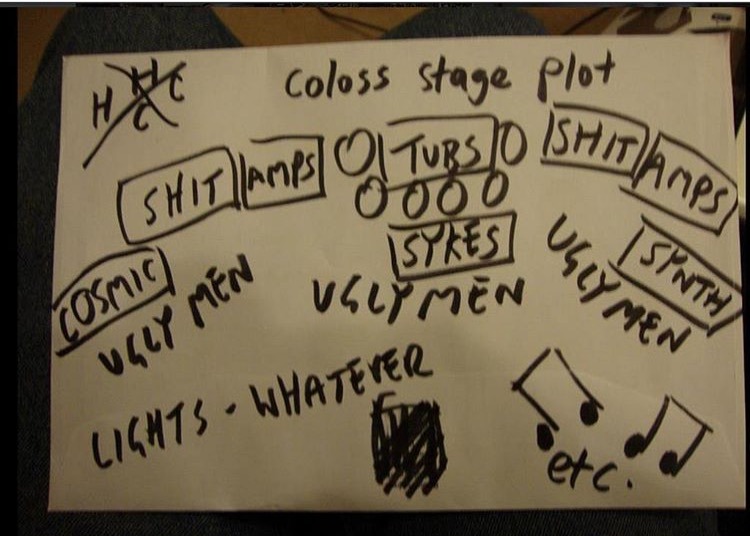
Unparalleled, unbridled creativity? It’s a neat trick that Hey Colossus have mastered. Here, we reveal the secret blueprint to their success:
See? It’s easy – any one can do it. Or so it would seem, when we listen to the easy-to-love, utterly immediate energy that infests “Summer Tombs,” the second album from the Hey Colossus-related Henry Blacker, and spectacularly, also released this year (on the also spectacular Riot Season Records). “Summer Tombs” is a nail-bomb spewing riff-rocket of an album, going down as smoothly and addictively as your favorite (or most lethal) intoxicant.
In simplest terms, “Summer Tombs” is an album we can relate to, terrifying as that may be. It’s loud and lumpy rock and roll just the way we like it, a mutant-metal battle-cry of adult angst, back pain and Monks-level complications, wherein the singer just might sigh, “aw, for fuck’s sake” in the middle of a song (as occurs in the brilliant “Shit Magus” – and we’re inclined to have a custom-made football jersey ordered with this name on the back). It’s an odd, electrifying eruption of three musketeers fueled by a “QOTSA-first-album-only” ethos that sounds serious, while being not even half-serious about it. Serious bands don’t come up with song titles like “Cold Laking,” but Henry Blacker does, and that’s what makes our love for Henry Blacker so serious. Seriously. It’s the sound of Tony Iommi taking a break from the toot in order to play you the riffs from “Mob Rules” just a half-step slower and saying, “fuck the fringed-leather – let’s boogie.” Henry Blacker responds to the musical question, “What if ZZ Top recorded ‘Welcome to Hell’?” with a query of its own – “What if Venom recorded ‘Tres Hombres’?”
Seven songs in thirty minutes, without a wasted moment, Henry Blacker’s second album is one that we consider perfect. Play often and at high volume. Choose your poison and met us in the “Summer Tombs.”
“Radio Static High” is available now from Rocket Recordings. “Summer Tombs” is available now from Riot Season Records. Your sanity is no longer available.
“Suffering is our best teacher because it hangs onto us and keeps us in its grip until we have learnt that particular lesson. Only then does suffering let go. If we haven’t learnt our lesson, we can be quite sure that the same lesson is going to come again, because life is nothing but an adult education class, If we don’t pass in any of the subjects, we just have to sit the examination again. Whatever lesson we have missed, we will get it again. That is why we find ourselves reacting to similar situations in similar ways many times.” – Ayya Khema
There’s an undeniably deep – and perhaps unjustifiable – personal connection that we feel in regard to the music of Dead Sea Apes, the UK-dwelling, three-headed hydra of space-dub who’ve recently released their third and arguably finest full-length album to date, “Spectral Domain” (a co-release from Cardinal Fuzz and their stateside partners, Sunrise Ocean Bender).
It’s a connection that, frankly, probably has something to do with the use of the word “ape.” But there’s also something much, much deeper than that. Yet having now been listening to Dead Sea Apes rather intently and undoubtedly intensely for the better part of five years, it’s difficult to parse out exactly what it is that sets “Spectral Domain” apart from the Ape-scapes that preceded it. Indeed, this album stands up nicely as simply a multi-dimensional prism of their first album, the world-beating “Lupus,” reflecting related territories, now further refined, but with a sound that cascades even more broadly, powered by a more muscular sense of sonic sturm und drang. That Dead Sea Apes seem to be growing steadily “heavier” – in the most sacred, most inexpressible sense of the word – is a bit counter-intuitive. If the earliest Dead Sea Apes material was heavily indebted to the power of the almighty riff, “Spectral Domain” sees the band training their collective third-eye on the invisible twin-engines of tone and timbre.
The tonal transitions that build the band’s battered bridge between wondering and wandering are evident in every single minute of “Spectral Domain,” without a single lost or wasted moment.
The ten minutes-plus of “Universal Interrogator” set the tone for the album as a whole – deliberate, unhurried and unafraid to paint their shared canvas several shades darker than “nefarious.” It seems key that the first word on “Spectral Domain” references the universal, especially given that the Apes provide no context clues in the form of vocals. It seems that the true magic of “Spectral Domain” – and the true magick of Dead Sea Apes, historically – is the band’s ability to create from thin air a shared musical language between its three members. In their capable hands, this experience tracks as something several meaningful degrees apart from simply “jamming,” and towards a freedom to roam and explore that envelops the listener into an exercise in Gnosis.
Big-G “gnosis” is not a concept that lends itself to easy explanation; in fact, it may defy explanation by its very definition, as does the music of Dead Sea Apes in general, and “Spectral Domain” in particular. Hailing Dead Sea Apes’ unearthly dub-gnosticism is a tricky proposition, as it’s quite literally impossible for us to write something that your ears don’t instinctively know. Yet somewhere between Armageddon and salvation, somewhere amid the P.K. Dick-meets-King Tubby-in-space environs masterfully manifested on album-closer “Sixth Side of the Pentagon,” there’s a shared knowledge that awaits transmission, and it begins with the realization that there’s no band on earth heavier than Dead Sea Apes.
If the strength of “Spectral Domain” lies in the Professor X-level mind-meld that occurs between the band’s members, the debut release from Zeta One benefits from an equal-but-alternate approach to roaming gnosis, a singular and solitary version of cosmic exploration, with no lack of mutant flavor in its mass of way-out sounds.
“DreamSnake II” (out now from the incessantly awesome Eiderdown Records) is the work of one Dawn Aquarius, who formerly spent time in previous (and without a doubt, future) “Band of the Week” victims, Herbcraft. Consisting of ten tracks over a pulse-quickening and eye-opening thirty-six minutes, “Dreamsnake II” sheds its sonic skin and leaves behind an unforgettable, indescribable, synth-heavy cosmic ceremony of turbo-weird delights.
So, what does it sound like? It’s called “DreamSnake II,” it’s the creation of a woman named Dawn Aquarius, who used to be in Herbcraft, and it boasts song titles like “Face Humanoid,” “Mysteri-Atman” and “Ching Witch.” You do the math.
Or better yet, don’t do the math. Listen to Zeta One without expectations, your ears open to any and all interpretation. We knew nothing about “DreamSnake II” or its creator upon our first listen; we knew only that it was a new release Eiderdown Records, which, historically, is all we need to pique the interest of the apes.
What we found was a release positively over-flowing with crystal-visioned creativity. Ladies and gentleman, we are floating way, way, way out in space. On “Electroscopic,” Zeta One echoes with the type of intergalactic yearning that recalls Brightblack Morning Light. On “Gamma Draconis,” Zeta One delivers a miniature Faust-ian waltz, appropriate for dances on alternate galaxies or in altered states. On “WORGOZWEIL,” Zeta One rumbles like Suicide’s “Ghost Rider,” generating an image of Johnny Blaze’s flaming skull sending stacks of tarot cards alight and up in smoke.
Smoke ‘em if ya’ got ‘em. “DreamSnake II” spoke to us directly, immediately. Not a day has gone by since first listen that we haven’t incorporated “DreamSnake II” into our daily rotation, either early, early in the morning and late, late, late at night – and Zeta One fits both spots perfectly. We know exactly what Zeta One is saying, even though, much like Dead Sea Apes, we’d be hard-pressed to accurately translate what exactly is being said. Listen – can you hear it, too?
“If we make a quick examination of our own mind, we can see the reason this kind of stability is so crucial. Although physics has observed light to be the fastest traveling phenomenon known to man, actually the speed at which our minds travel is even faster. We can circle the globe in a matter of seconds, and our minds generate doubts, emotions, and conceptual thoughts at a speed that defies that of all other phenomena. Because we lack basic mental stability, conceptual thoughts arise endlessly. So, if our goal is to realize the nature of mind, we first have to learn to still our minds, and free ourselves from distraction. The method for quieting the mind is called ‘meditative concentration.’ Once we have gained some initial mind stability, it is even more important that we continue our training so that this stability will increase. Without such stability, it is impossible for us to successfully learn to abide in the uncontrived view.” Anyen Rinpoche, The Union of Dzogchen and Bodhichitta






 Revolt of the Apes