Stoked to have the chance to let the Reverberations of the Apes be a part of this noisy weekend, known as RVA Noise FEST … I’ll play 999 Hawkwind songs backwards, simultaneously, during some ape-scapes on Sunday. Check it out!
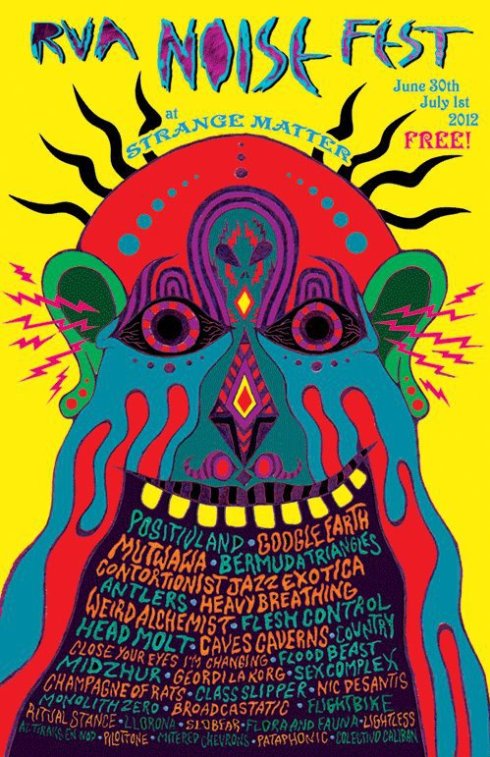
Stoked to have the chance to let the Reverberations of the Apes be a part of this noisy weekend, known as RVA Noise FEST … I’ll play 999 Hawkwind songs backwards, simultaneously, during some ape-scapes on Sunday. Check it out!
Summertime, and the living is … not so easy. In contrast to the generally sunny disposition of the Apes, we find the summer to be the most trying of seasons, owing mostly to our proximity to the equator, the gigantic nuclear furnace that we call the Sun and our utter inability to find employment as an ice cream taster. Who loves the sun? Not everyone.
Love or confusion, we recognize that we need the sun. This summer, we’ve found our spirit fortified by the rays of a different sun, but one that shines no less brightly – SunShineJane.
Our love of SunShineJane brings with it a particular brand of confusion, though we choose to think of this as more mystique than mystery. You see, SunShineJane often goes by the name MyDogJane – and the possibility exists that the creative train behind either Jane, a man named Scott Dupuy, is happy with neither name.
What Mr. Dupuy is happy with, one can infer, is his ability to manifest the music he hears in his head into something that can be shared with others, for the vibrations to carry. And what good, good, good vibrations they are – Dupuy’s sounds carry an instant jolt of recognition and blinding bolts of inspiration, via guitars fuzzy-and-phased, and the beat that helps you move your feet. Yet the initial pleasure soon gives way to an eerie, almost airless vibe – the spirit of the music has been trapped and it’s yearning to be free.
And free it is – to this point, the chief channel of distribution for the sounds of SunShineJane/MyDogJane is through a YouTube channel. We anticipate that in the future, he’ll get by with a little help from his friends. Until then, we urge all to crane their collective necks toward this sun and take in the words of SunShineScott Dupuy, who was kind enough to answer our ridiculous questions below. Enjoy.
What are your earliest musical memories? Can you recall the very first song that captured your attention as a child? What was it about that song that has such an impact on you? How has your relationship with that song evolved over the years, and what emotions does that song bring out in you today?
Pink Floyd and my dad singing a few lines of the song, “School” by Supertramp. Pink Floyd, “Echoes.” It was really long, beautiful and had some crazy sounds. Then in my early teens I discovered LSD and that song, along with many others, became different … in a very good way.

Was there a defining event in your life in which it became clear to you that music would be a central obsession in your life? What music soundtracked this event? How do you think your relationship with music has evolved since your adolescence? How do you think your relationship with music has evolved in, say, the past five years?
There was never a defining moment that I recall. I remember someone telling me to sing something other than Black Sabbath (Ozzy) and Pink Floyd. My dad had his records shipped from England when he came to Canada but only one milk crate arrived. Thankfully it had all of Floyd and one Sabbath record. The older I got the more appreciative I became of music makers. To me, it was the greatest and most underrated art form. Writing, recording, mixing, etc., take a lot of time … if you do it yourself. It’s a different process than just playing and creating … for an average of three-to-six minutes of art that most people expect for free … or for a dollar from fucking iTunes or some shit site like that … mind you, I put it all on YouTube which is basically giving it away. I like less production and lots of heart.
What effect do you believe hailing from The Great White North had upon your musical development? Are there any Canadian bands or artists who have made a great impression on you over the years? Are the Canadian Content laws a well-intentioned way to make sure the arts are well-supported under the banner of the Maple Leaf, or just another example of the “typical, passive-aggressive Canadian bullshit”?
I just made shit up without a thought of anyone noticing because I certainly didn’t/couldn’t/wouldn’t sound like Brian Adams or Neil Young to which most Canadians measure up to. There are certainly many unknown Canadian psych/garage bands but when I started making music, I was ignorant to their existence. The Ugly Ducklings are a great band … Hahaha – passive-aggressive.
What can you tell us about the origin of SunShineJane/MyDogJane? What compelled you to begin this project and what lead to you releasing this music out into the world? What is the story behind the rather unique name, and what is the relationship between the MyDogJane moniker and the SunShineJane moniker?
Well … I have to name drop to tell it … sorry. I have played for a long time by myself. I have a ton of bits and pieces recorded. I finally got on to that Facebook and added A.Newcombe. He got kicked from Facebook thrity minutes later and then I immediately got two friend requests: D. Cavanagh and A. McGee. I had no idea who these guys were until a month later. I put some tracks together with a lame picture up on YouTube and sent it to D. Cavanagh. He posted it, McGee loved it and thought it was from someone else, whom I admire dearly, which gave me some much needed inspiration. It happened so fast. I didn’t put much thought into a name. I am a huge animal person. I looked down and saw my dog, thought, well, fuck it. I have put a few songs out with the name SunShineJane. I think all of my stuff sounds different but the ones with that title, I put more effort into. I change my mind a lot so I’m never sure which one too chose. Fucking labels. Ha!
If you were standing on the street in Austin, TX, at 2:30 a.m., trying to hail a cab, and a dude approached you wearing shimmery, rose-colored Elton John sunglasses and a monkey-mask on the back of his head, would you invite him to share a cab with you? Please show your work.
Haha … I knew he would share an apple … thanks for that.
We don’t say this lightly, but SunShineJane/MyDogJane is some of the most evocative and communicative music that we’ve had the pleasure of hearing in recent years, thought it also seems to carry a real and perhaps intentional veil of mystery along with it. What do you feel like you are trying to communicate with your music, or is it something that you are unable to words to, quite literally? Is the sense of mystery that we sense when listening to SunShineJane/MyDogJane real, in your mind, or are we projecting our own emotions on music that you believe is built for a larger audience?
Thank you. No intent … I don’t think. I just really enjoy making noise. I hope I hit some right notes/frequencies so it’s enjoyable to who ever wants to listen. Emotional projection and music are great friends. That’s how music is enjoyed. Every song means something different to someone else.
What music have you been listening to lately? If push comes to shove, what is your favorite Neil Young song of all time and why? Please show your work.
Nightbeats, Growlers, White Fence, (always) BJM, Dead Skeletons, Strangers Family Band, UFO Club, some great Turkish music, Bombino, Strange Boys, Spindrift, G.D.D.L.F. from Spain, The Black Ryder, The Black Angels, a New Zealand band called Doctors, The Allah-Las … just to name a few. I can never choose a favorite song from anyone. They all have their own moment for the right mood.
What is the most positive or enlightening aspects of writing and recording music in your eyes? How do the emotions you experience during the writing and recording process differ from those you experience when watching a live music performance? What band or artist has delivered the most surprisingly transcendent performance that you ever saw – meaning that you had low expectations going in and had your mind irrevocably altered going out?
I just really like to create things. When I put my music “out there,” my idea was to make music for films. I can perform but it’s all nervous anxiety. Haha … I started drawing, writing and painting first. I played for so long without writing things down, which I still do, so recording makes it much easier to remember things. So many lost and wasted ideas because I didn’t want to stop playing to write things down. Now I just hit a button and we’re good. It differs when I see a live band because I realize that I need to practice more because they are usually/always much better than myself. There was a band called Vietnam that Evan Dando brought for the first time to Toronto. They were OK. Then we saw them again with the Black Angels and they blew me away. Great bunch of guy’s but I don’t think they are around anymore.
Laura Ingalls Wilder – author of “Little House on the Prairie” and a massive fan of Voivod – once wrote the following:
“As the years pass, I am coming more and more to understand that it is the common, everyday blessings of our common everyday lives for which we should be particularly grateful. They are the things that fill our lives with comfort and our hearts with gladness — just the pure air to breathe and the strength to breath it; just warmth and shelter and home folks; just plain food that gives us strength; the bright sunshine on a cold day; and a cool breeze when the day is warm.”
Your thoughts?
Agreed. I did like her sister better, though.
What’s next for SunShineJane?
Good question … Joe Foster has me on his publishing label at Sterling Songs. Joe and his wife, Tuesday Foster, are very kind people. I’m truly grateful to have them at my side. I’m hoping something will come out of that. I’ll just plod along either way like I have always done – I enjoy it very much. Take care.
Rightly or wrongly, we often try to frame the artistic aspirations of all those bands, all those musicians who make all that great music that has enhanced our lives throughout the years, within the generally non-artistic terms of a “mission statement.”
Rarely do bands make it as easy to deduce such a mission statement as do Canada’s lightsweetcrude – a band that actually has a mission statement. To wit:
“This collection of music exists to celebrate the Raga – that most ancient, most perfect set of instructions and specifications with regard to musical mood, movement, and pitch … and to fuse it with Western sounds, forms and vibes. Raga-fusion. The word Raga comes from the Sanskrit word for colour, rang, and we are often asked to imagine the Raga as being a sonic means to colour the imagination or mood, or both. Every Raga has its own shade, its own distinct hue, a proper time of day to best evoke it, and a family or two to whom it can be said to ‘relate’. Some are a serious call to action and devotion, and some ask you to relax, turn off your mind, and listen to the colour.”
In light of such a well-defined statement of purpose, it’s incredible to hear what a sense of freedom we receive from the music of lightsweetcrude on their debut, Listen to the Colour. With each listen, each of the album’s six songs truly does communicate different color, with endlessly nuanced shading. And because they’re from Canada, we sense in that color just a pleasant pinch of poutine for good measure. Delicious and satisfying.
As long as we’re using the words of others to describe lightsweetcrude, it seems appropriate to echo a description of the impact of their musical effort as something like that described in The Tibetan Book of the Dead:
“From the midst of that radiance, the natural sound of Reality, reverberating like a thousand thunders simultaneously sounding, will come. That is the sound of thine own real self. Be not daunted thereby, not terrified nor awed.”
Be not awed, but be delighted by the sounds of lightsweetcrude, and the words of Jason Steidman, who was kind enough to answer our ridiculous questions below. Enjoy.
Is the term “world music” a useful one, in your view? Do you feel there’s something less than specific, possibly empty and perhaps cloyingly paternal about the term? Has the world contracted to the point that such a phrase has outlived its usefulness? Or do you find it’s still a necessary bit of shorthand to use when trying to introduce the uninitiated to the music if lightsweetcrude?
Being specific is always best, and if not, why not say “non-Western” or “ethnic”? That’s usually the meaning, and they are just as completely useless, blanket terms, but at least they make some sense, and have some honesty. That being said, and speaking of “honesty” … I do use the term – it is a useful term in an ice-breaking context – where being too specific, and using the word “Raga” too much might be overwhelming at first contact.

Speaking of the uninitiated, how did you yourself first become not just interested in, but dedicated to the traditional and “modern traditional” (to use another cloying phrase) music that emanates from locales and culture not native to, let’s say, Canada? What was the first album or artist that truly kindled this fire within you? How has your relationship with this music evolved over the years?
It’s a strange story, but it was a dancer that started the whole thing. I had been working on staff at a big recording studio in Toronto, and had gone freelance to work at a couple of different places. I rented the top two floors of a house in the Junction, and set up a small studio on the top floor. I got a call from a kathak dancer who wanted to come in and talk about producing a track that fused Indian and modern (at the time) dance music, and this was back when that sort of thing was all over the place, and still “fresh.” I had little experience with either, really. I wasn’t a fan of dance music (though I’d been exposed to it plenty), and apart from Ravi Shankar in the Monterey Pop Festival movie (which is incredible), I didn’t really know anything about Indian music. Still, I wanted to do the project. I thought she was serious, and I was pretty green at running my own business, and didn’t get a deposit or anything like that … I just got to work on this tune, based on a traditional melody, and she left for India for a few weeks … and when she returned, she had changed her mind. Meanwhile, I had started fooling around with ideas, using some samples from Revolver and a few other things, and I really felt I was onto something … but, left to my own devices, I had left the dance thing far behind, so she wouldn’t have approved, anyway! I was going for the sequel to Eno/Byrne’s My Life In The Bush Of Ghosts. I had been turned onto that album by a friend in my late teens, and that was my point of reference for what I was trying to do. At one point, I tried reaching out to a musician who was involved in a local Indo-fusion project to see if he wanted to do a session, and he (perhaps unknowingly) made me realize, just by asking me a few questions to determine exactly what I was looking for … that I really hadn’t a clue about this music! That conversation was an eye-opener, and after some thought, it led me to the conclusion that A) I would need to find a teacher, and B) that I didn’t want to make recordings that were merely “dressings” or beats surrounding samples – that’s superficial gimmickry. I found a great teacher, Pakistani film composer and harmonium player Sohail Rana. Since I already was a longtime keyboard player, it made sense to me, despite the micro-tonalities of the music, to use the harmonium as my instrument. I studied with him for a while, and there was a stretch of a few years where I did little listening other than to cassettes of Mr. Rana, and Classical sitar, sarod, and vocal performances. I was in a musical vacuum for a while, trying to understand “Raga”, and believing very strongly that was going to take me where I needed to go, as corny as that sounds. There was an album that really inspired me around this time. The fire was already kindled, but Cheb i Sabbah’s Krishna Lila was a major boost: it wasn’t precisely the type of fusion I wanted to do, but it had the same respect, authenticity, and integrity I was shooting for.
How my relationship has “evolved” is a tough one! I feel my understanding has slowly grown, but I’m still at the beginning of this trip, and I’m pretty sure it’s going to be a lifelong thing. There’s always a “dipping your toes into the ocean” analogy used with this musical tradition. Looking back after finishing this first album, I could see that I needed to go deeper in the next round of material, especially into the micro-tonal aspects of the music, what is referred to a “meend.” I didn’t really get into that enough, except for the last tune written for the album, “Bhang Lassitude,” and there, only a little bit. I can also say that my relationship with Indian music has had a huge influence on how I listen to all music.
In what ways has the study of – or even just taking pleasure in – the raga impacted your life apart from the musical perspective? Does your interest in the unique nature of the raga extend to other arenas as well – from artistic pursuits like film and literature, or perhaps more solitary and personal ones, like politics or (gasp!) religion? What has been the most surprising thing that you have learned either about yourself or about the world since you dedicated yourself to exploring the universe of the raga?
Good question … I know this isn’t the “cool” answer, but my perspective on the universe and my relationship with nature hasn’t really been altered or developed as a result of the music. At least not in a way that is obvious to me. I have been working with it at various levels of intensity for about 10 years, so I’ll admit that it would be hard to be certain, because I have changed and my world has changed in that time. I find many concepts surrounding Nāda Yoga to be fascinating, and I do view my world in terms of sound in a big way, but this began before I found this music. Maybe there has been an influence there that’s taken me deeper in that direction, but there hasn’t been an “it” moment yet … that’s just my “normal.” The most surprising thing, funny enough, is from the religious side of things … awhile ago, I was listening to an online sermon on idolatry while collecting some voice samples for something, and suddenly, I really understood the concept for the first time. The idea of something other than the Creator being let into your heart, and held to have a supernatural power and divine beauty… I heard those words and realized – that’s how I feel about Raga! I am guilty of the sin of idolatry! I am guilty of “worshiping” it and its power and possibilities deeply. No regrets, mind you, but it was a strange feeling in that moment.
What can you tell us about the formation of lightsweetcrude? It would seem to us that a band with such a unique and focused mission statement does not necessarily form on chance – did you have a relationship with any of the other members prior to coming together under the lightsweetcrude banner? What has been the most enlightening part of your creative collaboration thus far?
Interesting. I suppose that must be true about any project with a “mandate.” lightsweetcrude was born in the studio with its mission statement. To continue my little story, I was in that “musical vacuum,” playing harmonium for a few years, and I was at a point where I understood the basic concept and workings of a few Ragas … again, there are galaxies in there to comprehend, but I was educated enough to be able to listen to and learn from classical performances, and did this for many hours everyday… and one night I was in my little home studio, and I remember I was just fooling around. I got a drum loop going very quickly, got some sounds together, played a bass line that was essentially the ascending scale of a Raga, and then played some organ (in the same Raga) to it, and there was the core of the first tune. Not close to complete, but striking in how it worked. I hadn’t figured out how things were going to unfold yet – I just knew I needed to study and learn about this music, until I could enlist the help of great players (both Hindustani and session dudes) who would be willing to go into the studio and make this happen. I hadn’t really made the connection of how one would lead to the other! I certainly didn’t think I would be playing organ, either … or possibly even playing at all on whatever was going to happen. Organ had always been my instrument, though, so it seemed honest to go there. Eventually that first track got fleshed out by various players that I had worked with on other people’s recordings as an engineer – so there’s one set of previous relationships. After uploading a few tracks that were completed in this manner, and one up on iTunes, I got a lot of great feedback online, and many questions about when the band’s next gig was! I had intended for this to be a studio project, still guided by My Life In The Bush Of Ghosts as the model, but soon I had gathered a bunch of people in a rehearsal space who I had attracted via a Craigslist post, plus Michael Kaler, a musician I had known since my late teens/early 20s from U of Toronto, but had only reconnected with just prior to putting this group together – a fortunate coincidence. So that’s the second previous relationship. The most enlightening part of working together with the live band, especially now that the lineup has stabilized, is seeing how we stretch out and reinterpret the material in a live setting. It’s always surprising to me when I think about it, but onstage, I’m the conservative one in so many ways, but I don’t think as a bandleader I have any choice – it’s my role. The rest of the band is always pushing the proverbial envelope during a show when given a chance, and if it’s unexpected, I sometimes feel myself resisting … and as we go to some new places, I feel what is happening is entirely chaotic or disconnected, but later when I hear the recordings, it’s often great. Our collaboration is helping me find a balance, and learn the meaning of “trust” in a musical context! I’m getting there …
Your album, “Listen to the Colour” contains the following words by way of explanation: “Every Raga has its own shade, its own distinct hue, a proper time of day to best evoke it, and a family or two to whom it can be said to ‘relate’. Some are a serious call to action and devotion, and some ask you to relax, turn off your mind, and listen to the colour.” Are these words meant to specifically recall the words of “Tomorrow Never Knows” … which itself recalls the popular Western translation of the Tibetan Book of the Dead? Is there a song on “Listen to the Colour” that you feel leans toward the “call to action” side of the ledger? What can you tell us about the origin of the album’s opening missive (and perhaps our personal favorite), “Kaafi Funk”?
For sure the big thing about “fusing musics” is drawing connections. When I first discovered that Raga and “colour” were related in Hindi/Sanskrit, I immediately thought of that lyric. But I haven’t read “The Book Of The Dead,” though I am familiar with it. Maybe I should. “Ahir/Now” has some raucous “call to action” type of moments, especially Alexei Orechin’s very muscular solo. Plus, c’mon – anything with handclaps is a “call to action”, right? As for “Kaafi Funk”, it was that first track that gave birth to the whole project. I owe a lot to Rez Abbasi, who played electric sitar on that tune. There wasn’t a lot on there other than loops and a MIDI arrangement when he first heard it, and the form has even changed since he cut his part on that tune. When I sent him an MP3 of what was there, and a horribly written chart (all my charts are horribly written), I was certain that he would turn me down. You know, say he was too busy or something, but he was down with it, and his absolutely killer solo on that track gave it a push, and inspired others who played after. “Kaafi Funk” really became the “beacon” for the project on many levels.
What music first obsessed you during your adolescence? Can you think of an example of a music that truly had a deep impact on you at one time, yet an impact that has not been lasting (meaning, you really can’t find pleasure in listening to it these days)? Conversely, what artist or album has captured your attention quite by surprise in recent years, perhaps one that you had resisted or prematurely formed an opinion of? What is it about that music that is now clearly compelling to you?
I got into a lot of different stuff in a short period of time in my early teen years, but my first true love was jazz, which I got into at seventeen. I discovered The Grateful Dead very shortly after and felt there was a connection, and became obsessed there, too. Post-punk had a big impact on me in my early teens, bands like Bauhaus, Gang Of Four, Siouxsie and the Banshees, etc. Much of it no longer holds up in the same way. I mean the attitude, the posturing, much of the vocals, etc – I cannot get behind that now. On the other hand, now I hear things in the production, and some playing that I missed before. For example, the production of some of the Bauhaus and Siouxsie albums is quite amazing, and John McGeoch’s guitar playing on Juju blew me away when I sat down with that album six years ago for the first time since the mid-80’s! I also see very clearly how so much of that scene was influenced by psychedelic music from twenty years prior. The Cramps, however – another band I was really into at that time – keep getting bettter, and I really “get” them now. I think the fact that what they were doing was firmly rooted in a musical tradition might have something to do with that.
Black Sabbath – this is a band I had written off initially because of their fans in my universe! I actually remember reading an interview with Trent Reznor about fifteen years ago where he stated the same thing about Zeppelin. There was a clear line in the sand back in the days when I was listening to the post-punk stuff. We had dyed hair, partially shaved heads, a dark aesthetic, that kind of shite, and the “Rockers” hated us, and so I stupidly had written off their music. I wouldn’t say I’m now in love with Sabbath, but I now respect and admire it, particularly the raw and visceral aspect of their music. I also think of it differently, more in terms of its place in history, after reading Joe Carducci point out how he feels they are directly related to Vanilla Fudge via Earth.
What music have you been listening to lately? If push comes to shove, “The Inner Mounting Flame” or “Birds of Fire” and why? Please show your work.
I’ve been listening to lots of random santur music, both Persian and Indian. Working and hanging with Amir Amiri really got me into that instrument. I’ve also been really digging and studying the sounds and arrangements of the Holland–Dozier–Holland canon. But in terms of actual recent stuff, neo-psych groups like Quilt, and also White Fence have been “on my iPod”. I can relate to and appreciate the pains taken to get the sounds right on those two groups’ albums.
I passed this question on to the rest of the guys – – Michael Kaler is all over La Monte Young’s Well Tuned Piano, Mark Segger has been digging deep on composer György Kurtág recently, and Alexei wants you to check Supersilent’s 10 and Peter Tosh’s Mystic Man.
If push comes to shove, “The Inner Mounting Flame” or “Birds of Fire” and why? It would have to be a fierce shove, as that is a tough one … I would have to say The Inner Mounting Flame. Both are stellar, but the writing on the first album is just a little bit stronger. It could be a first album thing. There are amazing moments on both, for sure. Usually the albums being made by groups on the verge of imploding have something special going on, and Birds Of Fire has a bit of that energy, interesting sonics, and I love the cover art … but I still must stand by the “composition” card on this one.
Would you care to comment on the rumor (the rumor that we are attempting to start right now) that lightsweetcrude will soon fuse the glam-metal of the early 80s Los Angeles Sunset Strip into your musical stew, changing the name of the band to lightsweetMotleyCrude, and releasing a new single entitled, “(She’s Got) The Looks That Kali”?
Haha! No comment … but one band member does have a Spandex allergy.
Victorian-era art critic and essayist – and, it should be noted, HUGE Deep Purple fan – John Ruskin once wrote the following:
“You talk of the scythe of Time, and the tooth of Time: I tell you, Time is scytheless and toothless; it is we who gnaw like the worm — we who smite like the scythe. It is ourselves who abolish — ourselves who consume: we are the mildew, and the flame.”
Your thoughts?
I need to clean my shower. And listen to more Deep Purple.
What’s next for lightsweetcrude?
The next album/EP is essentially written, so hopefully this Summer that will get started. The immediate priority, however, is a recording studio “Be In” that we’re holding at the beginning of July here in Toronto, where we’re going to film and record a few tracks live off the floor. Making videos of gigs has proven to be disappointing in terms of audiovisual quality, lighting, etc. For this taping, things are also being prepared so that there is a strong visual element in place with projections, liquids, and the like … I’m currently trying to source out a bubble machine! Projections are always present at every gig (venue permitting), but I’ll be bringing out an extra overhead projector or two for this one. We’re also hoping to stretch out more over the next year in terms of playing outside of Ontario, and eventually outside of Canada, as well.
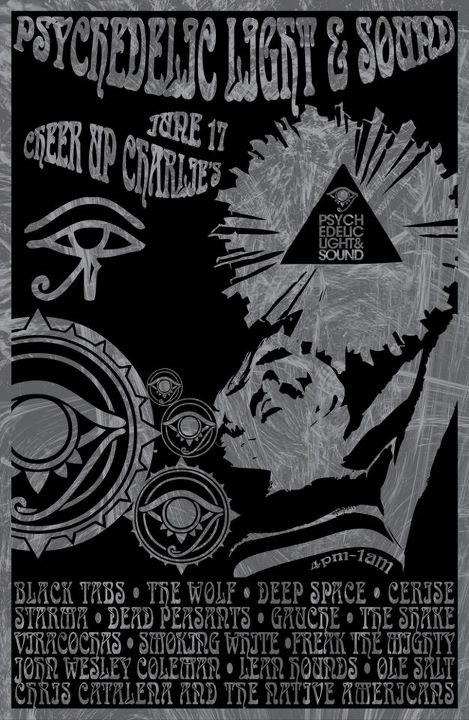
If the apes were any less than 1,467 miles away from Austin, TX, you can be sure you would see us at this event. The Black Tabs? Chris Catalena and The Native Americans? The Wolf?
Insane.
If you find yourself anything less than 1,467 miles from Austin, TX, this weekend, you should find yourself at Psychedelic Light and Sound. Odds are you’ll find yourself and find yourself odd.
Psychedelic Light and Sound is a three-person collective – Robbie D Love, Buddy Hacher, and Levi Murray (members of Deep Space) – who decided to throw our own music festival called Psychedelic Light and Sound, which is dedicated to consume, confuse, and overload the senses. Our first event will be held on Sunday, June 17, in Austin, TX, at a venue called Cheer Up Charlie’s.
There will be two stages, one inside and one outside. There will be 15 bands playing throughout the night. The entire venue will be bombarded by liquid light shows, lasers, and movie projections.
We started Psychedelic Light and Sound because we wanted to be part of something bigger in Austin & are really inspired by the guys at Reverberation Appreciation Society who throw Austin Psych Fest every year. Psychedelic Light and Sound is an excuse to get all our friends together and expose them to audiences who might not have had the chance to see these bands perform.
Psychedelic Light & Sound will continue to put on events in the future to bring more people together. We are inspired by the unknown, by the mystical spaces between the lines. Tune on, tune in, and drone on.
Also, we have assembled a mix tape of all the bands performing our event, which will be sold at the venue. People can check it out and purchase it online at http://www.psychedeliclightandsound.bandcamp.com/
Below is the line up, set times, & venues.
Outside:
9:50 The Wolf
9:10 Deep Space
8:20 Cerise
7:40 Chris Catalena and the Native Americans
7:00 Starma
6:00 John Wesley Coleman
5:00 Ole Salt
4:00 The Shake (Happy Hour)
Inside:
11:30 GAUCHE
10:30 Black Tabs
9:30 Smoking White
8:30 Dead Peasants
7:30 Lean Hounds
6:30 Viracochas
5:30 Freak the Mighty
Confirmed vendors:
-Reverberation Appreciation Society Records
-Melissa McCall Steampunk Jewelry
-Laced With Romance Vintage
-Groovy Killers On Acid
-BC Smoke Shop
-Bean Blossom Soap
-Kohana Coffee
Thank you so much for supporting us,
Psychedelic Light and Sound.
www.facebook.com/psychedeliclightsound
If we sometimes have difficulty (read: we always have difficulty) expressing through our words the radical, spiritual effects that music can have on us, we’ll have to concede defeat early in our fight to find the proper words to describe the visual wow-and-wallop of Drippy Eye Projections.
So we’ll employ the words used by Dan Nedal in his essay on The Joshua Light Show, direct ancestors of the Drippy Eyes:
“Psychedelia began manifesting across the globe around 1965, peaked around 1967-69 and slid into a coked-out robotic sheen … in the 1970s. But for a few years there were records, posters, tapestries, gee gaws and, yes, light shows. Light shows were unusual for being simultaneously performative, scientific and graphically engaging… Light shows were (and still are) a difficult, endurance-testing discipline that popped up wherever there was a rock club. Like deafening amps, the swirls and fades of a light show was part of the youth culture thing.”
We encountered the stunning visual work of the Drippy Eye crew during Austin Psych Fest earlier this year and soon arranged a poolside rap session that lasted about two-minutes. We knew that further investigation was in order – the appeal of the art that Drippy Eye provides doesn’t happen on accident, we suspected, no matter how stream-of-consciousness inducing its impressive, iridescent illuminations are.
Our suspicions were confirmed – and our bright view of Drippy Eye Projections grew in wattage – after this interview with team member Curtis Godino. Enjoy.
Where does the connection between music and visuals originate from for you personally? Can you recall the first combination of an aural experience and a visual experience that truly made a dramatic impact on you? What was it in particular about that experience that made it so memorable?
I think the connection between music and visuals originated around 10th grade, when I started getting into stoner metal and psych rock. At that time I started really diving deep into Pink Floyd and Sleep. I would say my first combination of an aural and visual experience that made a huge impact on my life was my 17th birthday. Me and a couple friends went and saw a Saucerful of Secrets, Wish You Were Here, and Dark Side laser light show at the Miami Planetarium. It was one of the first times the visual representation was just as important as the sound. It was a trip. But the lasers didn’t have the same feel as the old videos with Syd Barrett which were full of organic oil projections.

What was your first experience that saw you becoming a “hands-on” contributor to live visuals, as opposed to just a spectator? What in your background gave you the confidence that you could contribute something special to a live musical performance?
I used to watch a lot of old Pink Floyd videos. Their light shows (before lasers) were unbelievable and when I found out it was all just liquids and slide projectors, it blew my mind. I had a psych band at the time called Celestial Sound and we wanted psychedelic visuals to accompany our spaced out sound, so we got an LCD projector from a friend and started making videos from oil projections found on YouTube, our favorites being Joshua White and Mark Boyle. But after a week or so, we realized we needed the real thing, so I told my high school music teacher what I was trying to do and she hooked me up with five overheads, two slide projectors, and four clocks, all for free. She thought it was awesome that we were trying to do this stuff and that we were putting it to better use than the school was. So in the beginning, we had our bassist’s brother Hayden Toski sitting on the over head with two plastic take-out trays with some vegetable oil and colored water in them and he would just swish them around. That’s where we got the motivation to step it up. If it could look as cool as it did with some trays and vegetable oil, then it couldn’t be hard to start perfecting the techniques.
In the 1960’s, groups like The Joshua Light Show and The Brotherhood of Light expanded the context of how an audience perceived a light show – bringing creativity and ingenuity to the forefront by using overlapping light sources of various sources, etc. What is it about these early pioneers that you find most compelling? In what ways are you able to study the techniques used by the forefathers/mothers of the live light show?
Joshua White, I think, is one of the strongest driving forces behind what we do because he successfully did it. People really respect his art, not just for some trippy light show, but for the tons and tons of work and effort he put into it. I have yet to see him do it live, but in the beginning, when I was first learning how to work oil projections, we exchanged many emails explaining different ways to do it and how to get the right liquids. We still keep in touch – it’s cool that he got to see us start and now what we have been able to accomplish. Besides emails, I watched a ridiculous amount of oil projection videos on YouTube, with Mark Boyle being my second favorite projection artist due to his incredibly experimental methods. He was working in ways that Americans had never done. I’m not even sure how he did a lot of what he did but he was using some dangerous liquids and vertical slides.
How important is it to you to have the entire Drippy Eye Projections experience be presented using analogue equipment? What flexibility – or constraints – does this offer you that would not be there if you incorporated digital elements as well?
It is incredibly important that everything is analog, but we are not opposed to using digital elements. What I love about the 1960s light shows is that it was all analog because that’s what they had to work with, but as time goes on, technology gets better and therefore you have the ability to do even more. I really love video feedback and when there are video clips weaved in with all the analog light. We use document cameras run through an LCD projector – it’s still analog but it’s getting to be a little more digital looking. With analog there are no pixels, and no one’s body looks good with pixels on it. But I must confess my love for analog light – it’s the best. There’s no way to press a button to make it look good – you have to do it yourself.
What does an “ordinary” Drippy Eye performance consist of, from an equipment standpoint – projectors, inks, slides, etc.? What would your dream set-up consist of, if time and money were not an issue? What would you like to accomplish during a live performance that you have not been able to do up to this point?
Our performances vary since we work out of New York City and South Florida. But it can go from one overheard projector, one document camera plus LCD projector and one slide projector, to three overhead projectors, two document cameras plus LCD projectors, and two slide projectors. It’s always different. We usually try new combinations at every performance. When it comes to supplies we use clock faces, transparencies, color wheels, handmade slides, air pumps, bowls, and anything we can find that will look rad. We try to keep experimenting to get new psychedelic madness. People are always so curious about the liquids we use. We just use water with water based dyes, oil with oil based dies, alcohol, and the rest we like to keep secret. It’s like a mad scientist set up. We actually just started working with oil slides which seems to be only popular in Europe. It’s where u put a liquid concoction in between glass and let a high wattage slide projector boil it. The results are insane – brings you back to The UFO Club.
I’m glad you ask about our dream set up because it’s something we tend to discuss a lot. It would consist of five slide projectors doing their own thing. Then a couple optikinetic projectors with color cassettes, oil wheels, and distortion wheels, to set an ambient mood. Then about five or six overhead projectors with two people per overhead dimming in and out with clocks, bubble-boxes, transparencies, and color wheels. And last, two document cameras with a video mixer. Every wall would be covered with multiple layers or liquid … we will do it someday… Psychedelic Fun House. That too will happen once we can get funds.
Apart from the technical side of things, what do you feel you are trying to project with your visuals, from a social/cultural/spiritual perspective? How much are you able to lose yourself in the performance, versus having to be constantly aware of operating your equipment and being on the same wavelength as your partner? Do you feel that you have developed a sixth sense for performing under the Drippy Eye moniker?
Were trying to bring back that freak out culture, a part of time I wasn’t lucky enough to enjoy. With our light we try to transport you back to the 1960’s and make you truly experience a psychedelic concert. This also is another reason analog is so important. Right now we’re living in a time of instant gratification. Everyone and their sisters can go out and buy an expensive program and rip someone’s song off. I feel there is less appreciation of hard work. We’re trying to make you shut off your phone and live in the now. We do lose ourselves in the performances sometimes, so much so that we have a hard time remembering the bands. There’s a lot of focus and since we only have a few things that run automatically. we have to constantly be changing, tweaking, dimming, and drooling over the projectors. It gets to be a lot of work. A for having developed a sixth sense, I guess you could say that. At some points you notice that you know exactly where the song is going to go and what type of an effect would best represent the sounds being made. Then you may find yourself hypnotized by the rhythms of the music and liquid bouncing off each other.
How much does your own personal translation of the music being performed live factor in to Drippy Eye? What are you hoping to hear from bands and artists to inspire your visuals, or vice versa? Which bands have presented the best – or perhaps most abstract? – aural canvas for Drippy Eye to add its visuals to?
Personal translation of the bands is most important because the light show is based mostly off of feeling. We love doing it for music we dig. When we really get into the band we go all out and start squirting things where they’ve never been squirted before. I feel like the true experimentation really comes out when you can feel the energy of the show. Some shows are dead and when that happens we do our best to liven it up. When you do it for a band you like, it’s euphoric – you really get lost in all the sound and light. It’s like legal drugs. It’s really mind-blowing when bands start to jam and you can feel the creative energy bouncing off the visual projections and the auditory performance. I talked to a few bands after the shows and they would tell us how they were riffing off of what we were doing. A real beauty, I would say. Some bands I personally dove into at Austin Psych Fest were Moon Duo, Quest for Fire, and the little segments of Brian Jonestown Massacre that we were lucky enough to take part in. I’m not sure if it had to do with how stoned we got in Austin, (Thanks, Eeyore, for having your birthday the same weekend) or if it was that we were getting to do it for all our favorite bands. BJM was really awesome because we got to work with other artists; there were about six of us making the craziest projections I have ever seen. Bob Mustachio was amazing; he was controlling all the video feedback and mixing between the oil and live feed of the bands. After seeing Thee Oh Sees, I was pretty positive I had just watched Dawn of The Dead due to the tremendous amount of layering being done.
Speaking of music … what music have you been listening to lately? If push comes to shove, what is your favorite Black Sabbath song of all time and why?
I’ve been listening to a lot of The Brian Jonestown Massacre recently; their new album is pretty amazing in my opinion. Also the new Spiritualized album has been on the turntable for a while. What is my favorite Sabbath song? Man, that’s tough. I mean, I’m not sure if I can even answer this question, but I would have to say “Cornucopia.” It has that real stoner metal feel. On the topic of Black Sabbath, you got to check out Sleep’s re-release of “Dopesmoker” – the way they originally wanted it.
Camille Paglia is quoted as saying the following:
“The visual is sorely undervalued in modern scholarship. Art history has attained only a fraction of the conceptual sophistication of literary criticism. Drunk with self-love, criticism has hugely overestimated the centrality of language to western culture. It has failed to see the electrifying sign language of images.”
Your thoughts?
I agree. I tend to think about that a lot. Language is just a way of trying to make sense but sometimes, and most times, language cannot do it. Experience goes deeper than words. It takes away the essence, the purity of everything. I mean, you couldn’t get too far in this day and age without language, but when dealing with topics like art, music, love, etc., words don’t cut it. I feel, in a way, to truly experience something you must experience its essence, not try to figure it out, but to just be aware. She’s saying the visual component is undervalued – I totally agree. Alduous Huxley said ,“For in spite of language, in spite of intelligence and intuition and sympathy, one can never really communicate anything to anybody.” I find it kind of funny because I agree. I know we can communicate to others but never will we truly be able to pinpoint the feelings we have through language. That’s why visual representation is so important.
What’s next for Drippy Eye?
Well, for summer we’re working out of Florida so were going to be making new videos soon with some really sweet bands. We’re currently saving up for some new projectors and are really perfecting the art of oil slides. We have been non-stop experimenting with new material, so get ready for some eye candy in the near future. There’s talk of us doing some work for one of our favorite bands/friends at SXSW next year but it’s a bit far in the future. Check us out on our Facebook to see when our next show is. We’re planning to do as many shows as we possibly can this summer in Sunny Side Florida and then back to the City. We can get a lot into our videos but nothing will compare to the energy of the live experience. Shoot us an email at Drippyeyeprojections@gmail.com if you would like to work with our color.
I did not know Lee Jackson, but was moved by this. You may be, too. Ninety-four tracks from some outstanding bands, compiled for a worthy cause. We’re all one.
“This tribute album came together in love and honor of Lee Jackson, writer, music fan, dear friend, who passed in late March 2012 after a struggle with ALS, commonly known as Lou Gehrig’s disease. This collection of songs, nearly all of which are new or previously unreleased, comes from the many bands and musicians who Lee not only covered and celebrated with such passion, but also in many cases befriended over many years of correspondence, concert and festival attendance and more. The album’s liner notes contain full information about each song as well as thoughts from Lee himself about the contributing artists, taken from his writing work. All profits will go to the Texas chapter of the ALS Association; web.alsa.org/DFW2012 has more information about their continuing work. Please feel free to join our Facebook discussion group at www.facebook.com/groups/323110634410498/ if you’d like to learn more about the remarkable man who we all dearly miss; there is also a direct link to this album in Facebook itself.
Credits: Released 04 June, 2012.
Compiled by Mats Gustafsson, Travis Johnson and Ned Raggett — our endless thanks to all participating bands and performers!
Visit the “For Lee Jackson In Space” page on Facebook
“People like us, who believe in physics, know that the distinction between past, present and future is only a stubbornly persistent illusion.” – Albert Einstein
We believe science fact and science fiction to be separated by the thinnest of margins, margins that are, for all intents and purposes, rendered inconsequential by our psyche and our shared experiences – and this belief itself is, for all intents and purposes, confirmed by the paranormal paths of Cathode Ray Eyes and Goat.
It follows, then, that despite their aesthetic, musical and even geographic differences, we see little need to separate Cathode Ray Eyes (easily identified as the solo project of The Cult of Dom Keller‘s Ryan DelGaudio) and Goat (easily identifiable as the undefinable group project of a mysterious cabal of Swedish voodoo mystics … we think). Both explore the stranger realms of musical persuasion, not so much opening the doors of perception in the listener as they do forcefully and purposely push the listener through said doors – administering the aural equivalent of Ludovico technique for the third eye.
On “The Life and Death of Cathode Ray Eyes,” we’re treated to a feverish storm of ideas and atmospheres, resulting in an album that progresses as naturally as a stream of consciousness. Indeed, the songs of “Life and Death” don’t feel so much written as they do transferred through a series of fever-dreams – visionary psychedelic sounds as dream journal.

Death, resurrection, madness, burials – all are fodder for the vision shot through this Cathode Ray, which should come as little surprise for anyone familiar with the rituals of Eyes’ primary Cult (a cult that has thus far conjured three absolutely essential EP’s and is readying the release of a full-length album, following which – we’re relatively certain it is confirmed by modern science – the sun will swallow the earth).
It’s a heady trip, one deep into DelGaudio’s dream world, sounding imbued with equal parts quiet, confident cosmic consciousness and a barely suppressed, echoing inner-scream at being trapped within the hallways of the unknown.
Download “I Woke Up and The World Was On Fire” by Cathode Ray Eyes
If Cathode Ray Eyes can sing of dreams about James Dean, it seems that we can write of our own dreams: dreams of Ray Milland ripping out “the eye that sees us all,” dreams of Lovecraft’s elder gods, dreams of Meister Eckhart’s eye of God, and dreams of the thin – inconsequential, remember? – strands that connect them all.
But mostly, dreams of Ray Milland.
Appropriate, somehow, to then find the inconsequential strands that connect Cathode Ray Eyes, The Cult of Dom Keller’s “Goat Skin Dream” and the emerging cult of Goat, who bring to mind less a dream than a trance.

We’ve been entranced by the eyes of this Goat since the end of this past year (though also, perhaps, since the beginning of time), when their peculiar, possibly mythologized presence became revealed to us not in a dream, but under the cover of a seven-inch record from the incomparable Rocket Recordings, a bombastic-blast of Baphomet-beat wrapped in a wonderful Bathory-blaspheming sleeve.
Swedish cats making stomping, stinging African-influenced wah-wah juju voodoo, fomenting a fuzz-box fatwā fed by the French-Spanish incantations of the creole culture bred in American-Louisiana and spread further afield, toward the rocket-fueled birthplace of the steady and suggestive rock and roll beat, a rhythm built for kings and queens, winding up sounding something like a modern incarnation and diabolic distillation of the kosmische calls made by Ash Ra Tempel’s energetic, mind-expanding Egyptology?
Download “Goathead” from the upcoming LP “World Music” by Goat
No wonder their upcoming debut is entitled “World Music.” We’re not certain the world is prepared for this music. We’re very certain that we were not. And now that we’re firmly under the spell of the Goat, we know the difference between being prepared and unprepared is separated in our minds by the thinnest of margins – margins that are, for all intents and purposes, rendered inconsequential by our psyche and our shared experiences. Let go and let Goat.
“Wisdom never puts emnity anywhere. All these pointless cockfights between Man and Nature, between Nature and God, between the Flesh and the Spirit! Wisdom doesn’t make those insane separations … The new conscious Wisdom – the kind of Wisdom that was prophetically glimpsed in Zen and Taoism and Tantra – is biological theory realized in living practice, is Darwinism raised to the level of compassion and spiritual thought.” – Aldous Huxley, “Island“
“Last night your shadow fell upon my lonely room,” opens the song “I Had Too Much to Dream (Last Night)” with utmost urgency, placing the listener immediately within that familiar, eternal “lonely room” of our shared consciousness, delivered there by a buzzing, eternal American psychedelic-pop hymnal that remains as close to the perfect musical expression of cosmic yearning as has ever been recorded. Inexplicably not included among the golden records included onboard the Voyager spacecrafts, the song is a fuzztone-fueled firestorm, one that immediately, perhaps unconsciously, comes within an inch of the ultimate prize: tangible enlightenment and radical spiritual transformation, via Bixby wiggle stick.
Quite surprisingly, the The Electric Prunes were not the harbingers of the dawn of heaven. They did not exist solely to give spiritual solace, to provide an expressway to ecstatic, neo-ancient wisdom. Not that they didn’t try – coming perhaps even closer to prying open the third eye, once and for all, one night on Stockholm, and later, taking part in an nontraditional, traditional petitioning of the heavens above.
Yet like so many things, the truth of The Electric Prunes was and is more complicated than its initial promise (beginning with the fact that they didn’t write “I Had Too Much to Dream (Last Night),” nor was “Mass in F Minor” their idea).
It’s appropriate, then, that a recent, sensational book by author Peter Bebergal should carry the same title. “Too Much to Dream: A Psychedelic American Boyhood” carries the written equivalent of the buzzing, transformative urgency employed in song by The Electric Prunes nearly fifty years ago, reverberating in time with the legions of seekers that preceded the Prunes for millenia – if more upfront from the outset that this quest for communion with God will remain necessarily unfulfilled.
As a book, Bebergal presents something several degrees beyond simply a memoir. To describe what the book is, we turn to the words of Peter Coyote – no stranger to inhabiting the role of the seeker himself – who provides the book with its graceful forward:
“Peter Bebergal’s story elegantly elucidates that adolescent murk. Between his dedication to comic books and games of Dungeons and Dragons, an estranged and confused suburban existence in an unsteady secular Jewish home, and with older siblings slipping beyond his grasp into their tantalizing, initiated teenhoods, Bebergal describes his personal quest for wholeness and meaning with language that’s fresh and new, and yet also timeless:
‘… what I was looking for was spiritual in nature. Mysticism or magic, communion with God, or power over his angels.’
His journey, essentially religious, no matter how waylaid and temporarily diverted by youth, drugs and error it may have been, was as familiar to me as my childhood room.”
When the day comes that we can improve upon the words of Peter Coyote, we’ll be sure to make note of it (in fact, we’ll be sure not to shut up about it). Until then, we will simply say we totally agree with that dude, with a concurrent familiarity of that feeling of shadows falling upon our lonely room.
What’s more, we are totally sure that we will return to “Too Much to Dream” the book, in both reading and recommendation, much the same way we return to the song from which it takes it’s name, as a glorious and unforgettable electric-spirit signpost. We feel fortunate that Peter Bebergal decided to share his story and his thoughts with the world at large, and equally fortunate to present this interview with the author below. Enjoy.
Can you recall the very first album that you owned in your youth? Can you recall the very first album that you purchased on your own, using your own money? What was it about that music that initially captured your attention? How have you thoughts about that music evolved over time? What impact, if any, does that music have on your life today?
The first two records I ever owned were actually the two 45s on constant rotation on my Fisher Price Turntable; “Snoopy v. the Red Baron” by The Royal Guardsman and The Fantastic Four: The Way it Began Book and Record Set. After that I inherited my older siblings Styx, Queen and Rush albums. For the next few years my brother kept me in constant supply of Devo and the Cars. The first album I purchased on my own with my allowance was XTC’s English Settlement. I had seen the video for “Senses Working Overtime” at a friend’s house, the only kid on the block with cable and MTV. At that moment, I knew that music could actually give you hope, that it could point towards something beyond the familiar and the mainstream. I remember vividly going to the record store to look for it. They had one copy. No one I knew had ever heard of this band, and just looking at the cover with the cave drawing I felt as though I was being initiated into something secret, something that was bigger and better than anything playing on the Top 40, anything the kids in my school listened to. It really was that momentous. That record changed my life.

Relatedly, what was the first album, band or artist that you feel affected you on a more metaphysical level, the first music that you felt truly had an effect on your consciousness in a way that you were aware of? What topics did that music seem to arouse within your mind? Again, how have those feelings evolved over the years and what relationship, if any, do you have with that music today?
This was something that evolved subtly over time, and it happened with different albums in different ways. When I was about 11 or 12 I began a ritual of listening to my older brother’s records, and it was with those that things began to shift. David Bowie’s Diamond Dogs revealed something about sex. The Beatles White Album flipped a switch that that revealed a slight sense of the sinister and foreboding that I could feel viscerally. But it wasn’t until I listened to Dark Side of the Moon at about the age of seventeen that I captured a glimpse of something almost transcendent. It was then I understood how deeply music could move me, how under the right conditions music could alter consciousness.
Music plays a supporting role in your absolutely excellent book, “Too Much to Dream,” the title of which we knew originally as a song by The Electric Prunes. What led you to use this title for your book, and what does this title mean to you?
One summer afternoon when I was a sixteen year-old-hardcore punk I was flipping through records at a flea market. The table was manned by a long haired, long bearded fellow in a leather vest. I came across an album called The Cicadelic Sixties, a collection of garage rock nuggets. I had just started my own experiments with *ahem* psychedelics, and it just drew me in. There was something vaguely lo-fi and punk about it that it seemed a safe bet. The first song was “I Had Too Much to Dream (Last Night)” by The Electric Prunes and it blew my punk-infested mind. That song came to characterize for me the moment when my own rebellious and spiritual inclinations found a home in rock ‘n’ roll. It was a song that was both edgy and dream-like, a cultural artifact that perfectly represents the sixties co-mingling of psychedelic spirituality, rock, and pop culture, and that my book “Too Much to Dream” does it best to explore.
The story you tell in “Too Much to Dream” is vivid, compelling and utterly your own – yet one that will be found to be relatable to many. What were the circumstances that led to your being convinced – either by others or simply by yourself – to tell your story in such a way? What did you find most difficult about penning the book? What has been the most surprising thing that you learned during the course of writing the book? What has been most surprising about the reception the book has received?
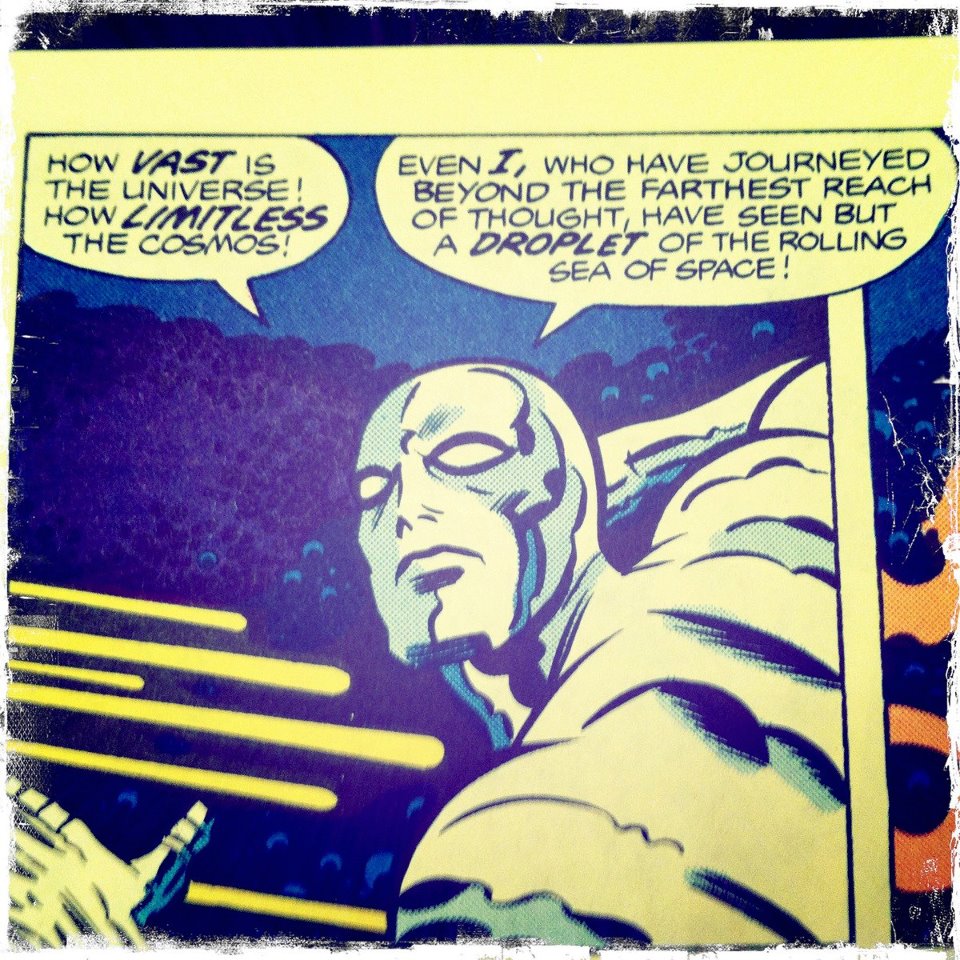
When I was around forty, having been clean and sober for almost twenty years, I found myself collecting psychedelic music again, reading Alan Watts, and grooving on the art of people like Arik Roper. I began to wonder why after so many years after having any kind of drug induced psychedelic experience I was still so drawn to the music, ideas, and images that relate to these experiences. It was a sudden realization that my psychedelic experiences had never existed in a vacuum of the drug themselves, but were in fact a product of all the cultural artifacts I surrounded myself with at the time; Silver Surfer comic books, Heavy Metal magazine, Syd Barrett albums, Carlos Castaneda, Tarot Cards. All these things mediated my experiences, gave them language and form. It was then I decided I wanted to write a book that was a hybrid of memoir and cultural history, an attempt to reconcile my drug use with the cultural forces that informed them so deeply.
In the opening of “Too Much to Dream,” you reflect on the impossibility to subdue, in the words of Aldous Huxley, “the urge to transcend self-conscious self-hood.” To ask an incredibly open-ended question (and to await an incredibly open-ended response), where do you feel this urge stems from? Can it ever be sated? How does this urge manifest itself in your life today?
This urge is is an essential quality of being human. Whether through religious ritual, intoxicants, art, or music, we have always sought transcendence in some form. It’s the irrational part of us that I believe needs attending to. It can’t be sated because I don’t believe there is any final experience or ultimate truth that we can ever really have access to. We can catch glimpses of it, shadows on the walls of the cave, as it were. There are moments when I am suddenly seized with the sense of something inexplicable, often in regards to nature, when I can intuit in the most profound way that there is something “more,” some extension of my consciousness that reaches towards transcendence. And then the only thing to do is put on some Sun Ra or Sun Araw and groove to their own inheritance of that urge.
Do you feel there is more or less of a stigma in today’s society (for lack of a more overused term) for those who have engaged in psychedelic experiences versus, say, 30 to 45 years ago? Did you have any self-consciousness or hesitation about being not only open but also nuanced about your experiences with psychedelics within the book?
I am not sure there is less stigma, but social media and the internet have widened the conversation in such a way as to reveal how many people there are that use these substances. Sites like Erowid, for example, put it out there pretty explicitly. In the past five years there has also been a huge increase in mainstream research activities involving psychedelics – John Hopkins and Harvard for example – that there is more public awareness in general. If I had any hesitation it was more about revealing how ugly things had gotten for me, and to describe my own debauchery in a public way and then go pick up my son at his school sometimes felt a little strange. But overall, I am glad to have told my story honestly. Too much of the discussion of psychedelics in the underground is about how wonderful they can be, and while this is true, there is a darker element that we should also be talking about.
Is there a sense that the conventional wisdom (again, for lack of a more overused and potentially meaningless term) on psychedelics has stagnated to a degree in a recent years? Our own observations seem to point to a largely bifurcated mindset on the topic, if discussed at all – those who are militaristically opposed to the use in all forms, and those who think it’s, like, so totally intense, dude, to get dosed and listen to Pink Floyd, without regard to any spiritual benefit? Could it be that it has always been this way in the view of society at large, and we’re just getting old ourselves?
I think many in the psychedelic drug community are trying to nuance the conversation, and there certainly is more resources for those who also want the spiritual dimension to be part of their understanding. But in some ways I think the typical stoner mindset is sometimes the most authentic. I think we often ask too much of these chemicals. I know people who use these drugs regularly and while they have profound experiences, not much happens except that they have these profound experiences over and over again. They are after some perfect awareness that will set them free, but I’m not sure that exists. For myself, any lasting spiritual experience is going to come from the long haul. Psychedelics might reveal the path, but for me they could never get me to the top of mountain.
Imagine for a moment that someone was going to drop acid and listen to Pink Floyd. What Pink Floyd album is best for such an endeavor and why? Please show your work.
Even though my own revelation happened with Dark Side of the Moon, I still think that Piper of the Gates of the Dawn is one of the most perfectly realized psychedelic albums of all time. It contains everything one is to experience on a trip: brief and mostly elusive cosmic understanding, moments of madness, surprise at the most mundane of happenings. whimsy, and if you are around cats at the time, the terrible gaze of a feline consciousness as it looks directly into your drug-addled consciousness.
In his excellent book, “Shroom: A Cultural History of the Magic Mushroom,” Andy Lechter writes the following:
“Science and anti-science have collided throughout the history of the magic mushroom. Just as the ricochets and trajectories of sub-atomic particles reveal something of how the physical universe is constructed, so, I think, do the reverberations caused by the magic mushroom expose something fundamental about our cultural universe, about the attitudes and sensibilities that shape our time. That we in the West, in the twentieth and twenty-first centuries, have found the mushroom’s litany of peculiar effects desirable is, I would suggest, symptomatic of a broader underlying craving for meaning – more specifically, for enchantment – that sits somewhat awkwardly within our supposedly rationalist, scientific and technological culture.”
Your thoughts?
Yes, I agree wholeheartedly. This is, I think, the same urge that Huxley describes; this desire for magic, for getting past the appearance of things and getting a glimpse of the numinous. Is it God? That’s one word for it. This why music and art are so essential. They give form and shape to the ineffable. Sometimes they can only describe the desire, and sometimes they can only describe the coming down, the melancholy of having not quite reached it, but that is just as important. I think a lot of current psychedelic bands are playing with this tension more and more. It’s not all beautiful fractals of machine elves and unmediated union with the divine consciousness. It’s sometimes a big bummer, a big beautiful crash that reminds us how human we are, how vulnerable, how lonely. That’s okay. We have music, art, and each other.
What’s next for Peter Bebergal?
I intend to continue to write on these themes, particularly, how esoteric and other spiritual ideas impact contemporary music. I feel really lucky to be part of the conversation, to get to talk about music and the things I love. Please stop by mysterytheater.blogspot.com for a glimpse of what I’m up to.
“Too Much to Dream: A Psychedelic American Boyhood”
Listen to Peter Bebergal on Episode 311 of “The C-Realm” podcast: Epidode 311 – “There But For Gratuitous Grace.
We’ve spent little time considering the origin or objectives of Oakland’s Owl, nor their connection to the mythological wisdom of their namesake. What we have done instead is spend time playing their weird, heavy music at mythologically high volume.

Owl is a strange bird, a description we think the band would be comfortable with, and one that is meant in strictly complimentary fashion. Theirs is a flight that takes place high, high, high in the sky, on a dual wingspan of simplicity and oddity. And each time we think a standard flight pattern of this Owl has been established, their direction changes – sometimes subtly, sometimes in a way that makes our head rotate in an almost complete circle.
Odd as Owl may be, odds are your initial head movement will not be of the semi-circular nature, but straight north-and-south. Their sound will be familiar, even comforting, to the sons and daughters of Sabbath – and perhaps even more so to the sons and daughters of the sons and daughters of Sabbath.
But it’s not just that with Owl. Appropriate to their Bay Area headquarters, the Owl flight gets even higher, as the band seems to have huffed the fumes of both the dead and the possessed that have preceded them. Indeed, the opening song on their free four-song demo, appears to quote directly from the early, teeth-rattling days of Metallica – bringing to mind “The Tibetan Book of the Dead” as soundtracked by “Kill ‘Em All.”
Uncontrolled might be one word used to describe the sound – though the last thing the knowledge of this Owl needs is to be controlled. Unhinged is closer to what we hear – a born-to-go, biblical bombast, a Sabbath-screech fueled for flight by the freaky friendship of Lilith and her owls.
All of these echoes of the past could be transmitted as pastiche if not for a particular power of Owl – one that we might grandly term with gross pretense as “passionate presence.”
The passion in this sense should be read as an emotion unable to be controlled, and the presence being the here and now of this Owl flight. The monolithic, metallic meditations of these mofo’s music worms its way up from the Glaurungian-graveyard of smashed vacuum-tubes, rising too high in the sky to offer bended-knee to the fierce riff-rituals of their forefathers and mothers, soaring with a sound sacred and profane at once.
Purely possible, of course, that we’re just easily entranced by wonton wah-wah abuse, suffering from a sort of sonic Stockholm-syndrome. Either way, that’s what we call a “win-win.” Brothers and sisters of the Apes, it’s time to fly with the Owl brotherhood.
“By contrast, the sludge-brained anomie of stoner noir is just what it looks like: the rudderless yawing of youth culture on the morning after the ‘60s. It’s the numb realization that the tide that carried in the counterculture’s utopian dreams and cries for social justice has ebbed away, leaving the windblown scum of Altamont and My Lai, the Manson murders and the Zodiac Killer. Stoner noir stares back at you with the awful emptiness of the black-hole eyes in a Smiley Face.Have a Nice Decade. As late as the mid-‘70s, the iconography of rebellion®, at least in the tract-home badlands of Southern California, was a politically lobotomized version of hippie: the bootleg records, blacklight posters, underground comix, patchouli oil, and drug paraphernalia retailed at the local head shop.
But stoner noir isn’t just the burned-out roach of ‘60s youth culture. It’s equally the toxic mental runoff of suburban sprawl: dirthead existentialism. It’s the psychological miasma that hung, like the sweetly rotten reek of Thai stick, over adolescent psyches battered by divorce, lives dead-ended in high school, torpid afternoons bubbled away in a Journey to the Bottom of the Bong. Stoner noir is the default mindset of teenage wasteland: life seen through a glass pipe, darkly.”

 Revolt of the Apes