Most of us will never make or survive a trip to the moon. Taking a trip withElectric Moon may be enough of a substitute.
And while there’s no shortage of connections in our mind between moon and music and muse and meditation and the mind-blowing and more, when it comes to the Electric Moon, we fall under a wordless spell.
Not long ago, we became convinced of the infallible truth that the end of the world would be upon us momentarily – ultimately, we realized we had simply been listening to “The Doomsday Machine” by Electric Moon for days on end. Such is the gravitational pull of the band’s music – absolutely insane, irresistible columns of marching, mountain-moving, heavily distorted soundwaves built for space exploration.
But the wordless spell meant that we invariably failed whenever attempting to describe the power and thrill of “The Doomsday Machine.” Here’s the thing: You’re either the type of person who’s in for the prospect of a musical moon mission that starts with the nineteen and a half-minute throbbing, acid-fried-amplifier-thrust that is the opening, title-track of “The Doomsday Machine,” or … you are not. Which ever side of the moon you find yourself on, we’re glad you’re here – but there’s nothing we can possibly express through words to alter your lunar positioning.
We feel comfortable declaring that the music of Electric Moon shines solely for those freaks who wanna get free, who wanna ride those soundwaves perched high atop the silver machines of their minds, sweating through silver-painted faces, prepared to put their helmets on, kneeling before the altar of the sky, and dreaming the dreams of the chosen sons and daughters of space snakes that rule the stars …
… or perhaps more comfortably, we declare Electric Moon to play awesome, concession-free kosmische rock.
Appropriate, then, to see the light of the Electric Moon shining bright among the absolutely planet-smashing line-up of “Head Music,” the latest collection from the unassailable, unstoppable mission of Fruits De Mer Records to make the wildest daydreams of every psychedelic-psyoul and kosmische-kranium come true.
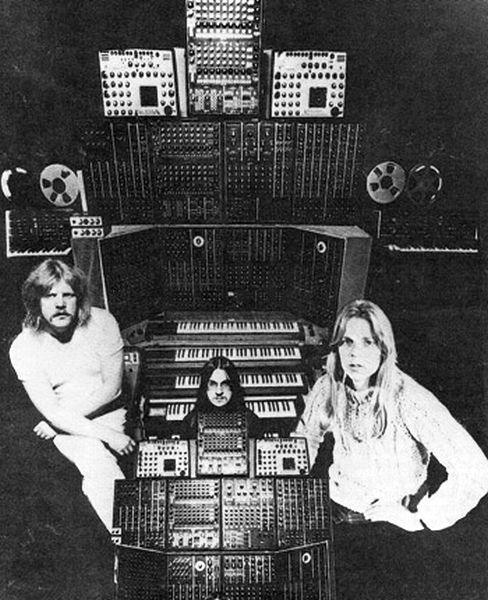
Electric Moon do their part by fulfilling that most persistent and patient of dreams, the dream of Tangerine Dream, a dream long held in high regard by these apes. Paying tribute to pioneers like Tangerine Dream can be risky business, but then fortune favors the bold – and the ears of anyone listening to the Tangerine Dream’s “Madrigal Meridian” drawn down by the Electric Moon will be fortunate ears indeed. Given the propensity of Electric Moon to ignore the calls of gravity (their 51-minute “Inferno” being the chief example) and the efforts of Tangerine Dream to prove for all that time is merely a construct of our minds (their 1972 album “Zeit” being the chief example), we were shocked to find the “Madrigal Meridian” turned in by Electric Moon on “Head Music,” at five minutes and five seconds, to be perhaps the shortest song in their growing repertoire. In this Dream state, however, we find Electric Moon more controlled and cathartic than ever before – though their moonlight no less cutting.
“Head Music” will surely continue to feed our head for many, many moons to come – the menu also featuring heavy, heroic, honorifics from Vibravoid, The Bevis Frond and fellow “Band of the Week” victim, the simian-space-soldiers that comprise Dead Sea Apes, sinking their kollective teeth into a cut from Kraftwerk.
We’ll surely have more to say about “Head Music,” the fruits of Fruits De Mer, and our love of the kosmische in the weeks and months to come. For the time being, however, we’ll remain until the spell of Electric Moon – its weightless freedom, its imaginary light and its dark mysteries.
“There is nothing you can see that is not a flower; There is nothing you can think that is not the moon … Seek not the paths of the ancients; Seek that which the ancients sought.” – Matsuo Basho
It wasn’t until the very tail-end of 2011 that we were introduced to the music of Pure X, via their excellent and appropriately-named debut album, “Pleasure.” It would be easy to think of the album name as somewhat tongue-in-cheek, given the album’s sparse art direction focused on an image of romantic masochism, picturing restraints and red roses.
Yet “Pleasure” in fact delivers just that – guitars overdriven beyond the hope of long-term hearing, their loudness belying the almost lethargic pace. The album drifts, dashes and directs itself toward the pleasure center located right between your ears.
Excited as we were to learn that Pure X would be part of Austin Psych Fest 2012, the band themselves display limited excitement in regard to the chore of answering the following “boring-ass” interview. But that’s OK – the pleasure has been all ours. Enjoy.
What do you find most pleasing – perhaps most ecstatic – about playing live music? Are there any bands or artists that you would credit with really inspiring you to move forward with making music after having seen them live? What do you dislike most about performing? About going to shows not as a performer, but an attendee?
What is “live music”? You mean playing in front of people? I like playing in front of people because it forces me to focus. It forces me to shut off my brain and really concentrate with every part of my mind and body. It forces me to get into a state beyond and outside of myself where I can channel God and the dead and the living and the souls yet to be born. A meditative place where time does not exist. A place where I am able to have contact with the true creative source – the root, the place where this world was first created and where it will go again.
Though we’ve not yet had the pleasure of seeing Pure X perform live yet ourselves, we can’t help but think that your album “Pleasure” has a very live feel. Not necessarily from the perspective of the technical side of the recording (of which we know less than nothing), but from the emotive and expressive point of view – the songs sound very natural to us, full of life and longing, and none too fussed over. Was there any expressed desire for what you wanted this album to sound like, for how you hoped it would be experienced? Or did the album come together in something more of an organic fashion?
We recorded the album live in the studio. We played most of it in a small room, really close to each other. The mics had a lot of bleed. This came about mostly out of necessity. We had no money and had to make the most of the time we had in the studio (this is still true).
The cover of the record is striking – what is the origin of that image? What does it represent to you? Is it too much to relate to the image as a sort of counterpoint to the album’s title? Can pleasure ever exist without pain? Could “Pleasure” have ever existed without pain? How important are the aesthetic decisions that one must make as a part of a band to you and to Pure X?
Death is breathing in you. It’s gnawing at your toenails. The sun keeps screaming: Wake up! Do something decent, for Christ’s sake! Turn off your computer! Go rub your face in a woman’s pussy! Jump off a train! Piss in your landlord’s ear!
How much of a pain in the ass was it to have to rename the band, even if only slightly, before releasing “Pleasure”? Could you ever be turned off to a band solely by virtue of their name? Are you bummed that Pure X are not “managed exclusively by PJT Enterprises Music & Entertainment exclusively”? Before the name change, how many people arrived at your shows hoping that you would be offering pure MDMA? Can you score us any?
Copy-writing band names is absurd and drugs should be legal. By making them illegal their price is driven through the roof and huge profits can be reaped by politicians, corporations, banks, and other scumbags “above the law.” It is also a convenient means of enslaving whole populations and making money off of their enslavement by way of the privately-owned prison system. Please use the internet while it is still “free” and learn up on this shit. Here’s one article to get you started. And here’s another one.
What music have you been listening to lately? Can you think of any bands or artists that you’ve only come to appreciate since playing with Pure X – either something someone else in the band has introduced to you or something that you have only recently grown to appreciate?
All I hear is a chorus of sorrow and absurdity careening through limitless emptiness.
Would you care to comment on the rumor (the rumor that we are attempting to start right now) that your next release will be a single-sided 10” swirled-purple vinyl picture disc, featuring covers of songs by X, King’s X and Exodus?
[Apparently, Pure X would not care to comment. Here’s a picture of our old friends Exodus and King Diamond to fill space.]
How did you first hear of Austin Psych Fest? Have you had the chance to attend previously? Are there any bands playing this year that you are particularly excited to have the chance to see?
I’m naked in my bed jerking off to my tumblr feed.
Is there a piece of artwork or creativity outside of music – a book, a film, a sculpture – that you can point to as a direct influence on the sound of Pure X? What is it about that in particular that makes it so compelling in your view?
Aldous Huxley (who once scored us some pure MDMA – true story) says the following in “After Many A Summer Dies the Swan”:
“Pleasure cannot be shared; like pain, it can only be experienced or inflicted, and when we give pleasure to our lovers or bestow charity upon the needy, we do so not to gratify the object of our benevolence, but only ourselves. For the truth is that we are kind for the same reason as we are cruel: in order that we may enhance the sense of our own power.”
Your thoughts?
I like this interview by Huxley. I never read the book your talking about though.
What’s next for Pure X?
Anything but wasting my energy on boring ass interviews.
There’s no real need to focus your vision too tightly when surrounded by Dark Fog. You won’t be able to see things with greater clarity, or make better sense of the sounds that surround – though some would say expecting, not to mention seeking, anything approaching clarity from an intense, appropriately bombastic sonic daisy-cutter called “Drug Portal: Heavy Dilemma” would be a fool’s errand.
Color us foggy-fools, then. We’ve long believed in the possibility of obtaining clarity – or something as near as our ape brain can tell – through song. Songs created out of heavy dilemmas. Songs created out of devotion. Songs created out of exploration, medication and amplification. Songs created underneath the neon and inside the Dark Fog.
Knock and ye shall find, and knocking upon the door of this portal finds us happily foggy-brained.
Consider the sci-fi swagger offered on “Flash,” ooo’s-and-ahh’s aplenty set atop a sound that swings like a sick, psychic, souped-up pendulum, the guitar attack built upon portal-only pedals pegging the “Ming the Merciless“-knob to ten, apparently.
Or so it would seem. We may have had our eyes closed while having our mind blown (appropriate when considering the band’s Chicago locale). We can’t imagine enjoying the fourteen and a half minutes of “Drug Portal” centerpiece “Sky Opening 1000 Times/Slowburn” any other way.
We cannot and will not make a medicinal recommendation* to accompany your journey through the “Drug Portal” – the “Heavy Dilemma,” not unlike the album cover itself, can be a frightening affair. But we highly recommend the benefits of taking the time to turn off your mind, relax and float through the fog.
“Like the savage, let us look at the leaf wet or shining with sun, or white with fear of the storm, or silvery in the fog, or listless in too great heat, or falling in autumn, dying, reborn each year anew. Learn from the leaf: simplicity. In spite of all we know about the leaf: its nerve structure phyllome cellular papilla parenchyma stomata venation. Keep a human relation — leaf, man, woman, child. In tenderness. No matter how immense the world, how elaborate, how contradictory, there is always man, woman, child, and the leaf. Humanity makes everything warm and simple. Humanity…” ― Anaïs Nin, “Children Of The Albatross“
* We will, however, dissuade any and all from choosing to follow our lead and imbibe the drink below when surrounded by Dark Fog.
If the initial meeting between the two principle members of The UFO Club lacks the drama of an alien invasion, their music is only that much stronger for it. Indeed, if the UFO Club felt confident that their collaboration would be a fulfilling one (and as described in the interview below, they did), that same confidence was found in the listeners who awaited entrance into this Club.
That confidence stems, of course, from the knowledge that The UFO Club is a collaboration between Lee Blackwell – he of the mighty, mighty Night Beats – and Christian Bland, recently of Christian Bland and The Revelators, along with some other band we keep meaning to check out (a band obsessed with fishing, apparently? The Black Anglers?).
When that first identifiable object from The UFO Club was released in the form of a split 10” LP with The Night Beats, surprised faces may have been few, but smiling ones were no doubt countless. The songs of The UFO Club activate their wonder-twin powers to resist the dour pull of gravity, floating care-free in the weightless atmosphere of rock and roll, switchblade-sharp and far-out fun.
In advance of the release of their full-length debut album and a rare appearance in human form at Austin Psych Fest 2012, Lee and Christian were kind enough to give us a look around their private club. Enjoy.
Would each of you take a moment to describe when and where you first met? Was it immediately obvious to you that there was a musical kinship, or did even the possibility of such a relationship take time to develop? What is something you assumed to be true of the other when you first met, but have learned is in fact not true? And vice versa – what is something you assumed to not be true of the other, but have learned is in fact true?
LEE: We met when we played together at a house show together in Austin during SXSW. I really enjoyed his music and wanted to hear his solo stuff live. It was pretty instant. I didn’t make many assumptions, aside from what I could gather through his music, as in I wanted to see for myself. One’s music usually says a lot about a person.
CHRISTIAN: We invited The Night Beats to play at Austin Psych Fest 3, so that’s where we first met. Lee came up to me at the festival and asked me if I wanted to record together, and The UFO Club was born. I had no preconceived notions of Lee, except that I was sure he was into the same music I was, given the sound of The Night Beats.
We’re familiar with The UFO Club as a legendary London club at the time of the emerging psychedelic scene in the 1960s – was this your inspiration for the name? What does the name represent to you aside from merely being a reference to the past? If you could go back in time to see any one of the following – Soft Machine, The Crazy World of Arthur Brown, or The Incredible String Band – play the original UFO club in 1967, which one would you choose and why?
LEE: Arthur Brown.
The club was the primary inspiration, but also I’m a believer, so me and Christian have that curiosity in common, other worlds and levels of reality. Something like that.
CHRISTIAN: Yeah, it was definitely the inspiration. I’m pretty obsessed with Syd Barrett, so I’d wanna see The Pink Floyd. The name has a double meaning. I’ve always been into unidentified flying objects and unsolved mysteries.
Is there one particular club that you did actually visit with frequency in your adolescent or post-adolescent years that you hold in your mind as being one that really helped to develop your sense not only of music, but also of belonging to a musical community? Or perhaps one that reminded you that you have no interest in being a part of certain musical communities? What was it about this club that makes it notable in your mind?
LEE: Chess club – there were no musicians and I liked it. Me and some friends founded a club in high school called “Brothers in Soul,” where we just met up, got high and jammed. We got it to be school sponsored, too – hah. I wasn’t really into taking classes about music or guitar. I much rather preferred spending time listening to music and spending time on my own.
CHRISTIAN: No. I never went to clubs as a kid. I lived in the suburbs outside of Houston. I did all my music listening in my room.
We’ve written previously about comedian Marc Maron, who in his 2001 memoir, “The Jerusalem Syndrome, “ mentions a melon-baller once owned by his grandmother and describes it this way: “I use it in the summer as a device to go back in time.” To what degree do you personally use music as a device to go back in time? What are the pleasures you get from this? What are the dangers?
LEE: I only time travel in my sleep. However, music transcends and looses the sense of time for me. There are no dangers.
CHRISTIAN: I use music to time travel forwards and backwards. I think the 50’s and 60’s was the golden era for rock ‘n roll and I’d like to bring that back to the forefront. To me, that’s not really “vintage” rock ‘n roll. Given the time humans have been on earth, it’s only 50-plus years ago – that’s nothing in the span of human existence. It’s the best music and it needs to be preserved and pushed into the future and expanded upon.
Would you care to comment on the rumor (the rumor that we are attempting to start right now) that both of you are planning to take a break from performing at the upcoming Austin Psych Fest 5, instead choosing to spend your time as food vendors, shilling the “UFO Club Sandwich”? In addition to the traditional turkey, lettuce, tomato and bacon, is it true that the UFO Club Sandwich also contains mushrooms?
LEE: It’s true.
CHRISTIAN: Yes and yes is no.
What are your plans for a follow-up to the split 10” EP with The Night Beats? How, if at all, do you anticipate your next recording will differ from the EP? What is the process – to the extent that there is one – when it comes to writing and recording with geographically separate home bases?
LEE: The UFO Club full length is out early 2012. There is no process. We don’t want one.
CHRISTIAN: The new UFO Club full length will be out in mid April. So it’ll be available at this year’s Austin Psych Fest. The process is just to play together and take the best stuff that comes from it. The album has been done for awhile, with the exception of a few overdubs, so it’s been a long time coming.
Where did the idea to cover the Ronettes’ classic “Be My Baby” originate from? What makes the work of Phil Spector so compelling even today, aside from his apparent and longstanding lunacy? If you could duet with Ronnie Spector on one number for the next UFO Club album, what song would you choose and why?
LEE: Christian does a great cover of it, so I threw out the idea to both work on a recording and put it on the record. Ronnie does a great version of “There Is An End” – that would be fun. “Mashed Potato Time” would be hilarious, too.
CHRISTIAN: I love The Ronettes and Phil Spector, so I wanted to cover “Be My Baby.” The Wall of Sound is indestructible. I’m not sure about a duet for the next album – no tunes have been written yet. This may be the last time. You’ll understand when the album comes out.
What music have you been listening to lately? If push comes to shove, what is your favorite song by The Sonics and why?
LEE: Soul music, early punk … Lantern from Philly and Cosmonauts from Cali are two great young bands I’ve been diggin’. And I guess a lot of this new project I’m working on with my friend Curtis Harding – he’s got unreal talent.
Sonics-wise, my favorites are probably “The Hustler” or “Shot Down.”
CHRISTIAN: Lots of Zombies and Beach Boys. Favorite Sonics song – “Strychnine.” It’s got hard lyrics. I’d want that guy on my side.
In the June 1975 issue of “Crawdaddy” magazine, legendary author William Burroughs had the following to say about a conversation with legendary not-an-author Jimmy Page, when their talk touched on the subject of Aliester Crowley:
“Jimmy said that Crowley has been maligned as a black magician, whereas magic is neither white nor black, good nor bad – it is simply alive with what it is: the real thing, what people really feel and want and are. I pointed out that this ‘either/or’ straitjacket had been imposed by Christianity when all magic became black magic; that scientists took over from the Church, and Western man has been stifled in a non-magical universe known as ‘the way things are.’ Rock music can be seen as one attempt to break out of this dead soulless universe and reassert the universe of magic.”
Your thoughts?
LEE: William thinks magic is the real thing? What people feel and want and are? I’d have to talk to him personally to understand his view on that. But the idea that rock music can be a way to break out from a mold, I do believe in. Just like any form of expression or art. Rock music is maybe more deliberate.
CHRISTIAN: I don’t think there’s black or white, just gray. What’s right or wrong is relative. Just treat others how you’d want to be treated in return.
I believe there’s good and evil. Black magic deals with casting evil upon someone and white magic is done for the good of man, from what I understand. I don’t practice magic – I just play music. I agree with his last statement.
Revolt of the Apes is pleased to offer you the following sampling of songs – nearly two hours worth – in conjunction with the Reverberation Appreciation Society. Stream below or download the full collection via .zip file at the link below. But no matter what … enjoy!
FEATURING: CHRISTIAN BLAND AND THE REVELATORS – THE GROWLERS – ROYAL BATHS – COLD SHOWERS – WET HAIR – BAD WEATHER CALIFORNIA – THE DIAMOND CENTER – SLEEPY SUN – ALLAH-LA’S – INDIAN JEWELRY – APACHE DROPOUT – THE NIGHT BEATS – WHITE FENCE – CRYSTAL ANTLERS – CROCODILES – ELECTRIC FLOWER – COSMONAUTS – FEEDING PEOPLE – FAR-OUT FANGTOOTH – QUILT – MIKAL CRONIN – ELEPHANT STONES – AMEN DUNES – PRINCE RAMA – PSYCHIC ILLS – SUN ARAW WOODSMAN – PURLING HISS – LUMERIANS – MIDDAY VEIL – THE BLACK RYDER!!!!!!!!!!!!!!!!!!
Austin Psych Fest and Sailor Jerry present: LEVITATION – March 15th at Spiderhouse / 29th St Ballroom … FREE TACOS AND BEER STARTING AT 12:30 TIL IT’S GONE! AUSTIN PSYCH FEST TICKET GIVEAWAY (RAFFLE AT 2PM)!
We declare our top-three favorite living guitarists to be as follows …
Number Three: Angus Young
Number Two: Malcolm Young
Number One: Gregg Foreman
If that’s not our truth, it’s pretty damn close (with apologies to the unending list of guitar gods, new and old, who make this a difficult list due to their refusal to die). And it’s pretty damn close because lists are personal, singular and unique – in such a way that we really don’t mind having a personal, singular and unique guitarist at the top of ours.
To give a biography of the life and work of Gregg Foreman would certainly be difficult and probably be pointless. As the current collaborator of choice for bands like Pink Mountaintops, The Meek, The Silver Chords, The Black Ryder and now The Silver Chords, it seems we’re not the only one with Gregg atop our fantasy guitarist wishlist.
Further back in history, Gregg was the singer and guitarist for a band that people called The Delta 72, a band that some people now call legendary. Certainly, they were legendary among our small circle of college friends, with word of their incendiary live performances in the nation’s capital making its way down to our tiny corner of Virginia, alongside the Delta 72 demos and seven-inch’s and soundboard tapes and eventual albums that also filled our ears.
I had one chance to go and see The Delta 72 live back in 1996 but I skipped that chance for a girl. Instead of letting the The Delta 72 take flight with my rock and roll dreams, I blew off their show to go to a party where I was told that a girl I really, really liked might be.
Sixteen years later, I’ve been married to that same girl for twelve years, and the legend of Gregg Foreman continues on, playing guitar and taking flight to those rock and roll dreams.
Austin Psych Fest 2011 gave us the opportunity to connect with Gregg Foremann after 16 years from afar – Austin Psych Fest 2012 will give our ears the opportunity to do the same at a much shorter interval, when he joins Pink Mountaintops on stage and probably your band, too. In advance of that appearance, we were fortunate to have Gregg answer a few questions about his life and music. Enjoy.
Who were the artists that early on stoked your interest in music in general? Can you recall what the first album you bought with your own money was? What do you think of that album today? Did you come from a musical family? How do you think that influenced your musical development?
To be honest, the first records I purchased were “Damaged” by Black Flag and Public Image – “First Issue.” Both records are still super important to me. My family were not super players of music but they loved the sound of the Stones and Motown, Morricone etc. Last year, I got to play music with Greg Ginn from Black Flag and it was inspiring for certain!
More specifically, when did you first pick up a guitar? Did you spend any time strumming a tennis racket or – like Hendrix – a broom before procuring a guitar of your own? What were the specific songs or riffs that made you determined to learn how to manipulate a guitar? Who are the guitarists that continue to impress or inspire you?
The guitar was around age twelve. I was listening to the Stones and The Clash, so I suppose Keith Richards, Mick Jones/Joe Strummer were the main inspirations. Well, while growing up I loved the playing of Robert Smith (The Cure), Pat Place (Contortions), Greg Ginn (Black Flag), John Valentine Carruthers (Siouxsie and The Banshees), The Reids from The Jesus and Mary Chain, Andy Gill (Gang of Four), Kevin Shields (My Bloody Valentine) … the main two, though, seem to be Steve Cropper (Booker T and The MG’s) and Rowland S. Howard … Rowland is a true outsider!
Do you recall the first time you took to a legitimate stage – be it in a bar, a gymnasium, or a dump like the Safari Club – as part of a band? What are your memories of that experience? What did you learn about being in a band early on that helped you the most, or made the greatest impact on you, during the following years of playing and performing?
HA – One of the first shows I played was in an all-synth group modeled after Mute Records’ bands and things like Fad Gadget and Kraftwerk. Played the school talent show – the sporty fellas wanted to fight us, but their girl friends seemed to like us!
What attracted you to the music of The Meek initially? What has been most surprising to you about how your relationship – musically or socially, or both – has evolved over time? We you initially terrified by the idea of collaborating with a group of musicians who are quite obviously deranged, psychotic and allergic to any t-shirt containing a color aside from black?
HA-hah! These are very good and humorous things you inquire. The Meek were loud and reverb-distorted, but I have to say I love Amy Lee and Aly, so when they inquired … (the same night, I was asked to maybe jam with a few other bands – one was The Black Ryder, who I now play for sometimes) …
How do you think collaborating with so many different musicians over the years has impacted your personality? Are skills like patience and diplomacy necessarily any more important in the life of a musician than in any other role? Do you feel you are more or less jaded about music – or more specifically, whatever passes as “music business” – than you were at, say, age twenty?
Well, for example, playing with The Meek is more refined in a set key, where as with Cat Power, it took me awhile to get that dynamic. It’s such a treasure to “get” to be involved with great musicians. That music business stuff and personal politics are not interesting to me. I never aspired to do major label music and still have no interest.
My favorite artists are outsiders like Suicide, the Velvets and Sun Ra and stuff of this nature … never thought I wanted to write pop songs. Well, unless “96 Tears” is a pop song …
Where did your connection with Pink Mountaintops begin? Do you think of your duty when playing with a songwriter as singular as Stephen McBean as to fulfill his vision, augment his vision with your own perspective, some combination of both or none of the above? Please show your work.
You are funny, Muldoon, which is why I enjoy you! Last year at Austin Psych Fest, I met Steve and we talked about playing. We bonded on stuff like hardcore and The Swell Maps and Roky! For the sound, I say I augment his vision with my own perspective + some combination of both … show your work, haha.
Would you care to comment on the rumor (the rumor that we are attempting to start right now) that you will spend your time at Austin Psych Fest this year not only performing with Pink Mountaintops and The Meek, but also opening your own clothing stand in the vendor area, filled with mod scarves, boots and jackets, to be called “Gregg’s For Men”?
Hahahahahahaha … no comment, but I do make crystal jewelry for promoting good energy!
What music have you been listening to lately? If push comes to shove, what’s your favorite AC/DC song of all time?
Man, I listen to a lot of psych and soul … Sharon (Shazzula) turned me on to The Master Musicians of Bukkake …? Pretty cool! Things like Rowland S. Howard’s last record! Lots of soul, always! Maybe Alan Vega and The Swell Maps. My fav AC/DC song would be “Live Wire.”
George Bernard Shaw – who I believe was once your bandmate in The Delta 72 – once said the following:
“I think I should have no other mortal wants if I could always have plenty of music. It seems to infuse strength into my limbs and ideas into my brain. Life seems to go on without effort when I am filled with music.”
Hmmmmm … Yes, George was on “The R and B of Membership.” He was right and the famous Norse poet Rolke said, “Music is the wind beneath my wings,” or “that’s what she said,” etc.
What’s next for Gregg Foreman?
Well, Cat Power just got back from a tour, going to play some with The Black Ryder and Sasha from Spindrift ‘s new band, The Silver Chords … then Pink Mountaintops is off to Australia with Dead Meadow … then The Meek and Pink Mountaintops play Austin Psych Fest 2012!
As long as The Saint James Society continues to preach their gospel, we can’t imagine being anti-social.
There’s something unnerving about the approach of this Texas-based band and the hexes they land – something unnerving about the way their debut EP staggers forward so immediately, so confidently, so jarringly jittery and jubilant.
Their’s is the sound of bad, bad, black juju on the approach. The EP begins with what we hear as the ominous sound of boots crossing a wooden floor immediately giving way to the beat, the beat, the beat. The beat! The beat is constant and crushing, allowing the band the space to gather and plant the seeds of the future Society.
Given the relative brevity of the EP, The Saint James Society’s sonic scripture is staggeringly well-defined and varied, as graceful as it is gargantuan. Sounding almost effortlessly intertwined around the aforementioned beat – the bewitching, bewildered vocals, the spiderweb-sticky bass, the guitars as efficient and deadly as a paid assassin – it’s as if the band had been waiting their entire lives to find their freaky, creepy and crafty tribe, and sing the songs of the Saint James‘ society. We were immediately drawn to these songs – these 21st century sick-southern dancing-death cult ditties sung by the light of the magical moon – not only for the echoes of the past that they contain, but for the way those echoes transform into a Society that is new, a Society that is now.
Forgiveness granted, then, if the EP’s four songs cause you to immediately peg this Society as being less warm and welcoming and more of a psychically-wartorn warning. Opening incantation “Reflections” holds a mirror up to our old friend, the cosmic void – placing the band and those listening “inside a sea that swells and twists and turns and warps our reflection,” Society singer Brandon Burkhart sounding at once joyful, disgusted and relieved by the predicament.
So Saint James sings and sins and snake-dances through the cresting tide of said void, all doom and gloom, demons and danger, menace and magick, alpha and omega, rock and roll. Save your prayers and sustain your spirit – Society rules.
“The greatest benefactor to society is not he who serves it by single acts, but whose general character is the manifestation of a higher life and spirit than pervades the mass.” – William E. Channing
When listening to the outstanding 2010 album by The Cush – entitled “Beneath the Leaves” – we admit to being at least momentarily overwhelmed by thoughts on the nature of relationship.
We say this not to isolate the relationship between the band’s musical and emotional center of Burette and Gabrielle Douglas, married though they are, and the fascination we have with those who make music from inside the dome of domestic partnership. Yet it’s dangerous – and ultimately not fulfilling – to focus exclusively or largely on the influence of interpersonal relationship dynamics on the music we love so much. If we did, this site would immediately be renamed “Revolt of The Wolf King of L.A.”
Rather, the relationships we consider when considering the considerably conspicuous content of “Beneath the Leaves” are those dualities which lie beneath the leaves that fall atop the lives we all lead – light and dark, love and desire, smiles and sadness. The Cush demonstrate that rare ability to capture both in their music – a place where fairly folky tendencies fall in with fuzzy ferocity.
In advance of their appearance at Austin Psych Fest 2012, both Burette and Gabby were kind enough to take our relationship to the next level, via the answering of our ridiculous questions below. Enjoy.
How do you feel the environment of your youth – either the physical locale or the emotional atmosphere – influences the music that you make today? Did you find yourself interested in making music at a young age? Was that interest encouraged? Discouraged?
BURETTE: Well, my parents were definitely music fans, my earliest musical memories are of riding in the car and listening to the radio, or looking at the covers on their 8-track tapes. The ones I remember were CCR, J.J. Cale, T. Rex, Rolling Stones. It wasn’t until I was in high school that I started to play the guitar and understand how music was actually made. My grandparents were musical, so it was encouraged, but also just sort of natural, like it just runs in the family. I always liked the deep tracks on albums – that probably had as much of an impact as anything, knowing at a young age that the hits weren’t necessarily the best songs.
GABBY: My family loves music and there are quite a few musicians/singers in the family. I remember making up songs and singing them out at a very young age. My siblings use to lovingly tease me about my so called songs. My father and sister played piano, they were taught classical music. I would sit down at the piano and play without really knowing how to play, but I would play anyway and make up a song. It felt natural and I was drawn to it. Being the youngest of four, I was exposed to all kinds of music through my parents and siblings. I mostly remember Queen, Rolling Stones, Led Zeppelin, Pink Floyd, John Denver, Willie Nelson, Neil Diamond. My interest in music was mostly encouraged. I began to more seriously play music and bass at age twenty.
What were your experiences playing live music prior to The Cush, not only with Buck Jones but with other projects as well, and how did those experiences contribute to the beginning stages of creating music as The Cush? How do those experiences contribute to your point of view currently?
BURETTE : I grew up in a really small town. There weren’t really any bands that I know of. I had an acoustic guitar that I would run through an old amp and my best friend scrounged up a drum set from somewhere. We wrote a handful of joke-ish songs and would play at beer parties or whatever. Eventually we met a bass player from Fort Worth, played a couple of gigs in Fort Worth and he quit. About a year or so later, I met Gabby through some mutual friends. She played bass, wanted to start a band, and was looking for a guitar player. I had always been more into the acoustic guitar, but I really wanted to be in a band with her, so I started working on my electric. That was the start of Buck Jones, which over the course of the next six or seven years, is where I learned all my lessons about playing gigs, making albums, touring, etc. Buck Jones burned out in 1999. Gabby and I eventually started writing and recording together what became the first album for The Cush. It was nice staring over fresh after all we’d done in the past and making music with no expectations. I think that the one thing that I’ve kept from all that time is to write music that I want to hear – not to pigeon hole myself musically or image wise.
GABBY: Buck Jones was my first band to play live and I remember those first shows feeling a combination of feeling so shy, nervous and wanting to rock out! I still get those feelings!!! I played some music with mutual friends before Buck Jones, but everyone was going in different directions with college and all, so it took over a year before I found friends that wanted to commit more time to a band, like I did. I had seen Burette perform with his band he mentioned, and I liked his attitude on stage and off stage. I didn’t know him at the time but we had mutual friends. I had played music a couple of times with the drummer from their band, and when he told me that Burette was looking for a band, I was psyched! Being a part of Buck Jones taught me so much about writing good songs, recording, playing live and the business part of the music biz. So, when we broke up, I applied what I had learned to The Cush, but allowed myself more freedom on all aspects. A few of the things I learned very well: stay true to yourself, to what you choose to create and the songs you hear in your mind.
Is there a musical component that goes along with changing your immediate environment from one area to another – meaning, do you feel the music you’ve made as The Cush living in Vermont differs significantly from that made in Texas? Do you feel those differences are too personal or perhaps just too subtle for most listeners to recognize?
BURETTE : Well, the sense of perspective that you acquire from being so far away from all you’ve known can be inspiring. As well as homesickness. I still have those feelings now that I’m back in TX – they’re just reversed now. Some of those songs are just now coming to me. Since the beginning, our band (other than Gabby and I) has been in constant flux. We’ve performed as a 5 piece, a 3 piece and a duo. Sometimes with keyboard, sometimes not. Different players bring out different things. Audiences in TX expect to be rocked when they go to a show – that definitely influences our set lists, whereas the Northeast has a lot of smaller, intimate rooms where the mellow songs come across beautifully.
GABBY: I’ve been told by close friends and family that it seems to them that I adapt to change very quickly. Once I was told that, I saw myself from another perspective and could see that … perhaps I do, if I’m comparing myself … With that said, in most ways living in another place most definitely affects my experience in life. What I’m going through, the stories all around me, how I feel about it. But in another way, life is life, no matter where you go, there are ups and downs, just part of it … there is always that reality. To be brief here on lessons learned: Vermont taught me to be more expansive creatively, step out of my shell and refine that creative energy. Texas taught me to stand strong, when the storm is blowing in your face at stinging/flatland speeds, not to mention it’s damn hot! I was born and raised in Texas, so my roots are here, but I now have roots in Vermont as well. The heartfelt “good-byes” from one place to another is always an inspiration for a song. Listeners of music will take from what songwriters write and apply it to their own experiences. I find it lovely that we get to be a part of their experience and they ours.
What are the challenges of playing together in a band with your spouse? What are the benefits? Was there ever a hesitation on either of your behalves to create music together? Do you feel you have learned things by playing music together over the years that make you a better spouse? Do you feel you have learned things over the course of your marriage that have made you a better musician?
BURETTE: I never really thought twice about it. I thought it was just a plus that my wife was a musician. Traveling together is great. Writing songs can be tough. We used to have a lot of head-butting, and still do from time to time, but I’m sure most songwriting collaborations do. I always think my idea is the best one, which isn’t always the case. Just learning constructive ways to communicate is the best thing musically in a marriage. The hardest part is that when we tour, no one is at home working and paying the rent. And sharing all the experiences is cool when it’s good times. But when things get tough, or you have a hard gig, or get discouraged … that can be hard because it’s doubled.
GABBY: No matter what you are doing with your time, your life, it’s about how you go about it. The challenges I feel are the same challenges that all long term relationships or marriages are faced with. We just have a mix to it that we create and play music with one another. Many relationships create children with one another. Our music is like our child, in an abstract way.
The benefits: We get to do this and be together! We both understand the need to write/play music. It’s all so exciting at times and it can be totally draining at times. Playing music with one another feels natural and I’m totally drawn to Burette’s music. I want to contribute to his ideas, and I feel it is an honor to write and play music with him. I believe he is one of the best songwriters I have ever heard. When things get tough, it’s part of life … nobody escapes this. For me, I choose to be as positive and focused and creative as I can, because I understand that every action has a reaction, and I want to make the best of it all!
What music have you been listening to lately? If push comes to shove, who are your favorite musical spouses of all time?
BURETTE: This week has been, Gillian Welch, Flaming Lips’ “Embryonic,” Neil Young (always), Sonic Youth (“Murray Street” through “Rather Ripped”). Musical spouses? It used to be Kim and Thurston
GABBY: This week is PJ Harvey v (“Let England Shake”), Sub Oslo (“Dubs in the Key of Life”), Ryan Power (“Is It Happening?”), Sad Day For Puppets (“Pale Silver and Shiny Gold”), Willie Nelson (“Stardust”), Fleet Foxes … Musical spouses … after given it some thought … I feel the same as Burette.
One of the many things that we’ve found easy to love about your album “Between the Leaves” is – for lack of a better description – its penchant for balance, meaning songs like “Telepathic Headdress” and “The Deer and The Owl” can (and have) sound-tracked sunny and rainy days alike. Is there a conscious effort on your behalf to make music with this balanced approach, or is it something that you see occurring organically? Would it be possible to deem a song “to happy” for The Cush, or perhaps “too heavy” for The Cush?
BURETTE: I just try to make the album that I would like to hear each time. I try not analyze it too much. We like to make albums that make sense from beginning to end, so there have been some things that we have that haven’t seemed to fit.
But you never know, they may fit in somewhere down the road. We may make a “happy” album someday.
GABBY: I think it is an organic thing that we strive to find balance in our music. Sometimes this is easier than other times … everyday is different, every song iS a different experience writing and recording it, so it’s always an interesting!
“Too happy” … I don’t know … The Aliens did an outstanding job of writing and recording “The Happy Song,” on “Astronomy for Dogs.” That song totally makes me happy! It makes me laugh, I want to dance and sing out, not take life to seriously. Totally works! I’d love it if we could write a happy song that had the same affect on people!
Would you care to comment on the rumor (the rumor that we are attempting to start right now) that you are making plans to forgo music making altogether in 2012 and focus your efforts on opening a new, freak-friendly bed and breakfast called, “The Cush Inn”?
BURETTE: It’s all true. We’re just going to run the B-and-B and live off all the royalties from all of our hit singles.
GABBY: We’ll host music and art festivals, with the best festivities, and we’ll all have a grand time at The Cush Inn!!!
How did you first become aware of Austin Psych Fest? Are there any bands in particular that you are excited to have the opportunity to see perform?
BURETTE: Well, being aware of The Black Angels, we were aware of Austin Psych Fest. It seems to be getting more popular every year. It’s much more important for us than something like SXSW because the people who go to it are into our kind of music already. There’s a lot of bands that I know by name only, so I ‘m excited to see a lot of them. I want to see The Telescopes, Moon Duo, Wooden Shjips and BJM.
GABBY: The Black Angels music and then hearing about them putting on this festival. Many bands that we’ve played with over the years have played Austin Psych Fest in the past. We’ve heard so many great things and we’re really excited to be a part of it. I’m so looking forward to it all!
We’ve returned more than once to an intriguing book by Lewis Hyde entitled “Trickster Makes The World,” in which Mr. Hyde (with no assistance from Dr. Jekyll) contends the following:
“The mind articulates newly where there is true coincidence, where roads parallel and roads contrary suddenly converge. The world is suffused with time and space, and therefore fresh speech is always appearing, always being invented. The world is teeming, so mind is teeming, so speech is teeming. There is no end to contingency, and so no end to language. We poeticize as transients.”
Your thoughts? Does your music benefit from a transient impulse?
BURETTE: If I understand the question and quotation correctly, I would say yes.
GABBY: Yes. Living in the moment, absorbing as much as possible and being in an open place to write it into a song that convey the feeling that we are trying to express in words.
What’s next for The Cush?
BURETTE: We have a few dates in spring with The Telescopes. We’d like to release a new album this year. And would love to do another UK/European tour if possible.
GABBY: Many new songs to choose from and work on for our next album. More new song ideas that I’m looking forward to working out. Very excited to be playing with The Telescopes in April and APF2012! Another UK/European tour, I’m ready!
Truth be told, we were absolutely wrong about Acid Baby Jesus. When first introduced to the band via their impossible-not-to love self-titled album, we imagined a band of garage-and-surf obsessed nutbars diving headlong into the deep end of the pool of fearless, free and fun catchy rock numbers that have kept our toes tapping and our brain melting since Davie Allen first freaked the fuzz out.
Maybe we were half-right at best. What we were clearly wrong about was our failure to connect the band’s music – youthful, chaotic, mesmerizing – to its land and culture of origin. This failure largely stemmed from the sad fact that our knowledge of modern Greece is largely defined by the great local deli where we sometimes buy a Gyro. It hasn’t taken much effort to learn a bit more than we knew before.
And when we see members of the band wearing t-shirts referencing the same mysteries we wondered about in our own long-passed youth, we know that Acid Baby Jesus may be Greek in origin, but truly universal in appeal. It was right in front of our ears the whole time:
“I’ve got to pay the rent.
My money’s always spent
And I am deep in debt.”
– Acid Baby Jesus, “Tooth to Toe”
If you can’t relate to that, we’d like to welcome the grandchildren of Aristotle Onassis to our humble little website. For the rest, let’s enjoy the following interview with Acid Baby Jesus singer Noda, in advance of the band’s appearance at Austin Psych Fest 2012. Enjoy.
The music of Acid Baby Jesus appeals greatly to us for a number reasons, not least of which because of the band’s use of some themes and sounds commonly associated with “surf” rock – an always under-appreciated art. What is it about surf music that appeals to Acid Baby Jesus? What was your first introduction to this sound? What do you think Jimi Hendrix meant when he said, “… And you will never hear surf music again” in the song “Third Stone from the Sun”?
We get that a lot, but to be honest, I’m not too familiar with the surf rock genre. I have noticed that surf rock has a lot of common scales as old Greek and Eastern music that we really like, I think that’s where we are coming from. Take Dick Dale’s “Misirlou,” for example – it’s based on the old Greek Rebetiko song. I guess if you translate that with a guitar and a Fender Twin amp you will get that result. Recently I heard some black metal being turned into surf music – I think a band called The Burzums! I guess you can turn any genre into surf music. Also, our guitar player Otto is a surfer so I guess he puts the “surf” in our music. I think Jimi meant, “You can’t surf in space.”
How do you think your upbringing in Greece impacted your interest in music in general? What are the first musical memories you have that you still reflect on today?
I guess growing up in Greece subconsciously influenced our interest in music, even though my first musical memory is me watching MTV on my parent’s bed … that, or my father playing a Rolling Stones record.
Once upon a time, many years ago, in a galaxy far, far away, we used to be in contact with quite a lot of bands from Greece that also referred to Jesus in either their name, music or image – bands like Rotting Christ, Varathon, and Necromantia, among others. What is it about Greece that inspires such a history of extreme, sometimes unpleasant music? Or are we simply mostly ignorant of the music scene in Greece?
I don’t think that references to religious icons and extreme music are Greek exclusives, but Greek history has lots of ups and downs and centuries of oppression, so I guess this translates in the music. In traditional Greek music, like Rebetiko, the lyrics are usually very dark, even more so than metal bands like the ones you mention. Or maybe Greeks drink too much … who knows?
Noting that we once used the postal system to contact these ancient bands from Greece, it might be fair to describe us as an “old fart” – which coincidentally is the name of a song on your self-titled album. What can you tell us about the origin of this song? Is it actually about me, or some other old fart?
No, it’s not about you. It was some old guy on the bus to work. He was filled with hate and that made me sad. We have nothing against the elderly – just the mean and miserable ones.
What is the most extreme reaction to the name Acid Baby Jesus that you have experienced? Have you ever had any difficulty booking shows because of the name? What does the name represent to you?
Haven’t had any really extreme reactions … actually, a taxi driver told me I’m very smart to have named my band like that because that way I can have both Christian rockers and hippies liking us. He didn’t mention babies. I think a lot of Christians hate our name. I always have difficulty explaining it to members of my family even though they are not really religious anyway.
What is your favorite type of show to play with Acid Baby Jesus? What components do you feel are necessary for a really memorable live performance? What are some of the best shows that you’ve ever experienced at home? What are some of the best shows you’ve had the opportunity to see in the U.S.?
Favorite type of show to play is when the crowd is up for having a good time. The more they are into it, the more we are into it, too. I also have to say I really don’t enjoy shows with only five people in the audience because more people create more energy. I like the shows that you get sucked in and you can’t remember exactly what happened except a general feeling.
I loved seeing Hell Shovel perform every night … never got even remotely bored of them.
What music have you been listening to lately? If you had to choose, what is your favorite album by The Cramps?
Have been listening to a lot of Velvet Underground, Angus Maclise, Waylon Jennings, Neil Young and Bruce Haack.
I would have to choose: “Songs the Lord Taught Us.”
How did you first hear about Austin Psych Fest? Are there any bands in particular that you are hoping to be able to see while there?
I had seen some clips of bands playing the festival on YouTube and then we got asked to play and I learned more about it … looks like a lot of fun. I’m really excited to see most of the bands. The line-up is pretty amazing – we’re glad to join.
Robert Anton Wilson is quoted as having said the following:
“Imagine gigabytes of information entering your brain not in two years, but in two nanoseconds, and radiating not just from this page but from the fruit on the table, the wall paint, the pencil, the cars passing in the street and the furthest stars. That’s why LSD has altered the world for so many of us in the last 60 years.”
Your thoughts?
As we live in concrete cities, we have to find ways to re-connect with our ancient selves and nature as humans. LSD could be a way of doing that, but too much psycho-psychology combined with a lot of LSD can definitely lead to ego destruction. We have done our fair share but we are not advocates of the drug as our name could imply.
Robert Anton Wilson has also said that yoga causes brain damage.
What’s next for Acid Baby Jesus?
We’re going for three shows to Israel and visiting Palestine, then recording our new album and in April touring in North America and Puerto Rico!





 Revolt of the Apes