GEIST AND THE SACRED ENSEMBLE

10 Jun

GEIST AND THE SACRED ENSEMBLE

“Dirt from Geist Hands as He Walks From the Grave”

It’s summertime and the dying’s easy – or such is the vibe when listening (repeatedly) to the strange, superb new album from Geist and The Sacred Ensemble, entitled “In Search of Fabled Lands.”

As a largely acoustic musical meditation on death and rebirth (various deaths and various rebirths, real and imagined, physical and psychological, to these ears), “In Search of Fabled Lands” resists easy categorization, at once skyward-gazing and planted firmly six feet underground. It’s an album that rewards the patient listener – nearly five minutes pass before opening track “Awaken/The Gut” moves beyond a grave-worm’s pace, only to be followed by the nine-minute “Grave Coins.”

Listen: I really don’t know how to describe the music of Geist and The Sacred Ensemble and I realize that describing this great album as “a largely acoustic musical meditation on death and rebirth” may bring to mind Simon and Garfunkel – this is not that (not that there’s anything wrong with that). This is music with groans and drones – I was listening to it one afternoon when a friend asked me, without a hint of jest, if I was listening to “music.” And I understood the question – though that friend did not have the benefit of listening to the album’s title-track, an instantly infectious, unforgettable bit of cosmic-carnival crash sure to turn the faith of any non-believer.

The album’s end result, for me, is something more far more life-affirming than might be expected. For those who can keep calm and carry on, the album is a unique soul flight, taking the listener from the dirt-caked and earth-bound to the full-moon and mystic … and back again. Not bad for an hour-long search.

Also not bad is the fact that for a limited time, you can download “In Search of Fabled Lands” for just one lousy American dollar – and you can grab individual tracks for free.

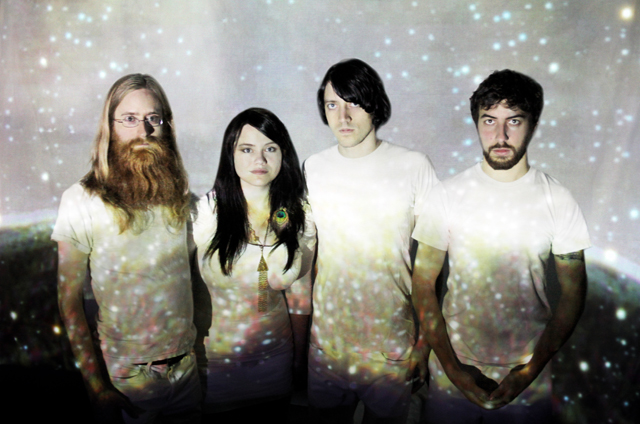
Frontman Michael Sauder was kind enough to answer our questions regarding the geist-bluster.

Translated into English from its Teutonic origins, the word “geist” can be used to refer to the mind or spirit, while at same time used to refer to a ghost, or the spirit of the dead. In what manner do you think of the word in relation to the music you create? How does the nuance of that word connect to the moniker “The Sacred Ensemble”?

I was born and raised on Geist Road in Lancaster, Pennsylvania. When I started thinking of a name to represent the music, I knew I wanted something that would remind me of my roots,and yet depict a similar mood to the sound. “Geist” would be the name. While spirit, mind and ghost are essentially one in the same, I feel each song could fill separate categories of spiritual fire, haunting or mental questioning to our modern reality.

Good friends are the most sacred things during our time on earth.”The Sacred Ensemble” includes some of my closest friends.

Photobucket

Would you ever consider the inspiration for your music – insofar as how sounds made long ago can lead to the creation to new sounds made today – as a form of communing with ghosts? What are the bands or musicians from the past that have most directly influenced your music?

Inspiration for the this album came from a time when I used to dig graves and set tombstones. From this work, I learned to be quite comfortable with death and the idea of other realms for our souls to go. As for musicians or bands that have influenced the music, I would have to say Ennio Morricone’s score for “The Good, The Bad and The Ugly”, George Crumb’s “Ancient Voices of Children” and Syd Barrett era Pink Floyd.

Continue reading

BAND OF THE WEEK: HOLSTENWALL

7 Jun

If the new EP from the French band known as Holstenwall, “Le Podium #3,” doesn’t come out swinging, it certainly comes out swirling.

Download “Telomeres” by Holstenwall, from the EP “Le Podium #3”

There’s a revolving, subtle, narcotic delirium within the first few seconds of the EP’s opening track, “Telomeres.” It feels somehow out of phase, out of this world, and threatening to spin out of control. Given the sounds that Holstenwall explore on the remainder of the EP – dark corners, deep regrets and missed opportunities are what we hear, along with guitars that chime like weeping angels – “Telomeres” is the sign at the entrance of the ride that warns us that we’re about to walk upon the edge of no escape.

Photobucket

Given these swirling, washed-out vibes crashing over us with every spin of “Le Podium #3,” it’s tempting to declare that Holstenwall will now inherit the crown long worn by our favorite French explorer of the deep (without whom, it could be argued, we would have never had this enhancement to our lives). That might be a bit premature – and who knows what the future holds? Yet when Holstenwall take their next step toward the podium to speak, we will be listening to every word.

“If we were logical, the future would be bleak indeed. But we are more than logical. We are human beings, and we have faith, and we have hope and we can work.” – Jacques-Yves Cousteau

Holstenwall – Telomeres from CLAP CLAP CLUB on Vimeo.

RISHI DHIR (ELEPHANT STONE / BLACK ANGELS’ ONSTAGE SITAR SAGE)

1 Jun

RISHI DHIR

“Dear Dr. Dhir – I Read Your Recent Letter”

To update a thought we posted last year: We would never be able to say who the “best” band was at the Austin Psych Fest (whether this year or any other). First of all, like all art, music is personal and subjective – who can quantify such enjoyment? Second, the answer is Rishi Dhir.

Perhaps not the answer you were expecting – especially considering the fact that Rishi Dhir is not a band at all, though he is a member of a great band called Elephant Stone and he memorably joined another band onstage at Austin Psych Fest 4 (some hoodlums from Austin, TX, called The Black Angels – never heard of ’em). Similarly, we were not necessarily expecting to find the interstitial, interstellar, solo sitar serenades presented by Mr. Dhir to be among the most strangely satisfying musical experiences of our old, old lives. But we did. And then we set about pestering Mr. Dhir to explain himself – which he was kind enough to do below.

What were your earliest musical obsessions? Can you recall the first music that truly affected you emotionally – whether it be joy, sadness, etc. – and how does that music make you feel today?

I guess my earliest obsessions was a mixtape my (older) brother made me of The Who’s “Meaty Beaty, Big and Bouncy” and “The Best of the Doors” as well as the North American release of “Revolver” (sans “I’m Only Sleeping,” “And Your Bird Can Sing,” and “Dr. Robert”).  I’d have to say that Teenage Fanclub’s “Alcoholiday” was the first song to really give me goose bumps all over … to this day the tune still sends my head into the clouds.

Photobucket

In making the transition from being a music listener to a music performer, what were the most critical steps for you? Who were the people who inspired you most to make that transition? At this point, can you imagine a life wherein you do not write, record or perform music?

I guess my brother was the one that inspired me to take the step to being a musician. I started playing bass when I was 15 (just after my brother got his guitar). We had a garage band that never really left the garage … at seventeen I joined a band called the Sea Beggars and have been playing music since … Music is who I am; there’s no way to separate it.

Continue reading

NEW YORK ROCK AND ROLL 1

26 May

Always on the cutting edge, Revolt of the Apes recently discovered an obscure, blues-influenced rock and roll band fronted by a wildly engaging singer – a singer with the guts and attitude to declare, “I KNOW – it’s only rock and roll … but I LIKE it!” You’ve gotta hear this band! They’ve been around forever.

Maybe the above isn’t true but here’s what is true: People are discovering rock and roll all the time – only rock and roll, perhaps, but they like it. And so do we. Which is why we’re enthused when others facilitate this endless discovery.

Case in point: Bang Bang Boogaloo Records, a new label out of NYC that also knows it’s only rock and roll, but they also like it – in fact, we’re willing to bet they love it. Because they have a new compilation called “New York Rock and Roll 1” featuring eleven songs from eleven NYC-based bands … and the whole thing is available to download for free.

Download – or stream – all eleven tracks from “New York Rock and Roll 1” on Bang Bang Boogaloo right here.

Our attention was immediately drawn to the appearance of two-time APF participants The Golden Animals, who famously met on the streets of Brooklyn before eventually moving to the third ring of Saturn. Apparently, they’re back in New York now – and while it’s not a new track, it’s never too late to walk with the Animals, whether in Brooklyn, California, Saturn, a setting moon or a lead balloon.

BAND OF THE WEEK: CARLTON MELTON

22 May

To unfairly summarize the music of San Francisco’s Carlton Melton, let’s call it sensory-awareness space rock born out of the desire to create loud, weird music recorded in a geodesic dome.

Certainly there are a million other things that can be said about Carlton Melton and about their latest album, Country Ways. But what else do you really need? Again: sensory-awareness space rock recorded in a geodesic dome. It’s fait accompli.

Download “Use Your Words” by Carlton Melton, from the “Country Ways” LP

A million other things can be said about Carlton Melton, and the million directions that Country Ways – with it’s extended cosmic guitar journeys oddly in harmony with some moon-rock-steady drum-based gravitational force – somehow subtly hints at without ever moving toward. Which is not to say the album goes nowhere – it doesn’t need to. It’s an extreme, exuberant and confident antenna of an album, receiving, retrieving and transmitting a million different ways to flip your lid. Again: sensory-awareness space rock recorded in a geodesic dome.

Photobucket

A million other things can be said about Carlton Melton, including band members previous efforts in the perfectly wild Zen Guerrilla – and the recollection of these apes seeing said guerrillas go to Mars and back on a “Moonage Daydream” cover in a small club called The Hole in the Wall many moon-ages ago, while the next morning brought news that a truck had smashed into the venue, putting a massive hole in the wall of The Hole in the Wall. Yet what seems most striking about the evolution of Carlton Melton is the unshakable feeling that Country Ways is one of the most “zen” albums (at least in terms of reflecting to this listener themes of meditation, self-contemplation and intuition through very, very loud amplifiers) and one of the most “guerrilla” albums (at least in terms of essentially being recorded in one take and – again – being sensory-awareness space rock recorded in a geodesic dome) that we’ve ever heard.

A million other things can be said about Carlton Melton, and our belief that Country Ways has at least its titular origins in the lyric of a previous Band of the Week victim:

“Well,you know that it’s a shame and a pity,
You were raised up in the city,
And you never learned nothing ’bout country ways.”

Sing it! Or don’t. There’s nothing like singing getting in the way of Carlton Melton’s journey on Country Ways. As our good friend R. (the “R” is for “Rockin'”) Buckminster Fuller once said, “If you are the master, be sometimes blind; if you are the servant, be sometimes deaf.” And if you’re Carlton Melton, sometimes you don’t have to say a word.

“Within the expanding consciousness of a generation, there was a spatial shift from square to round, from hard-edged to soft, from static to mobile, from exclusive to all-inclusive, and it seemed to be welling up from the deepest part of the human psyche. It drifted inexorably away from the linear, from the right angle, from the grid, the box – away from the whole Euclidean dead end – moving into an imaginary place that was at once flowing, ceremonial, globular and tribal, a place in which time and space were seamlessly interwoven. There was magic in circles, and for many of the fuzzily dispossessed, the revolution would manifest itself in the form of a free-standing pod, or dome.”

Alastair Gordon, “Spaced Out: Crash Pads, Hippie Communes, Infinity Machines and Other Radical Environments of the Psychedelic Sixties”

ROB YOUNG (author of “ELECTRIC EDEN: UNEARTHING BRITAIN’S VISIONARY MUSIC”)

20 May

Perhaps the least compelling thing to be said about Rob Young’s book Electric Eden is that it’s the best book about folk music you’re likely to ever read.

It’s a fair enough assessment, but ultimately lackluster and unambitious, in a way that Electric Eden never is. To belabor the point, Electric Eden is not only the best book about folk music you’re ever likely to ever read, but one of the best books about music in general you’re likely to ever read. Further, should you have an experience anything at all like our own, you’ll be likely to come away from Electric Eden with the opinion that it is simply one of the most marvelous books ever written, period.

High praise? Indeed. Hyperbole? Hardly. Mr. Young’s undertaking with Electric Eden is a work of profound scholarship and intense research, while also – it bears mention – being a really, really wacky fucking read, dude.

The pedigree of the author has some impact on this. Being a longtime member of the editorial staff of The Wire, Mr. Young comes to his book perhaps more likely to sing the praises of Throbbing Gristle over Jethro Tull (thank God for that, and thank Christ for the bomb). In addition, the author sets out not to tell a straightforward narrative tale of British folk music from point A to point B, but something much, much broader in scope – a secret (and not-so-secret) history of a country and a dream, multidimensional in scope and almost unfathomably dense.

Still, apart from the research, the uncovering of countless fascinating minutiae and the ability to make you feel a strange, unrequited love for Sandy Denny, what really makes Electric Eden come to life is, of course, the writing. Anyone who can sum up sound this way deserves our full attention: “Shades and sunny intervals dominate the lyrics, and the clouds part spectacularly for the closing ‘Bright Phoebus,’ where the the triumphant sun beams down with the full force of a spiritual awakening.”

We can recommend no book more strongly than Electric Eden and we are thrilled to offer the interview below with the author, Rob Young.

In his 2001 memoir The Jerusalem Syndrome, the great comedian Marc Maron mentions a melon-baller once owned by his grandmother and describes it this way: “I use it in the summer as a device to go back in time.” To what degree do you personally use music as a device to go back in time?

I think music is an instant signifier of different places, spaces and timezones, and its effect cuts very deep. I spent a great deal of the 90s as a professional writer covering a lot of the amazing new developments in electronica and experimental music, and found myself on all sorts of conferences and debates, or being asked to write articles, speculating on ‘what is the future of music’? This was during a period when you had incredibly rapid turnover of new ‘innovative’ styles, microgenres which briefly seemed to herald a new dawn only to be supplanted by another one six months later and then sounding obsolete. Music, for me at that time, was an incredibly powerful conduit to a brighter future. I passionately believed (and still do) in the idea of the European Union, for instance, and the incredible interconnectedness of European musicians and festivals – a vast international community linking up as you watched – seemed to be a precursor of something transformative in the European experience. A lot of that potential got thrown away after 2000, the war on terror and the disastrous economic mismanagement of recent times. Eventually I got pretty bored of music that was self-consciously trying to sound futuristic and realized that there’s very little you can actually predict about how music will SOUND in the future, and it’s a bit of a futile game trying. And I was suspicious of the fact that thinking of the future blinkers you to the present. 

At the same time, as a Brit one is very conscious of the heritage industry here, there is a vast industry dedicated to preserving a sense of the past, ancestral buildings and monuments, traditions and hierarchies (viz. the royal wedding etc) and of course there are many centuries of history all layered over each other and plainly visible in the architecture of our cities and even in the topography of our landscape. Things have been preserved on these islands for a very long, uninterrupted span of history and I think there’s an innate affinity with old things in many who are born here. But I’m not sure if I use music to ‘get back to the past’ as much as bring something of that past up into the here and now – it’s vastly more useful that way. Culturally speaking, I don’t like things getting stagnant; prefer to keep the waters fresh and free-flowing. 

Photobucket

Quite apart from the science-fiction, Trekkie-like notions that can be conjured just by using the phrase, the idea of “time-travel” is central to “Electric Eden,” beginning with the marvelous forward recounting your experience watching Cecil Sharp dance on Kinora spools, and continuing throughout the remainder of the book. How did this somewhat massive scope evolve out of the original idea of writing perhaps a more modest assessment of British folk-rock from the 60’s and 70’s? Was there one particular development or bit of learning that you can point to as most directly broadening the scope of “Electric Eden”?

Reading William Morris’s novel News from Nowhere had big impact on my way of approaching the early section of the book where I was looking at the first serious folk collecting boom in England. The novel, published in 1890, is a time-travel proto-sci-fi story where a protagonist wakes up 200 years in the future. But it’s a future which is an idealized vision of the medieval past – no government, no money, everyone’s a craftsman or artisan, the world is greener and less urbanized, and manual labor is enjoyed by all, rather than a chore set apart from the rest of life. It was Morris’s altruistic idea of a perfect society – fatally naive, but the logical outcome of his utopian socialist philosophy. News From Nowhere helped to clarify the notion that the British imagination – even in art that envisions the future – is much more attuned to the past, and a lost golden age. And discovering that composers Gustav Holst and Ralph Vaughan Williams, who were among the first to incorporate English folk music themes into their own works – had attended political meetings at Morris’s house felt like being given the key to a door that unlocked a profound secret about English music, folk culture and the radical tradition.

With apologies to Julian Cope, perhaps the most fascinating “legend” presented in the book is the path of Vashti Bunyan, especially as it’s one where the larger picture may be known to some readers, but the details you bring to the chapter really helps define the radical approach of her journey. Is there a more satisfying creation story than that of Derroll Adams telling a young Vashti, “You mustn’t hide your light”? Is it too much to assert that, for all of the connection sought to the days of yore, it was the future (or at least, new generations with inspiration and internet connections) that truly brought Vashti out of the “Where Are They Now?” file (to use the phrase that once described a legendary British band known to look backward and forward simultaneously, Spinal Tap)?

Well, the future for Vashti, as it turned out, was nothing like she could ever have imagined it in 1969-70 when she was making that journey. I think for a lot of young people in the late 60s and early 70s, a strong feeling of impending doom overshadowed the more familiar notion of the happy clappy hippy counter culture … the economic downturn – oil crisis, terrorism, Middle Eastern wars – of the early 70s put paid to a lot of high flying dreams and the underground moved to private closed communes if it wanted to survive. Vashti herself kept well under the radar for the best part of 30 years, living a rural, simple existence in remote parts of Scotland and Ireland, never owned a copy of her own album and had practically let her guitar rot away. Our old friend Google taught her how the album she’d created and then forgotten had somehow, beyond her control, been given a life of its own and was changing hands for many dollars; at the same time, new advocates emerged to champion her music – Devendra Banhart, Joanna Newsom, etc. She was one of the luckier ones. There was a large cull of bands and artists around 1971-72 when a lot of them broke up or ceased activities, largely because it just wasn’t financially viable any more and musical fashions had changed (glam into punk and so on). For them, the future would end up far from the dream.

At the risk of putting too fine a point on it … Donovan once bought an island? Never mind that – three islands (Isay, Mingay and Clett – coincidentally, I believe, also the first line-up of Blue Cheer)?!? The mind boggles. Is our world better or worse off today, in a time when we very rarely hear of folk singers investing in planting the roots of a utopian existence – especially when that investment comes from the profits generated by songs like “Starfish-on-the-Toast”?

It’s just different. It’s a more crowded world now, for sure – and perhaps harder and more expensive to decamp from the city to the country and pass the time in the leisurely creation of music inspired by nature and the landscape. In those days such retreats were often funded by the record company or management – impossible to imagine that now! But the model for producing music now is so different anyway – it’s not studio centric or city based, so music can emanate from anywhere on earth, and I’ve had music sent to me from extremely remote spots – Yorkshire, Scandinavia, American deserts, Canadian mountains, Iran … as overheads are reduced the potential becomes wider. 

Photobucket

For you, what was the most surprising discovery that came from writing “Electric Eden”? Both from a research-oriented perspective – meaning a particularly meaningful fact of history that you would not have predicted would land within the book’s pages – and from a personal perspective, what did you learn from writing the book that has had the most impact on your life or listening habits?

Lots of them really – connections and intersections between people, music, films, etc popped up all over the place. It could be minutiae that were nevertheless revealing – like the fact that the Anglo-Irish psych-folk band Dr. Strangely Strange used to stay at the house of psychogeographic author Iain Sinclair in the early 70s, where a screen writer called Tom Baker, who co-wrote the ‘folk horror’ classic Witchfinder General with Michael Reeves, was also living … or the weird magnetism of the Cader Idris mountain in North Wales, site of Arthurian legends, setting for the eerie children’s fantasy novel The Owl Service by Alan Garner, also near Bron Y-Aur, where Led Zeppelin’s Page and Plant wrote much of their Celtic/Tolkien-infused “Stairway To Heaven”-era material, and the folk-rock band Trees also rehearsed in its shadow …

There was also the recurrent presence of musicians like Danny Thompson, Dave Mattacks, Harold McNair, etc., across a huge range of musics spanning decades … A surprising one was discovering that Henry Williamson, author of books like Tarka The Otter, Salar The Salmon, etc., who lived a fairly unconventional, salacious life (proto-hippy?) in a small village in Devon, had a son, Harry, who went on to play a small but significant role in 1970s free festival culture hanging out with Hawkwind, Gong and so on, and working with former Genesis founder Anthony Phillips. 

As to what I learned which had an impact: I think writing this book helped me to “read” folk music and culture in a way I hadn’t managed to do before. It helped me to overcome notions about “authenticity” which linger around the idea of folk (in all cultures), and to understand that most folk traditions are handed down and recorded in a pretty arbitrary way, and the trick to getting the most out of them is not to get hung up at all about how “true” to some imagined original they might be (as you’re never going to find the original), but to appreciate each new iteration as something authentic, fresh and valuable in its own right. The acorn is not a pale imitation of an oak, it IS a new oak. 

What are the artistic pitfalls that can arise from too much emphasis on “getting back to the garden”? At what point does the longing for days gone by become an avoidance of the here-and-now, resulting in music that’s greater parts pabulum and pastiche than anything else? Should the artist even be concerned with these questions? Should the listener?

This is a very important question and another core theme of the book. All along the line, the notion of radicalism and revolution is indivisible from the idea of restoring something – a state of being or of mind – that has been lost in the past. I think folk revivals (or any revivals really) are attempts to reclaim something when it’s at its most endangered. So the music becomes a kind of doorway through which you can step back into a time that’s envisioned as holding the possibility of a better life. In the “getting back to the garden” idea, which of course connects right back to the biblical Eden, we tap into one of the foundational myths of civilization. I think we have to recognize that while it’s literally impossible (and in many ways, undesirable – would you really like to have to plough the fields and harvest every year?), we also have to recognize that it’s important to keep the dream alive. I would rather live in an age of hope and idealism than one of despair, cynicism and pollution, and the “garden” myth, in its broadest sense, acts as a guiding beacon to living in a better world. Wow, I just got all hippy on your ass. 

At least in broad strokes, can you give us a sense of your own musical evolution? How long has music been your paramount passion, and what were some of the events that signified an assumed life-long love of music? How have your listening patterns evolved over the years?

The first record I bought was “The Number One Song In Heaven” by Sparks. That was a revelation, when I discovered – what, you mean you can BUY the music you hear on the radio? So I’ve been an avid consumer and listener (occasionally player) of music since I was barely 10 years old. Reading the NME and Melody Maker from the mid-80s taught me much about the critical reception of music but also I learned a lot about politics and ideas there which I simply wasn’t getting at school. Writers like Biba Kopf, Simon Reynolds, David Stubbs, Ian MacDonald, etc., were huge influences on my musical thinking and I have been immensely fortunate to have ended up working with and commissioning many of them in later life. The Wire was the first magazine to publish my work and I have stuck with it since the early 90s, working as Deputy Editor, then Editor, now as a part-time member of the editorial team. A very interesting period to be involved, as it marked some huge shifts in the creation and consumption of music, through the electronic revolution of the 90s into the current digital paradigm shift in parallel with partial returns to ideas of acoustics, folk and psychedelia. But my musical interests have always been extremely varied and I have written about free improv, contemporary composition, jazz, all manner of electronic music and techno, Krautrock, experimental music, rock, etc. I think I have a pretty restless ear and I tend to lose interest when stuff seems to be falling into generic patterns; I generally prefer music when it’s pushing at limits or being tested or stressed in some way.

What artists have you been listening to lately? What excites you about music today? Are there any current artists not discussed in the book, that you feel could eventually wind up at least being mentioned in a future, “updated” edition of Electric Eden?

Electric Eden certainly set me off on new pathways and there were plenty of artists that for different reasons it wasn’t possible to include at length in the book. Among them was Roy Harper who I’m listening to a great deal right now and in fact am in the middle of conducting some interviews with him for The Wire. I also became obsessed with the English composers of the early 20th century – Vaughan Williams, Holst, Peter Warlock, John Ireland, Cyril Scott, Ernest Moeran and others – all of whom were pretty complex, interesting and unconventional characters whose music connects in all kinds of ways with arcane aspects of the landscape, the occult, and the English visionary literary tradition. And I’m still following those leads.

From Electric Eden: “But where ‘Tomorrow Never Knows’ was saturated in quasi-Buddhist mysticism and Jungian psychology, ‘Strawberry Fields’ is the first example anywhere of what Ian MacDonald called ‘a sort of technologically-evolved folk music’: an innately English psychedelia.” Of course, this begs the question – isn’t Ringo just awesome?

Yup, plus his voiceover on “Thomas The Tank Engine” brought out the quasi-Buddhist mysticism and Jungian psychology of those mischievous locomotives, too.

What’s on the horizon for Rob Young?

On my immediate horizon are a stream of planes waiting to land at Heathrow. On the temporal horizon, I’m delighted to have just taped about 5 hours of interview with the amazing Roy Harper at his home in Ireland, which will form the cover story of the July issue of The Wire. Since Roy didn’t figure very heavily in Electric Eden, for reasons too boring to go into here, I hope this article will be like a “missing chapter of the book. Longer term, there are plans for more books shaping up at the moment but it’s still a bit too early to divulge details I’m afraid. Keep an eye on my blog!

Rob Young’s Electric Eden

BAND OF THE WEEK: OS OVNI

15 May

We’ve been thinking a lot recently about the past and the future, and the spaces in music where those two intrinsically linked things intersect most clearly. We find the music of Os Ovni to be one of those spaces.

Download “Radioactivity” (Kraftwerk cover) by Os Ovni

Photobucket

The last thing we’re going to attempt is a description of the music of Os Ovni. We could throw around words like “spacey” or “electronic” or “psychedelic” or “weird” or “dramatically damaged digital detritus” and not feel disingenuous. But we’d also feel like we’re missing the point or that there may not be a point (which may in fact be the point).

Listen: All I can tell you is that I met a kid in the ninth grade who was smart, funny, troubled and way into some band called Kraftwerk. He played me “Pocket Calculator” one day after school and I thought he was nuts. I tried to turn his attention away from Kraftwerk and more toward, say, Krokus, but it was not to be.

If you would have told me then that in just a few short years I would be paying my rent by driving a forklift in an electrical supplies warehouse alongside a recently discharged Army soldier whose two favorite things in the world were Chaka Khan and Kraftwerk, and that he would ultimately impart upon me the joys of both, giving me the tools and inspiration to take another leap of faith in my listening habits and evolution as a nerd obsessed with sound … I would have thought you were nuts, too. But you would have been correct (and probably creepy).

And if you were to tell me that a number of years after that, I would be singing the praises of two Texas-based space cadets who had taken Kraftwerk’s blueprints and created something utterly weird, utterly compelling and utterly their own, I would have openly accused you of being nuts, potentially correct and unfathomably creepy.

Mama-mama, we’re all creepy now. Here’s to the past. Here’s to the future. Here’s to the sounds, the nutty, correct and creepy sounds of Os Ovni. Long may they evolve, timeless and obsessed with sound.

“We do not grow absolutely, chronologically. We grow sometimes in one dimension, and not in another; unevenly. We grow partially. We are relative. We are mature in one realm, childish in another. The past, present, and future mingle and pull us backward, forward, or fix us in the present. We are made up of layers, cells, constellations.”

— “Awesome” Anaïs Nin

SHAZZULA

10 May

SHAZZULA

“Here, There and Everywhere”

We could probably get away with a factually and chronologically correct detailing of the work engaged in by Shazzula/DJ Shazzula/Shazzula Nebula/§ђ∆ZzV⇂∆. But what would be the fun of that?

Whether you know her from the music she made with Aqua Nebula Oscillator, or from her frequent cameos with such galaxy-crushing luminaries as White Hills and Farflung, or from her frequent DJ sets across the globe, or some combination of the three, the fact  is that you know Shazzula. And if you don’t know her … you probably actually do – you just haven’t realized it yet.

Not to be too metaphysical about the matter, but Shazzula represents less of “a” thing to us as she does all things. Her involvement with and presence in and proximity to such a wide variety of projects represents to us not only her own individual and seemingly indefatigable creative energies, but the utter endurance and inspiration of creative energies in general. Plus, she made us aware of the existence of the “Time to Suck” album, which had somehow not passed through our consciousness. These are the type of things that make one eternally grateful.

Do you view any live music performance as a “ritual,” if only by your own definition? Do you bring a different mindset to a DJ Set, apart from performing live music with a band?

I named every moment I capture by photography a “ritual” – they are instants … With Aqua Nebula Oscillator, I started every concert with a ritual: darkness, fog, myrrh, incense and start with heavy drones and oscillations with reversed hymns & Latin incantations. For the DJ sets … it all depends where sound is diffused, which venue, the crowd … but I truly prefer to play the weirdest music ever (ex: once,we were in a very old doctor’s castle, a special event with a collective artist exhibit, and I started the set with Jacula, “In Cauda Semper Stat Venenum,” followed with some Aleister Crowley, “The Beast Speaks,” etc.).

Photobucket

What does the word “ritual” mean for you in music? Do you view a ritual with a sense of reverence toward the music, or are you in a certain sense searching for the power to control music? Do you feel like a conqueror of music, or do you find that music is more likely to conquer you?

Ritual & music can fit …trance music could be ritualistic. I don’t feel like a conqueror. I’m just an addict of sounds, noise and effects.

What was the first music that captured your attention in your youth? What childhood memories do you attach to music?

Believe me or not,the first sounds I was attracted were the recordings of Native American music, their celebrations and ceremonies to the moon, the sun, death, etc. I was renting CDs and transferring them on tapes and listening to them in my room. The other music I loved was, of course, the Maestro – Ennio Morricone! I always wanted to be an Indian, to be free, faces painted,with wild horses and wild wolves! As a child, my first instrument was an old Banger. I still have it with me on every trip. My other specialty since I was a kid is to imitate birds and animal sounds.

For lack of a more specific term, when did “underground” music reveal itself to you? What were the first bands that introduced you to the dark side of music? What feelings do you have for those bands today?

First time I heard the mention of “underground” music was in the early 90s, listening to the Belgian Radio Panik (independent radio). They were different to my ears compared to the usual crap! I recorded many old programs off the radio on tape (lots of ambient music, trip hop, electronic, sound effects). So, let’s say that my first interests were ambient and electronic (Underground Resistance, Disko B, Aphex Twin, Acid Kirk, etc.), then into soundtracks, library music, Latin, 60s, 70s, Nuyorican soul, mod shit. Then, of course, HEAVY and Sabbath, Arthur Brown, Deep Purple, Edgard Broughton Band, Il Balletto di Bronzo, etc. GET ME INTO HEAVY! First dark band? Black Sabbath, then maybe later The Cramps, but I was already more in search of the HEAVY sounds, the prog and the psych since the beginning to be honest. Afterward, darkness became obviously necessary through the years. The psych and the prog turned me to black metal in the end.

How did you first get together with Aqua Nebula Oscillator? How long did you play with that band? What are your best memories of your time in ANO?

I met Davis Os, guru of the band in London. Our mutual Transylvanian friend Attila Babos introduced us to each other. I really loved his strong French accent (speaking English)! He directly told me about his band with a long name, the jams, the travels, the psychedelic scene in Paris (I had never heard about it – I used to HATE Paris). He sent me a CD afterward and I fell in love of ANO – AMAZING (that was the time when the band sounded more like the “Cave Recordings” LP on Funeral Folk and when Juan Trip was in the band as well). I invited ANO to my fest, Suicide Twist, in Brussels in 2006. They did one song that was 30 minutes long. Result: MY FAV BAND EVER! I followed Os back to Paris, got together and at first I wanted to be their manager. Os put me on a Korg MS2000 – I never had a synth in my hands before (since then, I’ve never stopped synth!). We started the Muzikasphaera duo (Os on guitar and vocals, me on voodoo drums, synth, effects and vocals). The painted faces came from Muzikasphaera. Afterwards, Os kicked out ANO members (Juan Trip, Takumi Iida, David Alfonso Gallego) to reform the band with new members: the Canadian drummer Vince Posadzki, the bassist Simon Bouteloup  and me (vocals and synth). We played together 4 years. We did “Under The Moon.” We could have done more but the band was really hard to deal with. My last gigs with ANO were Yellowstock fest and the Nouveau Casino with The Black Angels in Paris.

My best memories with ANO: On acid with Mr. Sky Saxon, tour support of The Cult in Europe (Ian Astbury is a great man, nice taste and a cool dude) and the latest, best memory was our Dunajam experience – an amazing place, amazing people, good energies – the best place to play!

Regarding the Funeral Folk LP of ANO, Os had tons of old tapes that he let die in the humid caves. I met Sylvester Anfang dude Willem in Brussels and I told him about it and he wanted to do a LP of it for Funeral Folk, a Belgian Label. I said, “Ok, let’s see what the guru says.” Os didn’t want to do anything – I pushed him. I did all the archives and sent the songs to the Belgian friends. They did, I think, one of the best LP’s of the band.

Regarding the “Excavation” EP, David Jasso, owner of Assommer (the best US underground heavy psych label!!) came to our gig in Paris and offered to every band member of ANO a fantastic pair of glasses – what a great freak! We stayed in touch – he was and still is a fan of ANO. I totally love his band, OGOD (Over Gain Optimal Death). His label is majestic – he put out such bands as Mainliner, The Antarcticans, OGOD and much more!! HEAAAAVYYY LSD SOUNDS! He is also an amazing graphic artist, I think – he did lots of visuals for ANO.

Similarly, how did you first connect with the mind-crushing force that is known as White Hills? What is it about their music that makes it so compelling to you?

As I started the ANO MySpace (before even joining the band in 2005-2006), and in a way, being the booker of the band, doing the promotion, spreading the sounds and imagery through the internet’s parallel universe, many great bands were supporting ANO and me supporting them. Danava was the first band I followed on MySpace, then Serpentina Satellite, The Black Angels, Phantom Family Halo, White Hills and many more … We were already helping each other. I discovered White Hills through MySpace. I saw them at first at an Orange Factory show in Belgium. I gave our last LP, “Under The Moon,”  to Dave and he wrote back a cool review on the Rocket Recordings website. Later, Dave proposed that I join White Hills for their gig at La Maroquinerie in Paris and it followed with other gigs, like WTFF in Berlin, ATP in NY and the UK, etc. It’s fun playing with White Hills. I love their sound and it was fun also to record in Oneida Studios in NY last September (album out very very soon!). Thanks to White Hills, I discovered Farflung, Gnod, Mugstar and Seven That Spells. Recording with Farflung and Over Gain Optimal Death (OGOD) is also a GREAT experience.

What band would you most like be able to collaborate with? Do you prefer “raw” – little practice – live events with bands, or are you equally pleased to work on a recording with a band or artist that you enjoy?

Joining bands on the road and gigs is good FUN but recording is the best, I think. It’s more intimate and we have a good opportunity to experiment in depth with the sound. For the future … I have some projects in mind … but for that, my gypsy travels have to stop. I need to be based somewhere and work. There is also lot of people I want to work with … patience!

In a March 1978 issue of “Sounds,” Jimmy Page is quoted as saying the following: “”I feel Aleister Crowley is a misunderstood genius of the 20th century. Because his whole thing was liberation of the person, of the entity, and that restriction would foul you up, lead to frustration which leads to violence, crime, mental breakdown, depending on what sort of makeup you have underneath. The further this age we’re in now gets into technology and alienation, a lot of the points he’s made seem to manifest themselves all down the line.” Your thoughts? If you prefer, you may alternately just tell us your favorite Led Zeppelin song.

“Dazed and Confused”! “No Quarter”!

What’s next for SHAZZULA?

The “Black Mass Rising” movie (experimental,120 minutes) will be presented for the first time in Lima,Peru together with a sound performance and various sound works in the country … personal sound works (as §ђ∆ZzV⇂∆), recordings, live performances … works with duo S†U … help The Entrance Band with Minik for booking in Europe … continue helping bands (Swamp Booking),spreading the sounds when I DJ … continue the Rituals photos and restart painting … continuing non-smoking, be back into RAW vegetarian food, ENJOY LIFE IN MUSIC AND ART! Never stop … continue to FIGHT!

Shazzula

MIDDAY VEIL – “ANTHEM” VIDEO

4 May

We were absolutely thrilled to offer an extensive interview with Emily Pothast of the Seattle-based band Midday Veil as our very first post of 2011. As we said at the time, “there was no more striking, affecting, defining, epiphanic and just plain awesome listening experience of the past year than that psychically provided and engineered by Midday Veil’s most recent album, ‘Eyes All Around.'”

Among the most immediately striking songs contained within that album is entitled “Anthem,” for which the band just yesterday posted its official video.

I wouldn’t dare to attempt to capture the emotional resonance of this song in words – especially when Emily does just that more than capably on her own blog, along with some background on the creation of the video itself. I also wouldn’t dare to attempt an explanation of why or how such an intensely personal song has taken up a permanent residence in my brain (specifically, the medial prefrontal cortex region), where I am confident it will remain until the day I die. I hope that day is a long way off, even as listening to “Anthem” reminds me that we often haven’t any say in the matter.

If you’ve not checked out Midday Veil yet, I offer my strongest possible recommendation to do so … and what better way than live and in the flesh?

May 7, 2011 at The Black Lodge, Seattle, WA
with Yuni in Taxco, Poney Express (France), The Webelos

May 9, 2011 at the Comet Tavern, Seattle, WA
with Cloudland Canyon, Brainfruit

May 13, 2011 at Rhinoceropolis, Denver, CO
with Nightshark, Night of Joy, Décollage

May 14, 2011 at The Kosmos, Albuquerque, NM
with Shoulder Voices, Phantom Lake

May 15, 2011 at Rubber Gloves Rehearsal Studios, Denton, TX
with Peopleodian, Shiny Around the Edges, San Soleil, Lucretia Borgia

May 16, 2011 at Emo’s, Austin, TX
with No Mas Bodas, OS OVNI, Chris Catalena and the Native Americans

May 18, 2011 at Sound Kontrol, Phoenix, AZ
with Otro Mundo, others TBA

May 19, 2011 at Public Fiction, Los Angeles, CA

May 20, 2011 at The Fuzzplex, Oakland, CA
with Moccretro, others TBA

Midday Veil

THE WORST AUSTIN PSYCH FEST 4 PICS

3 May

“Carrying Pictures of Chairman Mao: The Worst Austin Psych Fest 4 Pics”

Full report coming someday, I swear.

Photobucket
WHITE HILLS
Photobucket
THE VACANT LOTS
Photobucket
TJUTJUNA
Photobucket
THE MEEK
Photobucket
THE DIAMOND CENTER
Photobucket
THE SHINE BROTHERS
Photobucket
Look at this joker! Rocking out with a beer & a bag of Revolt of the Apes stickers by his pedals … it must be …
Photobucket
PONTIAK!
Photobucket
OMAR RODRIGUEZ-LOPEZ
Photobucket
NO JOY
Photobucket
HELLFIRE SOCIAL CLUB
Photobucket
THE GROWLERS
Photobucket
FUNGI GIRLS
Photobucket
DIRTY BEACHES
Photobucket
DAUGHTERS OF THE SUN
Photobucket
THE FOOKIN’ CULT OF DOM KELLER
Photobucket
BEACHES
Photobucket
BASS DRUM OF DEATH
Photobucket
THE BLACK ANGELS